Website Design for NDIS Providers

Websites for disability support providers that work for everyone who reads them: participants, families and nominees, support coordinators shortlisting providers, and plan managers checking you can be paid.

What an NDIS provider website needs to do

One participant's choice of provider can involve four readers. The participant may be using a screen reader or a magnifier. A parent or nominee wants to know who will walk through the door. A support coordinator is comparing three providers before a planning meeting, and a plan manager needs to know you can invoice them. Each should find their answer without ringing you.

  • Registration status, stated exactly

    If you're registered, show your registration number and the registration groups you hold, worded to match the NDIS Commission's NDIS Provider Register, because coordinators check it. If you're unregistered, say so plainly. Participants whose funding is NDIA-managed can only use registered providers, so one clear line saves both of you a wasted call.

  • A referral form coordinators can finish in one sitting

    Referrer name and organisation, the participant's first name and suburb, the supports needed, how the plan is managed, the plan end date, urgency, and a tick box confirming the participant agreed to the referral. It's short enough to complete between appointments and arrives in your inbox ready to act on.

  • Answers plan managers and self-managers look for

    Which funding types you work with (self-managed, plan-managed or NDIA-managed), your ABN, how often you invoice and what each invoice shows. Self-managing participants and their families pay you directly, so they want this spelt out before the first shift.

  • Pages that work with assistive technology

    Real headings, labelled form fields, a visible focus outline for keyboard users, strong colour contrast, alt text on photos and no words baked into images. The Australian Human Rights Commission's 2025 guidelines on equal access to digital goods and services say organisations should conform with WCAG 2.2 at Level AA as a minimum, so it's worth asking any web designer how they handle it. Easy Read documents or Auslan videos you already have get a clear place of their own.

  • Plain words about what you deliver, and where

    Name each support the way a participant would say it, such as help showering and dressing, getting to appointments or a weekly clean, before any NDIS category name. Then add the suburbs or regions you cover, your hours, whether there's a waitlist, the languages your workers speak and whether participants can choose the gender of their worker.

  • Claims to keep off the site

    The NDIS doesn't approve or endorse products or services, and businesses have paid ACCC infringement notices over ads claiming goods were “NDIS approved” or that “if you have NDIS funding, it's covered”. From 27 November 2026, the NDIS Amendment (Securing the NDIS for Future Generations) Act 2026 bans providers from offering kickbacks and inducements, and the NDIS Commission's Code of Conduct guidance already lists offering inducements or rewards to take up a service as a sharp practice, so we leave sign-up gifts off the site.

Care and support websites we've built

We haven't yet built a site for a business whose main work is NDIS supports. The two closest projects in our portfolio are a cleaning business whose services include NDIS cleans for participants, and an in-home support service that takes referrals from other providers.

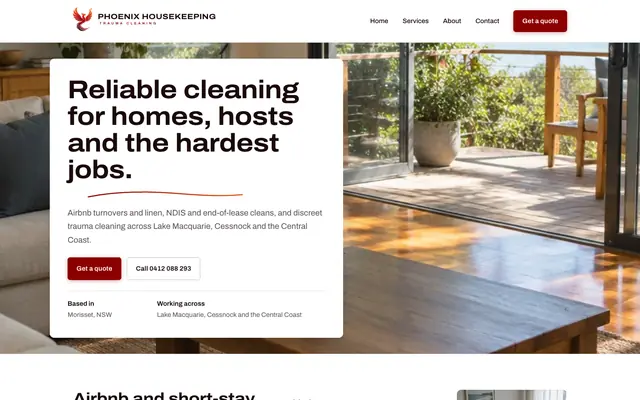
Home page of the Phoenix Housekeeping website

Phoenix Housekeeping

Home & care services · Lake Macquarie, Cessnock & Central Coast

A family-run cleaning business whose work includes regular and one-off NDIS cleans for participants, alongside Airbnb turnovers, end-of-lease and trauma cleaning. Its multi-page site has published pricing, a homes and NDIS services page, suburb pages and a quote form with a discreet call-back option.

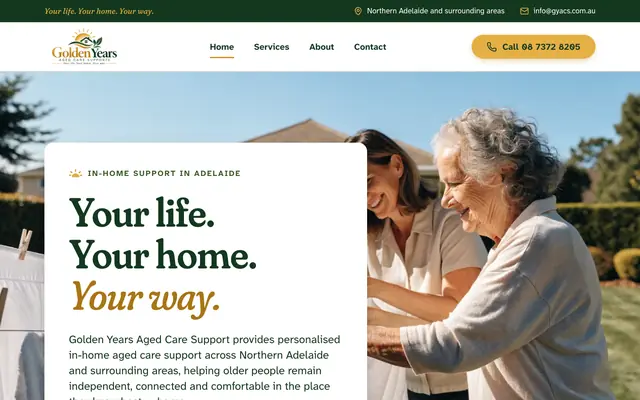
Home page of the Golden Years Aged Care Support website

Golden Years Aged Care Support

Home & care services · Northern Adelaide

In-home support for older people across Northern Adelaide, so aged care rather than disability support. Its six-page site gives aged care providers referring a client their own option on the enquiry form, separate from older people and families, with large readable text and tap-to-call on every page.

“…gave us a fixed quote so we knew exactly what we were paying, and turned around the build faster than we thought possible.”

SA Tiling Pro Pty Ltd, Google review

What an NDIS provider website costs

One page

$399

A sole trader or small team: supports, service area, registration status, funding types and the referral form on a single page.

Our suggestion for most NDIS providers

Up to 3 pages

$899

A home page, a supports page explaining each service in plain words, and a referrals and funding page that coordinators and plan managers can bookmark.

Up to 8 pages

$1,499

For providers with several support types or regions: a page per support, area pages, an Easy Read page and a careers page linking to your support worker job ads.

  • Payment. No deposit. We build your draft first, you ask for as many changes as you like, and you pay once you approve it. If you don't go ahead, you owe nothing.
  • GST. WebCraft Studio isn't registered for GST, so no GST is added.
  • Timing. Most sites are live within 5–10 days of us getting your words and photos; bigger sites (up to 8 pages) take 2–3 weeks.
  • Hosting. After launch, hosting is $30 a month: hosting, security monitoring, backups, email support and unlimited text and image changes on your existing pages. New pages or features are quoted first. No contract, cancel anytime.
  • Domain and email. We register your domain in your name (about $20 a year), connect it to your site and set up your business email.

See full pricing and what each package includes

Questions NDIS providers ask us

Do we need to be NDIS registered to have a website?

No. Unregistered providers can deliver many supports to participants who self-manage or plan-manage their funding, and a website is how those participants find you. Registration is required to work with NDIA-managed participants and to provide plan management, specialist disability accommodation, specialist behaviour support or regulated restrictive practices. Since 1 July 2026 it has also been required for supported independent living and NDIS digital platforms, with transitional arrangements for existing providers. The Government's timeline has mandatory registration for higher-risk supports such as personal care and daily living rolling out from 1 July 2027, alongside a new enrolment system for most other providers. Check the NDIS Commission's registration guidance for your own situation, and we'll word the site to match.

Can our website show testimonials from participants?

It depends on the service. For a regulated health service, such as physiotherapy, occupational therapy or psychology from an Ahpra-registered practitioner, section 133 of the National Law prohibits using testimonials about clinical aspects in advertising, and Ahpra's testimonial guidance explains what that covers. That rule doesn't reach supports like cleaning or community access, but a published review still has to be genuine, and we'd only add one with the participant's written permission.

Will the site meet WCAG accessibility standards?

We build with proper headings, labelled form fields, keyboard access and strong contrast, which covers a good part of what WCAG 2.2 asks for. What you add later matters too, so we flag things like scanned PDFs or text inside images. We don't certify compliance: if you need formal sign-off against WCAG 2.2 Level AA, an independent accessibility audit is the way to get it.

Can support coordinators send referrals through the site?

Yes. Each referral comes through to your email, and the person sending it sees a confirmation that it went through. The form asks only for what you need to make first contact. Plans and detailed health information are better requested after that first call through a secure method you already use: the OAIC's guidance is that a disability service provider holding health information is covered by the Privacy Act, even as a small business.

Which package suits an NDIS provider?

A sole trader support worker or therapist can start with the one-page site at $399. For most providers we suggest the 3-page site at $899: referrals and funding details then get a page of their own. Providers with several support types, regions or ongoing recruitment are better suited to the 8-page site at $1,499.

Do you build NDIS provider websites outside Adelaide?

Yes. We're an Adelaide (South Australia) web design team working with businesses Australia-wide by phone and email, and our current clients are in SA, NSW, VIC and QLD. Everything from the first quote to approving your draft happens by phone and email, wherever you're based.

Ready to start your NDIS provider website?

Tell us whether you're registered, which supports you deliver and the areas you cover. We'll quote, build the draft, and you pay only once you approve it.

We reply within 24 hours. Prefer email? info@webcraftstudio.com.au