Website Design for Allied Health Practices

Websites for physiotherapists, podiatrists, occupational therapists, speech pathologists, dietitians, exercise physiologists and multidisciplinary clinics, built around how your clients are referred, how they pay and how they book.

What an allied health website needs to do

A new client usually turns up with a referral or a sore knee and two questions: can this clinic help with the problem, and what will it cost after any rebate? A good allied health site answers both before anyone reaches the booking page, and makes it clear who they'll be seeing.

  • Booking by practitioner and appointment type

    A Book button on every page that opens the online booking you already run, such as Cliniko, Halaxy or Nookal. Where your system supports it, the link goes straight to a particular practitioner or to an initial assessment, so a first-time client isn't left guessing which appointment to pick.

  • Bios that show registration as it stands

    Physiotherapy, podiatry, occupational therapy, chiropractic, osteopathy and psychology are registered through Ahpra; speech pathology, dietetics and exercise physiology are self-regulated through peak bodies such as Speech Pathology Australia, Dietitians Australia and ESSA. Each bio names the practitioner's profession, qualifications and registration or accreditation accurately, with a photo and the kinds of clients they see most.

  • Claims that stay inside the advertising rules

    If your clinic offers services from Ahpra-registered practitioners, the National Law covers how the business advertises: no testimonials about clinical care, nothing that creates an unreasonable expectation of beneficial treatment, and any offer must state or refer to its terms. Ahpra also flags “specialises in” as likely to imply specialist registration, so a bio is safer saying “works mainly with”. You approve every line before it goes live.

  • Referral and funding pathways spelled out

    Clients ask whether they can use a GP Chronic Condition Management Plan (since 1 July 2025, up to five Medicare-rebated allied health services a calendar year for most patients, shared across professions), their NDIS plan, private health cover, a DVA card or a workers' compensation claim. Each pathway you accept gets a short plain-English section saying whether a referral is needed and what the client pays.

  • NDIS status stated accurately

    Being a registered NDIS provider changes who can use you. Participants whose funding is NDIA-managed must use registered providers, while self-managed and plan-managed participants can usually choose either. The site says which you are and which plan types you work with, so a family doesn't book and then find out they can't claim.

  • Fees and the practical details

    Initial and follow-up consult fees, whether you have HICAPS for on-the-spot health fund claims, parking, wheelchair access, and whether you visit homes, schools or aged care facilities and in which suburbs. For mobile services, a list of named suburbs tells people more than a circle on a map.

Health and care sites we've built

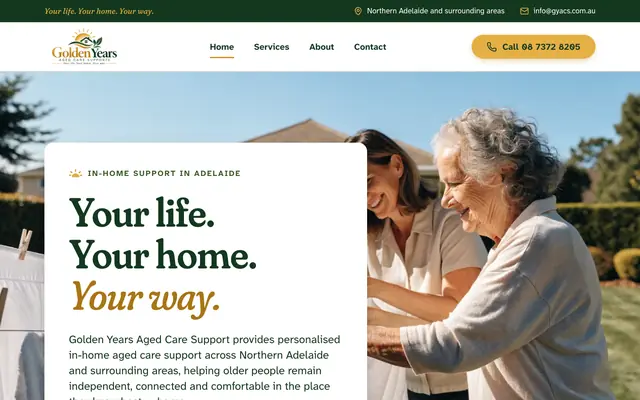
None of the sites in our portfolio is for an allied health clinic. The nearest is an in-home aged care provider in Northern Adelaide, which shares the jobs that matter here: taking referrals from other providers, explaining several services clearly and staying readable for older visitors.

“My website is exactly how I wanted. I highly recommend Salem for any business wanting a professional website without the bull.”

Johannah Whilding, Google review

What an allied health website costs

One page

$399

A sole practitioner or mobile service: what you treat, who you see, fees, funding options, the suburbs you cover and a booking button, on one page.

Our suggestion for most clinics

Up to 3 pages

$899

A home page, a services and fees page covering Medicare, NDIS and health fund details, and a practitioners page with a bio for each clinician.

Up to 8 pages

$1,499

Multidisciplinary clinics: a page for each discipline (say physio, exercise physiology and dietetics), plus practitioners, fees and funding, and a page for new clients.

  • Payment. No deposit. We build your draft first, you ask for as many changes as you like, and you pay once you approve it. If you don't go ahead, you owe nothing.
  • GST. WebCraft Studio isn't registered for GST, so no GST is added.
  • Timing. Most sites are live within 5–10 days of us getting your words and photos; bigger sites (up to 8 pages) take 2–3 weeks.
  • Hosting. After launch, hosting is $30 a month: hosting, security monitoring, backups, email support and unlimited text and image changes on your existing pages. New pages or features are quoted first. No contract, cancel anytime.
  • Domain and email. We register your domain in your name (about $20 a year), connect it to your site and set up your business email.

See full pricing and what each package includes

Questions allied health practices ask us

Can clients book online through the site?

Yes, through the booking system you already use. We don't sell booking software; every page gets a Book button that opens your Cliniko, Halaxy, Nookal or similar booking page, linked to a specific practitioner or appointment type where the system allows. A tap-to-call button sits beside it for people who would rather ring reception.

Can we put client reviews on our website?

Not about clinical care, if your clinic provides services through Ahpra-registered practitioners. Ahpra treats comments on symptoms, diagnosis, treatment or outcome as clinical, and the clinic is responsible for reviews on any website or page it controls. Comments only about customer service or communication aren't testimonials. A practice with no Ahpra-registered staff, such as a speech pathology practice, should still check its association's code. Ahpra's testimonial guidance (opens in a new tab) explains the detail.

Should our site explain Medicare chronic condition plans?

If your clients use them, yes, briefly. GP Chronic Condition Management Plans replaced GP Management Plans and Team Care Arrangements on 1 July 2025 (older plans can be used until 30 June 2027), and the five rebated services a year are shared across professions, so a client seeing a podiatrist and a dietitian draws on one allocation. We put that in a few lines and link to Services Australia (opens in a new tab) for the rules.

We have several disciplines under one roof. How should the site be set out?

Around what people search for, which is often a discipline and a place: a podiatrist near their work, or a paediatric OT in their suburb. Each discipline gets its own page with its practitioners and booking link, which usually means the 8-page site at $1,499. A single-discipline clinic with a few practitioners fits the 3-page site at $899 and a sole practitioner can start on one page for $399.

Do you build allied health websites outside South Australia?

Yes. Our team is based at Ste 3/110 Hutt St, Adelaide, and works with businesses Australia-wide by phone and email; current clients are in SA, NSW, VIC and QLD. You send your practitioner details, fees, words and photos, and we send back a link to the draft site.

Ready to start your clinic's website?

Tell us which disciplines you offer, how clients book now and which funding you accept. We'll come back with a quote, and you don't pay until you've approved the draft.

We reply within 24 hours. Prefer email? info@webcraftstudio.com.au