Website Design for Support Coordinators

Websites for independent support coordinators and coordination practices, written for a participant who has just received a new plan and for the family member, local area coordinator (LAC) or therapist who refers them to you.

What a support coordination website needs to do

People tend to look for a support coordinator at a turning point: a new plan with coordination funded, a coordinator who has moved on, or a situation that has become hard to manage. Whoever is searching wants three things answered quickly. Do you have room, do you cover their area, and can you work at the level their plan pays for?

  • The level of coordination you provide

    The NDIS funds three levels: support connection, support coordination and specialist support coordination, the last for participants with complex needs. Say which levels you take on and, for specialist work, the kinds of situations your coordinators know well, such as housing, hospital discharge or contact with the justice system.

  • Current capacity, near the top

    One line such as “Taking new participants in the northern suburbs” or “Waitlist open for specialist coordination” answers the first thing a referrer wants to know. Email us when it changes and we update it; text changes on existing pages are part of hosting.

  • Two ways to refer: family or professional

    A family member needs a gentle form with a few questions and a call-back time. A therapist, LAC or hospital social worker wants to give their organisation, the participant's suburb, plan dates, the funded level, how the plan is managed and whether consent has been given. One form whose first question routes each person to the right fields handles both.

  • How you handle conflicts of interest

    Coordinators connect participants with other providers, so conflicts matter. The NDIS Commission's Code of Conduct guidance asks providers to disclose real or potential conflicts to the people they support. If your organisation also delivers therapy or daily supports, the site should say so, along with how participants stay free to choose other providers. The same guidance says providers shouldn't give or accept gifts or inducements tied to referral arrangements, and from 27 November 2026 offering kickbacks and inducements is an offence for providers.

  • A plain explanation of your role

    Participants can mix up support coordinators, plan managers and local area coordinators. A short section on what you will and won't do, such as finding providers, building the participant's confidence and sorting out service agreements, but not paying invoices, helps people decide whether you're the right call. An Easy Read version, if you have one, sits beside it.

  • The areas you cover and how you meet

    Name the suburbs, towns or regions you cover, whether you meet in person, by phone or by video, and the languages you work in. If you travel to regional towns, listing each one helps people searching from there find you and saves them a call to ask.

Referral-ready websites we've built

We haven't built a website for a support coordination business yet. The two closest projects in our portfolio are below, chosen for the part of the job they share with yours: taking a structured referral or intake before the first phone call.

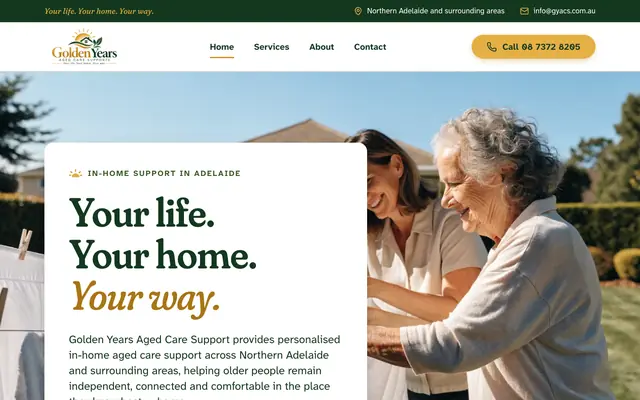
Home page of the Golden Years Aged Care Support website

Golden Years Aged Care Support

Home & care services · Northern Adelaide

In-home support for older people in Northern Adelaide. Its enquiry form has a separate option for aged care providers referring a client, apart from older people and families: the same split between professional and family referrals a coordination practice handles.

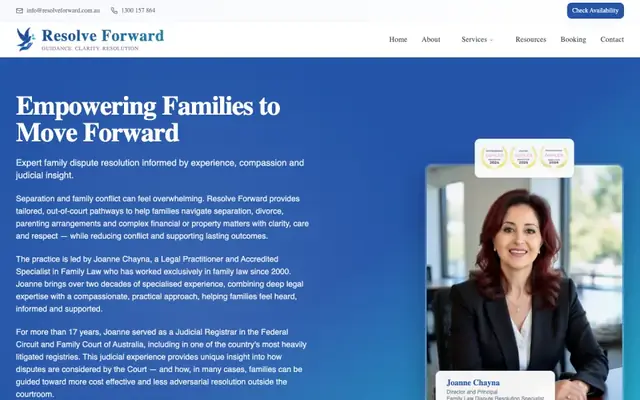
Home page of the Resolve Forward website

Resolve Forward

Professional services · Sydney

A family law dispute resolution practice in Sydney, so a different field entirely. We include it for its five-step intake form, which gathers what the practice needs before a first session, plus six service pages, FAQs and priced packages linked to online booking.

“He was incredibly hands-on, always available to answer questions, and made every requested change promptly and without hesitation.”

Resolve Forward, Google review

What a support coordination website costs

One page

$399

An independent coordinator: the levels you offer, your areas, current capacity, how you work and the referral form, together on one page.

Our suggestion for most coordination practices

Up to 3 pages

$899

A home page, a how-we-work page covering the coordination levels and your conflict of interest approach, and a referrals page professionals can bookmark.

Up to 8 pages

$1,499

Coordination teams: coordinator profiles, a page per region, a specialist support coordination page, an Easy Read page and a careers page.

  • Payment. No deposit. We build your draft first, you ask for as many changes as you like, and you pay once you approve it. If you don't go ahead, you owe nothing.
  • GST. WebCraft Studio isn't registered for GST, so no GST is added.
  • Timing. Most sites are live within 5–10 days of us getting your words and photos; bigger sites (up to 8 pages) take 2–3 weeks.
  • Hosting. After launch, hosting is $30 a month: hosting, security monitoring, backups, email support and unlimited text and image changes on your existing pages. New pages or features are quoted first. No contract, cancel anytime.
  • Domain and email. We register your domain in your name (about $20 a year), connect it to your site and set up your business email.

See full pricing and what each package includes

Questions support coordinators ask us

Do support coordinators have to be NDIS registered?

Not at the moment, unless you work with participants whose funding is NDIA-managed, as they can only use registered providers. The NDIS Commission consulted on mandatory registration for support coordinators and paused that work in December 2025. Separately, the Government's timeline has a new provider enrolment system rolling out from 1 July 2027. Your site should state clearly whether you're registered, and the Commission's mandatory registration page is where any change will be announced.

How will the NDIS reforms to support coordination affect our website?

The Government's published timeline for the Securing the NDIS for Future Generations changes ran consultation on a new support coordination and connection function from 7 September to 2 October 2026, with that function due to begin on 1 July 2028. Names, levels and what's funded may shift before then. Rewording your existing pages when the details are confirmed is covered by hosting; any new pages are quoted first.

Can the referral form collect a copy of the participant's plan?

It can take file uploads, but we suggest it doesn't. NDIS plans contain health information, and the OAIC's guidance is that a disability service provider holding health information is covered by the Privacy Act whatever its size. A safer pattern is to ask for the plan after first contact, through a secure method you already use.

Can participants book a first chat online?

Yes, if you use a booking tool such as Calendly or Microsoft Bookings. We don't build our own booking system; we add a clear button on every page that opens the tool you already have. If you'd rather speak first, the site leads with your phone number and the referral form instead.

Which package suits a support coordinator?

An independent coordinator can start with the one-page site at $399. For most practices we suggest the 3-page site at $899: referrals then get a page of their own. Teams with several coordinators or regions are better suited to the 8-page site at $1,499.

Ready to start your support coordination website?

Tell us the levels you offer, the areas you cover and how referrals reach you now. We'll quote and build a draft, and you pay nothing until you approve it.

We reply within 24 hours. Prefer email? info@webcraftstudio.com.au