Victoria's building regulator is now the Building and Plumbing Commission (BPC), which took over the work of the Victorian Building Authority and the state's domestic building insurance. Under the Building Act 1993, a builder has to be registered to take on a major domestic building contract, the kind needed once a job passes a set value. The BPC's guidance adds that a company must be registered in its own right before it can enter into one of those contracts in the company's name. Clients can look you up on the BPC's Find and check a practitioner register by name, business name, registration number, location or type of work, so we link to it from your footer.
The advertising rule is in section 169H of the Act: an advertisement or written statement offering to carry out domestic building work must state the name the practitioner is registered under and the registration number. Section 169I applies the same rule to a registered builder in partnership with someone who isn't registered. HIA's guidance on company registration lists online webpages and social media alongside written quotes, contracts, flyers and print ads, and says both individual and company registration names and numbers belong on them. A website that offers to build for someone is advertising, so the details go on every page rather than only the contact page.
From 1 July 2026, Home Warranty replaced Domestic Building Insurance for new eligible contracts. The Victorian Government describes it as covering building contracts above a minimum value on projects of three storeys or less, run by the BPC, and says homeowners can claim when a building issue is first identified rather than only as a last resort. Contracts signed before that date with a DBI certificate keep their DBI cover. Clients will ask how it applies to their job, and a link to the BPC's guidance on your FAQ page is safer than paraphrasing a scheme that is still new.
Melbourne's planning strategy, Plan Melbourne, sorts the metropolitan councils into six regions: Inner Metro, Inner South East, Western, Northern, Eastern and Southern. Separately, the Planning and Environment Act names seven councils whose land can be declared a growth area: Wyndham and Melton in the west, Hume, Whittlesea and Mitchell in the north, and Casey and Cardinia in the south-east. A builder doing house-and-land work in those councils writes for a different client from one renovating period homes in Boroondara or Glen Eira, so your service list should follow the work you want rather than every suburb you could reach.
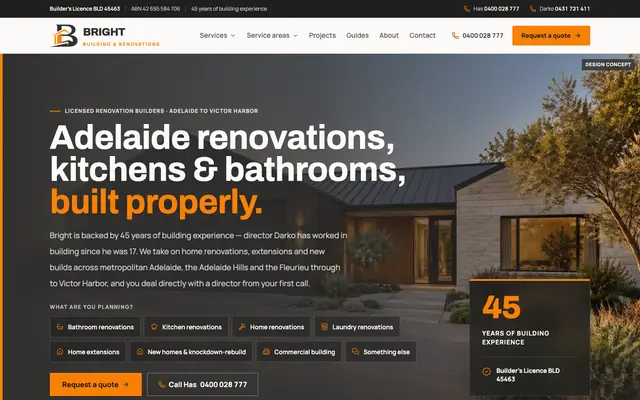
We're an Adelaide team on Hutt St, and we work with Victorian builders by phone and email. The one builder in our portfolio is in Adelaide, so everything Victorian on your site starts with what you send us: your registration, your projects and the regions you build in. We reply with a draft link you can check from site, and you ask for changes the same way.