Website Design for HVAC and Air Conditioning in Canberra

Websites for Canberra heating and cooling installers, refrigeration mechanics and HVAC contractors, in a city where heating, not cooling, takes most of a home's energy. Your electrical licence class and ARC licence sit where customers check them, the gas-to-electric changeovers Canberra households are pricing get a proper explanation, and your number is one tap away when a heater stops on a frosty morning.

What a Canberra heating and cooling website needs

Because heating is most of a Canberra home's energy use, many enquiries are about winter rather than summer. An owner in Kambah wants the old ducted gas unit swapped for reverse cycle before the next frost. A property manager in Belconnen has a tenant whose heating died overnight. A homeowner in Reid wants a split system nobody will see from the street. Each of them looks for something different on your site before ringing.

  • Who does the wiring, stated plainly

    The ACT doesn't issue a stand-alone air conditioning licence. The wiring falls under the electrician licence, whose restricted refrigeration and air-conditioning class covers only the incidental wiring involved in disconnecting and reconnecting a system. Access Canberra's electrical inspectors say new low-voltage wiring needs an unrestricted licence. If your technicians hold the restricted class and an unrestricted electrician runs new circuits, the site says so, with each licence number shown.

  • Your ARC licence type, beside the right services

    The national refrigerant licence comes in more than one form. The full RAC licence takes in refrigeration and air conditioning work of every kind outside the automotive trade; the restricted split-system licence covers only installing and decommissioning single-head splits (and two-part heat pumps) under 18 kW. If you hold the full licence, put it next to your multi-head, ducted and repair work, because that is the difference a customer can't see.

  • Heating figures written for the cold zone

    The cold-zone stars on the national energy label are calculated from Canberra's own climate data, and the ACT Government's buyers guide tells households to look for units suited to its winters. A short panel on the red heating stars, the 2°C heating capacity and why you recommend particular models helps a buyer compare quotes on more than the bottom line.

  • Gas ducted changeovers, step by step

    The ACT guide warns that old gas ducts are too narrow to reuse for reverse cycle, suggests new ducting carry at least R1.5 insulation, and says a large ducted or multi-head job can need a 3-phase supply. A page that walks through your survey, duct design, any supply upgrade, capping the old gas line, and whether the household should ask its retailer for a temporary disconnection or a permanent abolishment (the ACT Government's switching-off guide explains both) answers the questions that stall these quotes. Since most residential respondents in a survey the ACT Government cites said they'd go electric once a gas appliance breaks, the same page should work for someone reading it on the morning their heater won't light.

  • A page agents can nominate you from

    Under the ACT's standard tenancy terms, a breakdown of anything essential for heating or cooling counts as an urgent repair, and a tenant who can't reach the landlord can call the tradesperson the landlord nominated in the lease. A page for property managers with your after-hours number, how you invoice agencies and how quickly you can usually attend makes you easier to nominate.

  • Installs that suit heritage streets

    Inner-north and inner-south heritage precincts come with expectations about where an outdoor unit goes. Captioned photos of ground-level, screened installs, plus a quote form that asks whether the house is heritage listed or part of a unit complex, show an owner you've handled their kind of job before the site visit.

  • Rebates and loans, described accurately

    Name only the schemes you take part in: Brighte accreditation, which both the Sustainable Household Scheme loans and the Home Energy Support rebates run through, and ActewAGL's approved installer network. Link each one to its official page for current terms, so the site never quotes an amount or eligibility rule that has since changed.

Licences, cold winters, gas changeovers and placement rules in the ACT

Who may do the work. The construction licences issued through Access Canberra include builders, electricians, plumbers, drainers and gasfitters, gas appliance workers, surveyors and assessors, and none of them is for air conditioning or refrigeration. The trade reaches the licensing system through its electrical and gas work. The electrician licence includes a restricted class for refrigeration and air-conditioning, limited to incidental wiring for disconnection and reconnection, and the Electrical Inspections team's fact sheet on split systems states that a restricted licence holder may disconnect and reconnect low-voltage wiring but not install it; the same sheet sets out the AS/NZS 3000 isolator rules for outdoor and indoor units. The ACT Government's buyers guide puts it simply for homeowners: installing a reverse cycle system needs an ACT licensed electrician, and replacing a gas system also needs an ACT licensed plumber. Refrigerant handling is licensed nationally by the Australian Refrigeration Council. The ACT's advertising rule for licensed trades (the name on your licence, its number and, for a company, its ACN) is set out on our Canberra tradies page.

A heating market first. The ACT Government's guide to reverse cycle systems says heating makes up about 60% of the average Canberra household's energy use. The Bureau of Meteorology's Canberra Airport station, open since 2008, averages 0.1°C overnight and 12.9°C by day in July, and it recorded 44.0°C on 4 January 2020; the older airport station it replaced bottomed out at −10.0°C on 11 July 1971. The national Zoned Energy Rating Label calculates its cold-zone figures from Canberra's climate file, and its 2°C heating capacity is there to show how a unit copes with frosting conditions, since outdoor coils start to frost once the air drops below about 5.5°C. The ACT guide suggests looking for an H2 rating for Canberra winters, and the Home Energy Support rebates for eligible homeowners set firmer terms: the system must heat and cool, be listed on the GEMS register, be able to operate in the cold zone and meet minimum annual efficiency figures. Few buyers know what any of that means, so a site that explains it does work the quote would otherwise have to do.

The move off gas. New gas network connections have been blocked in the ACT's residential, commercial and community facility zones since 8 December 2023, and the ACT Government's 2026 discussion paper on future gas appliance rules shows how far heating has already moved. Among ACT households with a gas connection, 69% use electric space heating and 43% gas (dual-fuel homes count in both), the highest electric share in Australia. In a survey of 1,885 households cited in the paper, 59% of residential respondents said they intend to go electric when their gas appliance breaks, and another 28% will weigh up the costs at that point. Evoenergy expects about 40,000 customers, roughly a third, to stop using gas between 2026 and 2031, and some sections of the network may begin to shut down from the mid-2030s. Consultation ran from 5 August to 16 September 2026, and the example the paper gives of how rules could help installers plan is stopping new gas space heating installations in two years. For the cost, the Sustainable Household Scheme offers 3% loans through Brighte (our Canberra electricians page covers how suppliers take part), and under the Energy Efficiency Improvement Scheme, ActewAGL and Origin Energy are the retailers delivering upgrades; ActewAGL's current offer covers replacing ducted gas heating with ducted reverse cycle through its approved installers.

Where the outdoor unit goes. Under the Planning (Exempt Development) Regulation 2023, an external air conditioner is exempt from development approval, provided it also meets the general exemption criteria, if no part of it is within 1.5 m of a side or rear boundary, a roof-mounted unit rises no more than 1.5 m above the roof and stays inside any solar building envelope, and a ground-mounted unit sits behind the building line. Places on the ACT Heritage Register lose that exemption unless the Heritage Council advises in writing that the work won't diminish the place's heritage significance or follows its heritage guidelines. The conservation policy the Council uses when advising says units shouldn't be visible from the street or other public places, should sit at ground level with screening (evaporative units aside) and shouldn't go on a roof that can be seen from the street. Registered places include the housing precincts in Reid, Braddon, Barton and Forrest. Noise is regulated separately: Access Canberra's residential standard is 45 dB(A) by day and 35 dB(A) overnight, and 5 dB(A) lower in multi-unit developments. In unit complexes, the Unit Titles (Management) Act lets an executive committee approve a minor use of common property, and the Act's own example is an air conditioner that extends over it.

Districts, the border and us. Canberra has no local councils, so customers search by suburb and district; we list the districts you cover, from Gungahlin and Belconnen in the north to Woden and Tuggeranong in the south, with the suburbs under each. Queanbeyan, Googong and Jerrabomberra are in NSW, where air conditioning work needs a NSW licence, and our Sydney air conditioning page explains those rules. We're an Adelaide team on Hutt St and work with Canberra businesses by phone and email. We haven't built a site for a heating and cooling business or an ACT client yet; our current clients are in SA, NSW, VIC and QLD.

Service-area websites we've built

No heating and cooling business is in our portfolio yet, and none of our clients is in the ACT. These two show the parts a Canberra HVAC site would use: a large trade site that customers can search by suburb and postcode, and a service business with suburb pages and a quote form that offers a call-back.

Home page of the SA Painting Professionals website

SA Painting Professionals

Trades & construction · Adelaide & all of SA

An Adelaide painting company with 12 service pages, region pages across South Australia, a suburb and postcode search, a quote form and tap-to-call. The same search would let someone in Googong or Gordon check whether you cover them before they fill in a form.

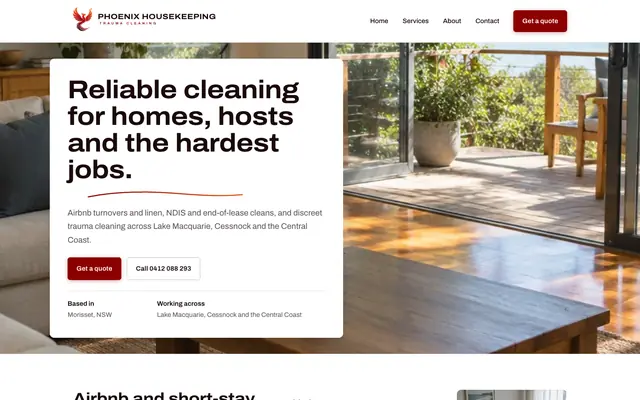
Home page of the Phoenix Housekeeping website

Phoenix Housekeeping

Home & care services · Lake Macquarie, Cessnock & Central Coast

A family-run cleaning business around Lake Macquarie with published pricing, service pages, suburb pages and a quote form with a call-back option. A property manager reporting a dead heater could ask for a call-back the same way instead of filling in a long form.

“He listened to my feedback and made no hesitations to revise and adjust my website until we were completely happy with it.”

Tony Bleijswijk, Google review

★ 5.0 from 33 Google reviews (opens in a new tab)

Want numbers from a trade site? Western Sydney Stump Grinding has landed at least 62 jobs, about $46,500 of work, from a single-page site we built. Read the case study.

See all 14 recent client sites in our portfolio.

What a Canberra heating and cooling website costs

One page

$399

Heating, cooling and servicing on a single page, with your electrical and ARC licence numbers, the districts you cover, a quote form that takes a photo of the old unit and tap-to-call.

Our suggestion for most Canberra installers

Up to 3 pages

$899

A home page for breakdowns and installs, a page on replacing ducted gas heating with reverse cycle, and a page written for property managers and landlords.

Up to 8 pages

$1,499

For crews doing homes and commercial work: separate pages for splits, ducted and multi-head, gas changeovers, rebates and loans, rentals, unit complexes and commercial refrigeration.

  • Payment. No deposit. We build your draft first, you ask for as many changes as you like, and you pay once you approve it. If you don't go ahead, you owe nothing.
  • GST. WebCraft Studio isn't registered for GST, so no GST is added.
  • Timing. Most sites are live within 5–10 days of us getting your words and photos; bigger sites (up to 8 pages) take 2–3 weeks.
  • Hosting. After launch, hosting is $30 a month: hosting, security monitoring, backups, email support and unlimited text and image changes on your existing pages. New pages or features are quoted first. No contract, cancel anytime.
  • Domain and email. We register your domain in your name (about $20 a year), connect it to your site and set up your business email.

See full pricing and what each package includes

Questions Canberra heating and cooling businesses ask us

Which licence numbers should a Canberra air conditioning website show?

Your ARC refrigerant handling licence, the electrician licence and class held by whoever does the wiring (the restricted refrigeration and air-conditioning class, or an unrestricted licence), and your plumbing or gasfitting licence if your business disconnects gas heaters itself. The ACT also expects licensed trades to show the name on the licence, its number and, for a company, its ACN. We put them in the footer, so they appear on every page.

Is the cold-zone energy rating worth explaining on our site?

Briefly, yes. The label's cold-zone stars are worked out from Canberra's climate, and the ACT Government's guide points buyers towards units suited to its winters. A short panel on the red heating stars and the 2°C capacity figure, beside the models you usually install, helps someone comparing quotes see why yours is priced the way it is.

We're accredited with Brighte and on ActewAGL's installer list. What should the site say?

Name each one, say what it means for the customer (a 3% loan through the Sustainable Household Scheme, or a discount applied by the retailer) and link to the official page for current terms. The scheme's loan limits now depend on whether a household applied before or after 1 July 2026, so we leave amounts off unless you want to keep them updated; text changes like that are covered by the $30 monthly hosting. If you're not part of a scheme, the site doesn't mention it.

Is a page for property managers worth having?

If rentals are a steady part of your work, yes. The ACT's standard tenancy terms list the breakdown of a service essential for heating or cooling as an urgent repair, and if the landlord can't be reached, the tenant can book the tradesperson nominated in the lease, who may bill the landlord directly. A page with your after-hours number, how you invoice agencies and your usual attendance times gives an agent a reason to nominate you. On the $899 site, it would be one of the three pages.

Can one site cover Queanbeyan and Googong as well as Canberra?

Yes, as long as it shows the right licence for each side of the border. Air conditioning work in NSW needs a NSW licence or certificate (an air conditioning, refrigeration or electrical licence, depending on the work), so we list your NSW towns separately with that number beside them and keep your ACT districts in a list of their own.

You're in Adelaide. How does a Canberra installer work with you?

By phone and email. We're a web design team at Ste 3/110 Hutt St, Adelaide, working with businesses Australia-wide, and our current clients are in SA, NSW, VIC and QLD. You send your words, licence details, districts and photos of finished installs, we arrange them into the pages and send a draft you can check on your phone, and you pay once you approve it. We reply within 24 hours.

Ready to start your Canberra heating and cooling website?

Send us your licence numbers, the districts you cover and photos of a few finished installs, ideally including a ducted gas changeover. You'll get a quote first, and we build the draft before you pay anything.

We reply within 24 hours. Prefer email? info@webcraftstudio.com.au