Air conditioning and refrigeration work in NSW needs a licence or certificate, whatever the job is worth, and Building Commission NSW administers it. The options are individual and company or partnership contractor licences, the qualified supervisor certificate and the provisional tradesperson certificate. The licence also covers the associated electrical wiring: testing and diagnosing faults, disconnecting and reconnecting permanently connected components, replacing load-side components, repairing cable terminations and making minor wiring changes, although some licences carry a condition restricting that electrical work until the holder shows evidence of the mandatory electrical modules. Self-contained single-phase plug-in units, such as portable air conditioners and domestic fridges, sit outside the definition. On top of the state licence, anyone who handles fluorocarbon refrigerant needs a refrigerant handling licence from the Australian Refrigeration Council, and any person or business that buys, stores or sells refrigerant needs a Refrigerant Trading Authorisation.
The NSW Energy Savings Scheme gives households and small businesses an upfront discount on a new or replacement energy-efficient air conditioner. It's delivered through installers partnered with an Accredited Certificate Provider, and IPART accredits those providers and lists them. The discount depends on the model, not every model qualifies, and a more efficient unit generally earns a larger one. The NSW Government tells customers to get several quotes, check the installer's licence, and sign the nomination form before installation begins. An installer whose site explains those steps is answering the questions the government has told customers to ask.
Strata is the other everyday Sydney question. NSW Fair Trading lists a reverse cycle air conditioner among minor renovations: the owner applies to the owners corporation, strata committee or managing agent, and approval comes from more than half the votes cast at a meeting, or from the committee where a by-law lets it decide. If the committee holds that role and doesn't refuse within three months, the application is taken as approved, and work that changes the outside or structure of the building isn't minor. For planning, most units are exempt development under the state's Codes SEPP if they meet its standards, which allow a unit on the floor of a balcony, though strata by-laws can still limit where units go. On a heritage item or in a heritage conservation area, the unit has to sit at or behind the rear building line, and on a heritage item it must also be ground-mounted.
Noise rules changed this year. The Protection of the Environment Operations (Noise Control) Regulation 2026 commenced on 28 August 2026. Restricted night-time hours for household air conditioners heard inside a neighbour's home now start at 11 pm instead of 10 pm, and the time limits don't apply during severe or extreme heatwaves declared by the Bureau of Meteorology. Heat itself is the Sydney fact to build around: on 4 January 2020 the Penrith Lakes weather station reached 48.9°C, the highest temperature recorded in Sydney's metropolitan area. If you cover Penrith, Blacktown or Campbelltown, lead with breakdown call-outs and say how soon you can usually get there.
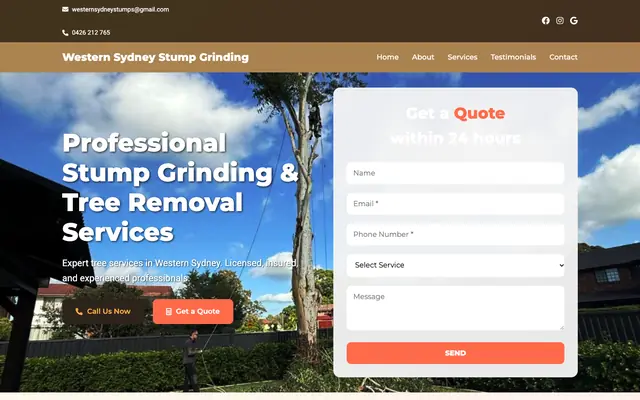
Customers search by region and suburb, not council: Greater Western Sydney and Macarthur, the Hills District, the Upper and Lower North Shore, the Northern Beaches, the Inner West, the Eastern Suburbs, St George and the Shire. Name the regions you work in with the main suburbs under each, and say if ducted installs, strata jobs or commercial refrigeration only go to some of them. We're an Adelaide team on Hutt St and work with Sydney businesses by phone and email. We haven't built a site for an air conditioning business yet; our closest Sydney example is Western Sydney Stump Grinding, a one-page trade site with two quote forms and tap-to-call throughout.