Website Design for Wedding Vendors

Websites for venues, celebrants, florists, stylists, hair and makeup artists, cake makers and wedding musicians that answer a couple's first question (are you free on our date?), show real weddings you've worked on, and spell out what each package includes before anyone has to ask.

What a wedding vendor's website has to answer

Couples usually find you online months before they meet you, and they're weighing several vendors at once, often on a phone in the evening with a partner or parent reading along. They narrow the list on three things: whether you're free on the date, whether your price fits their budget, and whether your past weddings look like the one they're planning. A site that answers those three without making them write in first saves both sides a round of emails.

  • A date check before anything else

    The enquiry form opens with the wedding date and the venue or town, then guest numbers, ceremony and reception times, and a budget range. If you take only one wedding a day, say so beside the form, so a couple with a clash knows to ask about a second choice of date. Venues can add a line, in their own words, about which days and months fill first, which helps couples deciding between a Saturday and a Friday.

  • Packages with inclusions and a starting price

    Couples compare like with like: hours on the day, set-up and pack-down, travel beyond a set distance, the number of arrangements or cake tiers, a hair and makeup trial, or a venue's minimum spend and per-head price. A starting price on each package lets them check it against their budget. If you prefer to send a full pricing guide after someone enquires, keep the main inclusions on the page as well, so couples who won't hand over an email address still see them.

  • Real weddings, credited and cleared

    A real weddings page with one entry per wedding (the venue, the season, what you supplied) tells a couple more than a grid of loose close-ups. Credit the photographer on each, and ask before you publish: the Arts Law Centre explains that photos commissioned for a private purpose such as a wedding belong to the couple who paid for them unless a written agreement says otherwise. We put up only the images you send us.

  • Venue details couples plan around

    Seated and standing capacity for each space, where ceremonies happen and the wet weather plan, the time the night has to finish, whether catering is in-house or outside caterers are allowed, step-free access, parking, and accommodation nearby. Floor plans shown as images on the page, with photos of each space both empty and set for a reception, help couples picture the day without downloading anything.

  • Celebrants: the wording the Marriage Act asks for

    Commonwealth-registered celebrants must state on their website and social media whether they're a marriage celebrant or a religious marriage celebrant, and the Attorney-General's Department says “civil marriage celebrant” meets that rule. Its advertising guidelines also suggest “registry-style weddings” rather than “registry weddings”, which could mean ceremonies run by a registry office, and tell celebrants not to give visa advice, but to point couples to the immigration department's website or a registered migration agent.

  • Deposits and terms in plain view

    What secures the date, when the balance is due, what happens if the wedding is postponed, and any travel or after-hours charges. Say exactly which event makes a deposit non-refundable: the department's example for celebrants is to write “receipt of the NOIM”, because couples read “lodgement” as the day it reaches the registry. For taking deposits online, we build booking and payment systems into the site, quoted per job, or link the client management tool you already use.

The closest work in our portfolio

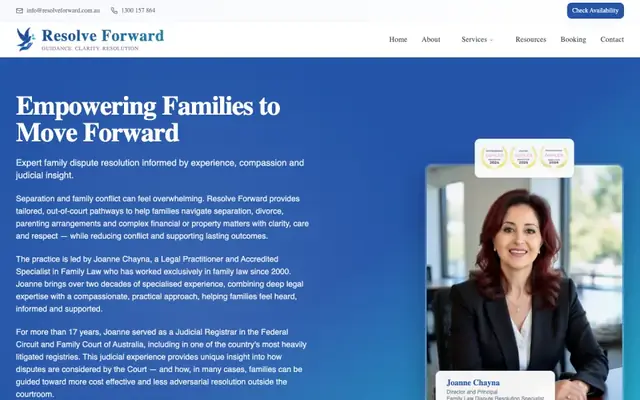
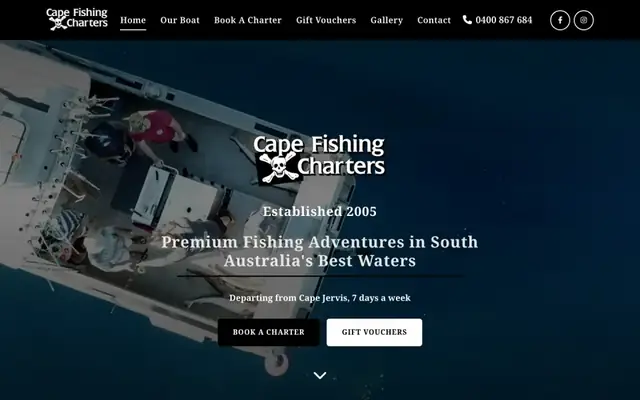
We haven't built a site for a wedding vendor yet, and we won't dress another client up as one. Two client sites handle the jobs a wedding business leans on most: Cape Fishing Charters takes booking requests and gift voucher requests through its site, and Resolve Forward sets out priced packages that lead straight into online booking. The review below is Resolve Forward's, and it mentions that bookings page.

Home page of the Cape Fishing Charters website

Cape Fishing Charters

Community, creative & tourism · Cape Jervis

A fishing charter business at Cape Jervis, South Australia, not a wedding vendor. Its one-page site is built around a booking request form, with gift voucher requests, a catch photo gallery, an FAQ, customer reviews and a map. Swap the catches for real weddings and the trip booking for a wedding enquiry, and it's a layout a celebrant, florist or makeup artist could use.

Home page of the Resolve Forward website

Resolve Forward

Professional services · Sydney

A Sydney family law dispute resolution practice. Six service pages with FAQs sit alongside priced packages that link to online booking and a five-step intake form. A venue could use the same pattern to let couples book a tour, or a vendor with fixed packages to let couples book a first consultation.

“Salem created a sleek, professional website for www.resolveforward.com.au with an intuitive and easy-to-use bookings page.”

Resolve Forward, Google review

What a wedding vendor's website costs

One page

$399

A celebrant, makeup artist or musician: packages with starting prices, a gallery, your terms, reviews and a date-first enquiry form, on one page.

Our suggestion for most wedding vendors

Up to 3 pages

$899

A home page, a real weddings page with an entry for each wedding, and a packages page holding your terms, FAQs and the enquiry form.

Up to 8 pages

$1,499

Venues and larger suppliers: a page for each space or service, ceremonies, receptions, packages, real weddings, accommodation and getting there, and enquiries.

  • Payment. No deposit. We build your draft first, you ask for as many changes as you like, and you pay once you approve it. If you don't go ahead, you owe nothing.
  • GST. WebCraft Studio isn't registered for GST, so no GST is added.
  • Timing. Most sites are live within 5–10 days of us getting your words and photos; bigger sites (up to 8 pages) take 2–3 weeks.
  • Hosting. After launch, hosting is $30 a month: hosting, security monitoring, backups, email support and unlimited text and image changes on your existing pages. New pages or features are quoted first. No contract, cancel anytime.
  • Domain and email. We register your domain in your name (about $20 a year), connect it to your site and set up your business email.

See full pricing and what each package includes

Questions wedding vendors ask us

Should we show prices, or ask couples to enquire?

We suggest a starting price for each package, with a note on what moves it: guest numbers, the season, travel, extra hours. Couples on a tight budget can rule you in or out without writing, and the enquiries you do get already know the range. When your prices change for a new season, send us the figures; text changes on existing pages are covered by the $30 monthly hosting.

Can couples pay a deposit online to hold their date?

Yes. We build booking and payment systems into websites, quoted per job: for example, a fixed-price package where the couple picks a date, agrees to your terms and pays the deposit in one go. If you already send quotes, contracts and invoices from a tool such as HoneyBook, the site can open its enquiry form instead, so your paperwork stays where it is.

Can we use photos the couple's photographer took?

Ask first. Copyright in photos commissioned for a private purpose, like a wedding, belongs to the couple who paid for them unless an agreement says otherwise, according to the Arts Law Centre of Australia (opens in a new tab), and the photographer's contract may change that. A short written OK from both covers you, and a credit line under each wedding is good manners. If someone later asks for a photo to come down, removing it is part of the hosting.

We're a celebrant. What should our website say about the legal side?

First, which kind of celebrant you are, as listed on the register. If you explain the Notice of Intended Marriage, the department's getting married page (opens in a new tab) says it must reach you at least one month and no more than 18 months before the wedding, and since June 2024 it can be witnessed by video link. The advertising guidelines for celebrants (opens in a new tab) say legal requirements you describe must be correct and warn against copying other celebrants' text or images. We arrange your own words, and we can link the department's page so couples always see the current rules.

Which package suits a wedding business?

A celebrant, musician or makeup artist with a few packages can do well with the one-page site at $399. Most vendors suit the 3-page site at $899 because real weddings and packages each get room to breathe. Venues with several spaces, or suppliers offering ceremonies, styling and hire, are better on the 8-page site at $1,499. A site that size takes 2–3 weeks once we have your words and photos.

Do you build sites for wedding businesses outside Adelaide?

Yes. We're a web design team at Ste 3/110 Hutt St, Adelaide, working with businesses Australia-wide by phone and email, and our current clients are in SA, NSW, VIC and QLD. You send your packages, terms and photos; we send back a link to the full draft to check on your phone between weekends.

Ready to start your wedding business website?

Send us your packages, your terms and a few favourite weddings with the photographer's OK. We'll quote it, build the full draft, and you pay only once you've approved it.

We reply within 24 hours. Prefer email? info@webcraftstudio.com.au