Website Design for Personal Trainers in Brisbane

Whether you run a 5:30am group by the river, hire a corner of a gym in Newstead, train people in their garages across the Southside or coach online, your website should say where you'll be, what ten sessions cost in total and how to book an intro. We build the draft first and you pay only once you approve it.

What a Brisbane trainer's site needs before anyone books

Queensland is one of the few places where a mandatory fitness code names personal trainers, and Brisbane City Council treats paid training in its parks as a commercial activity that needs its permission. Neither changes how good a trainer you are, but both shape what a careful website says. A prospective client mostly wants to know if your sessions fit their week and their budget.

  • Group size that matches your park permission

    If you run outdoor groups, put the maximum number per session on the timetable. Council charges nothing for commercial fitness groups of up to 10 participants and charges a monthly or yearly fee above that, so the number you advertise should be the number your permission covers. People joining a small group like knowing it stays small, too.

  • Packs priced the way Queensland expects

    Show each option with its full cost rather than a per-session figure alone: the single session, the pack of ten and how long it lasts, the weekly plan and its minimum term, plus any joining or admin fee. Queensland's fitness code requires a written statement of fees, with the total payable, before a client signs a membership agreement. A packages page that already adds it all up makes that paperwork easy and saves you answering the same price question by text.

  • Studio terms on their own page

    If you train people in your own indoor space with equipment, your membership-style agreements are more likely to fall under the code's rules about fitness centres: the 48-hour cooling-off period, the written agreement, and copies of your rules before signing. Give those terms a page of their own, written in your words, and link it from every price.

  • An intro session one tap away

    A single Book button, repeated on each page, opening whatever your first step is: a free chat, a paid assessment or a trial group session. It can go straight into the booking app you already use, or we can build booking and payment into the site and quote it once we know how your packs and credits work.

  • Results captions that hold up

    Queensland's fitness code says a supplier's promotional material has to be truthful, accurate and unambiguous. For progress photos that means real clients who've said yes, the number of weeks between shots, no editing, and a line on what the program involved. We set the pairs out in a swipeable gallery with the caption under each one.

  • Screening questions in the enquiry form

    The Adult Pre-Exercise Screening System, developed by AUSactive with Exercise & Sports Science Australia and Sports Medicine Australia, is one many trainers already use. A form that asks about goals, injuries and current activity before the first session means you arrive knowing whether to start gently, and the client sees you take it seriously.

  • A plan for storms and hot mornings

    Brisbane summers bring afternoon storms and humid early starts. Say what happens when a session can't run: moved under cover, shifted to a different time, or credited back to the pack. Put it next to your late-cancellation rule so a client knows before they buy.

Training clients in Brisbane: the Queensland code and council parks

Queensland doesn't license personal trainers, but it does have a mandatory code: the Fair Trading (Code of Practice—Fitness Industry) Regulation 2003 (opens in a new tab). Its dictionary gives "a person operating a business as a personal trainer" as an example of a supplier of fitness services, and its advertising clauses ask that promotional material be truthful, accurate and unambiguous. The parts about membership agreements are written around services at a fitness centre, which the code defines as an indoor facility with fitness equipment. Where they apply, the Queensland Government's consumer page (opens in a new tab) sums them up: a plain-English fee statement before signing, a 48-hour cooling-off period, no more than 12 months paid in advance, and no ongoing agreement with a minimum term longer than 18 months. Clients who can't resolve a complaint with you can go to the Office of Fair Trading, or to AUSactive if you're a member. Our gyms page compares this code with the ones in WA and the ACT. Whether a particular agreement is covered is a question for the Office of Fair Trading, not for us; we lay out the terms you give us.

Outdoors, most of the parks inside the City of Brisbane come under one council, so the riverside and suburban parks trainers use generally have one set of rules. Under its Public Land and Council Assets Local Law 2014, Brisbane City Council (opens in a new tab) lists personal training among the commercial activities that need its permission. Trainers apply online at least 10 working days before their first session, with a marked-up map or aerial photo of the area of the park they want to use, and the council aims to reply within 10 working days. A public liability certificate of currency for at least $20 million is asked for where the activity is high-risk, and a security bond can apply depending on the equipment you bring. The park fees table (opens in a new tab) makes groups of up to 10 participants free and charges larger groups by the month or year.

That map is useful on the website as well. If the council has approved a particular stretch of a park, describe the meeting point the same way on your timetable (which end of the park, which shelter or path), so a newcomer finds you at 5:30am without phoning. When you add a park or a bigger group, update the permission first and the website second.

Greater Brisbane runs well past the council's boundary, into Logan, Moreton Bay, Redland and Ipswich, and each of those councils sets its own rules for commercial use of its parks. If you train across a boundary, check with each one, and list only the places you're cleared for. People also search by area rather than city: Northside, Southside, Bayside, the western suburbs. A trainer who works in two of those can give each its own page with its parks, gyms and home-visit suburbs, the same way our Northside and Southside pages split the city.

We're a web design team in Adelaide and work with Queensland clients by phone and email, including a dance school on Brisbane's Bayside and a Queensland plumber. We haven't built a personal trainer's website yet, and we say so; the two sites below carry the parts a trainer would use.

Two Queensland sites with parts a trainer can reuse

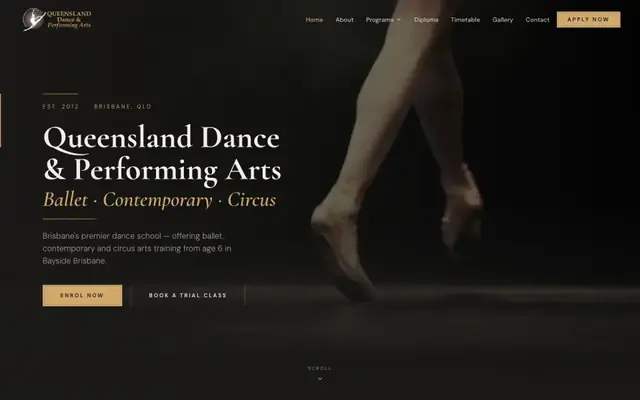
Neither of these is a fitness business. One is a Brisbane Bayside school that runs a weekly timetable of classes and takes enrolments online; the other is a Queensland tradie's one-page site with a swipeable photo gallery and reviews, the layout a solo trainer starting out often needs.

Home page of the Queensland Dance & Performing Arts website

Queensland Dance & Performing Arts

Community, creative & tourism · Thorneside, Brisbane's Bayside

A dance school in Thorneside teaching ballet, contemporary and circus arts. Its 12 pages give each program its own page and share a weekly class timetable, a filterable gallery, FAQs and an online enrolment form. Swap classes for bootcamp and small-group sessions and the timetable and enrolment form carry over almost unchanged.

Home page of the M.J. Debney Plumbing & Gas website

M.J. Debney Plumbing & Gas

Trades & construction · Queensland

A licensed Queensland plumber and gas fitter. One page covers six services, a 13-photo gallery that swipes on a phone, client testimonials, a protected contact form and tap-to-call. For a trainer, the gallery becomes consented progress photos with captions and the services become your packs.

“They were very helpful and envisioned exactly what I was wanting for my website. They created the site very promptly and cost efficient.”

Michael Debney, Google review

What a personal trainer's website costs in Brisbane

One page

$399

One scrolling page: where you train and when, packs with full prices, a few captioned results, qualifications and an intro-session button.

Where most Brisbane trainers start

Up to 3 pages

$899

Home with your parks or studio and the Book button, a packages page with terms and wet-weather rules, and an about page with results and screening form.

Up to 8 pages

$1,499

Room for a page per area of Brisbane, separate pages for one-on-one, small groups and online coaching, studio terms, results, FAQs and contact.

  • Payment. No deposit. We build your draft first, you ask for as many changes as you like, and you pay once you approve it. If you don't go ahead, you owe nothing.
  • GST. WebCraft Studio isn't registered for GST, so no GST is added.
  • Timing. Most sites are live within 5–10 days of us getting your words and photos; bigger sites (up to 8 pages) take 2–3 weeks.
  • Hosting. After launch, hosting is $30 a month: hosting, security monitoring, backups, email support and unlimited text and image changes on your existing pages. New pages or features are quoted first. No contract, cancel anytime.
  • Domain and email. We register your domain in your name (about $20 a year), connect it to your site and set up your business email.

See full pricing and what each package includes

Questions Brisbane personal trainers ask us

Does the Queensland fitness code affect what goes on our website?

Its advertising clauses ask for promotional material that's truthful, accurate and unambiguous, which covers your results photos and prices. If you run an indoor studio and sign people to agreements, the fee statement, 48-hour cooling-off and agreement rules are worth setting out on a terms page too. We arrange the wording you provide and point you to the Office of Fair Trading for questions about whether a rule applies to you; we don't give legal advice.

We run a group of 12 in a council park. Should the site mention the permit?

A short line saying you train with Brisbane City Council permission reassures people meeting a stranger in a park at dawn. Council charges groups of more than 10 a monthly or yearly fee, so make sure the group size on your timetable is the one you've been approved for. Changing either later is a text edit included in the $30 monthly hosting.

Can people buy a pack of ten and book sessions on the site?

Yes. If you already sell packs through a booking app, each Buy and Book button opens it at the right session type. If you'd like booking and payment built into the website itself, we quote it per job once we understand your credits, expiry dates and cancellation rules. Our booking tools comparison covers some common options.

We train in Brisbane and also in Logan. Is one page enough?

One page can list both, but a page for each area lets you name the parks, gyms and home-visit suburbs that apply there, and the council you hold permission from. The 8-page site at $1,499 has room for that and takes 2–3 weeks once we have your words and photos.

How does an Adelaide team work with a Brisbane trainer?

By phone and email, as with all our clients outside Adelaide. You send your packs, timetable, qualifications and the client photos you have permission to use; we send a draft link you can check between sessions; you ask for changes until it's right and pay only when you approve it. We reply within 24 hours.

Training clients around Brisbane?

Send us your packs and prices, the parks, gyms or studio you train in, your qualifications and any client results you're allowed to share. We'll quote it, build the draft, and you pay once you're happy with it.

We reply within 24 hours. Prefer email? info@webcraftstudio.com.au