New South Wales doesn't license personal trainers: the NSW Government's page on running fitness services lists nothing beyond registering a business name if you trade under one. NSW has no mandatory fitness industry code like those in Western Australia, Queensland and the ACT (our gyms page sums those up). NSW Fair Trading says (opens in a new tab) a cooling-off period applies to a fitness contract only if the contract includes one. Its customer service tips for fitness businesses (opens in a new tab) still translate well to a website: give people a separate list of every fee, keep terms in plain language, explain how to cancel or suspend (it says a simple letter should be enough), consider a cooling-off period or an obligation-free trial, and don't pressure anyone to sign on the spot. Where a dispute can't be settled, it says to refer the customer to AUSactive if you're a member, or to NSW Fair Trading if you're not. That line belongs at the foot of your packages page.
Outdoor training is where Sydney gets complicated, because the grass under a session may belong to a council, a state trust or a parklands agency, each with its own rules. The City of Sydney (opens in a new tab) charges trainers nothing to use its parks and reserves; it asks them to sign up to a voluntary code, lodge the form in person and collect a fitness trainer ID card while they wait. Centennial Park and Moore Park sit with Centennial Parklands rather than the council. In the Domain, the Royal Botanic Garden and Domain Trust issues a personal training permit (opens in a new tab) for 6 or 12 months: permit holders get a photo ID permit, keep the Trust's cone in view, change lawns from one session to the next, and can't train inside the Royal Botanic Garden itself. Waverley's fees for commercial training (opens in a new tab) in Bondi, Bronte, Tamarama and Marks parks step up with group size and with whether you use a fixed spot and equipment. Next door, Woollahra (opens in a new tab) issues calendar-year permits for named parks such as Rushcutters Bay Park and Lyne Park, and requires noisy training, such as boxing, pad work and shouted instructions, to stay 40 metres from homes.
North and west, the pattern repeats with local twists. Northern Beaches Council (opens in a new tab) requires permission for fitness sessions on public open space and says its outdoor exercise stations aren't for group sessions led by commercial businesses. Hornsby caps a group at 18 and lets each application cover up to three locations. Inner West (opens in a new tab) makes commercial trainers hold a permit and pay to use its parks and sporting grounds, and takes bookings on its sporting grounds only until 4pm, so an evening group belongs in one of its listed parks. The City of Parramatta issues permits by the season, and in Parramatta Park (opens in a new tab) Greater Sydney Parklands asks for a permit, senior first aid, public liability insurance and Fitness Australia registration. On the website, that comes down to three habits: list only the parks your permits cover, keep the group size you advertise within the permit, and say exactly where each group meets.
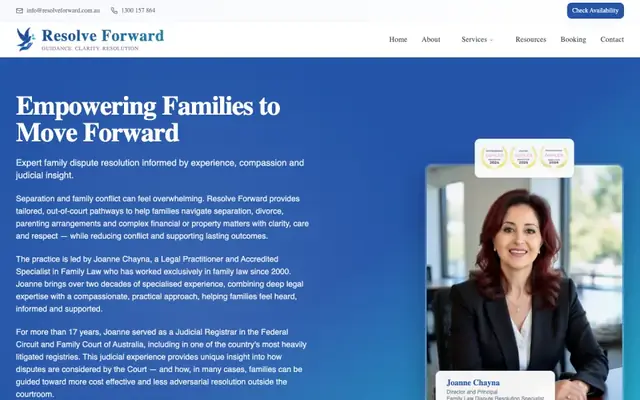
People also tend to look for a trainer close to where they live or work, so someone in Marrickville may search for their suburb rather than the city. If you train in two or three parts of Sydney, a page for each area, naming its parks, gyms and meeting points, gives that person a page about their own neighbourhood. We're an Adelaide team and work with Sydney trainers by phone and email. We haven't built a personal trainer's site yet; our Sydney client Resolve Forward, shown below, sells priced packages with online booking in much the way a trainer sells session packs.