Website Design for Personal Trainers

Websites for studio, mobile, outdoor and online personal trainers that tell a nervous beginner where you train, what a block of sessions costs and how to book the first one, before they ever send you a message.

What a personal trainer's website needs to answer

Picking a trainer is a personal decision. Plenty of the people looking are starting again after years away from exercise, working around an old injury or training for a wedding or a fun run, and they want to feel sure about you before they turn up in their gym gear. Registering with an industry body such as AUSactive isn't a legal requirement, so the website has to carry the reassurance: where you train, what it costs, what you're qualified in and what a session with you is like.

  • Where and how you train, on the first screen

    Your own studio, a gym you contract in, clients' homes, a local park or video sessions: say which, and list the suburbs you'll travel to. If you run sessions outdoors, mention your council permit. Brisbane City Council, Hornsby Shire in Sydney and the City of Onkaparinga in Adelaide's south all require approval before anyone runs paid fitness sessions in their parks and reserves.

  • Session packs and prices people can read

    Set out each option the way you sell it: a single session, a pack of ten, a fortnightly membership, small-group training, an online program. Give the price, how long a pack stays valid and your late-cancellation rule. Western Australia's fitness code covers personal trainers, and it requires a fitness service to make its charges, including the total minimum cost of a membership, publicly available, so nobody has to meet you just to find out the price.

  • One clear first step

    A single button, the same on every page, for whatever your first step is: an intro session, a phone chat or a movement assessment. It can open the app you already take bookings through, such as Mindbody, Acuity or Calendly, or we can build booking and payment into the site itself, quoted per job. A short form beside it suits people who'd rather explain their goal or injury in writing first.

  • Qualifications a client can check

    Name your Certificate IV in Fitness or exercise science degree, any specialist courses, and your current first aid and CPR. If you're registered with AUSactive (formerly Fitness Australia) or Physical Activity Australia, say so. AUSactive publishes a searchable profile for each registered professional, and we can link your name to yours. The Victorian Government's Better Health Channel tells people to check a trainer's qualifications, first aid, registration and insurance before agreeing to anything, so put those where they'll look.

  • Client results, told straight

    Progress photos and client stories persuade more than anything you say about yourself, and they need to be genuine. We use the photos and words your clients have agreed to share, with a caption giving the time frame and what the program involved. Testimonials go up exactly as the client wrote them, and progress photos aren't retouched, so what a reader sees is what actually happened.

  • The people you train best

    A trainer who mostly works with new mums, people over 60, office workers with stiff backs or first-time lifters should say so plainly, with a short section for each group describing how sessions are adapted. The right people recognise themselves, and you hear less often from people wanting something you don't do.

  • An about page with your face on it

    Clients are trusting you with their body and a few hours a week, so the about page matters: a real photo of you, how you came to training and how you coach. A friend with a good phone can take the photo, or you can hire a local photographer; we size and place whatever you send. If you film a short clip explaining a first session, it can sit on the page too.

Our closest work to a personal training site

We haven't built a site for a personal trainer or a gym yet, and we won't present another business as one. Two client sites have the parts a trainer needs most: priced packages that lead into online booking, and a class timetable with an online enrolment form.

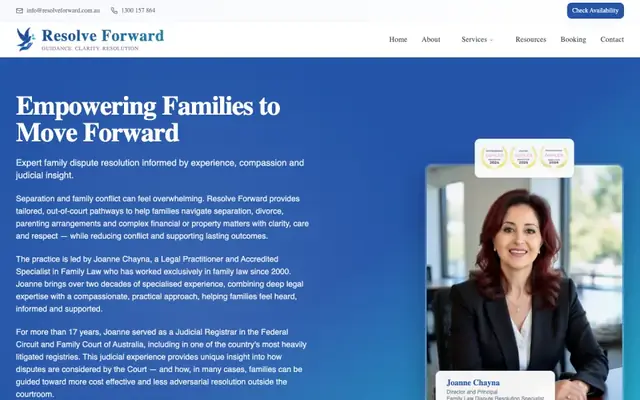
Home page of the Resolve Forward website

Resolve Forward

Professional services · Sydney

A Sydney family law mediation practice that sells its services as priced packages, each linked to online booking, so a client can choose and book without a phone call. A trainer's session packs can work the same way. The five-step intake form is the kind of thing that would carry a pre-exercise health and goals questionnaire.

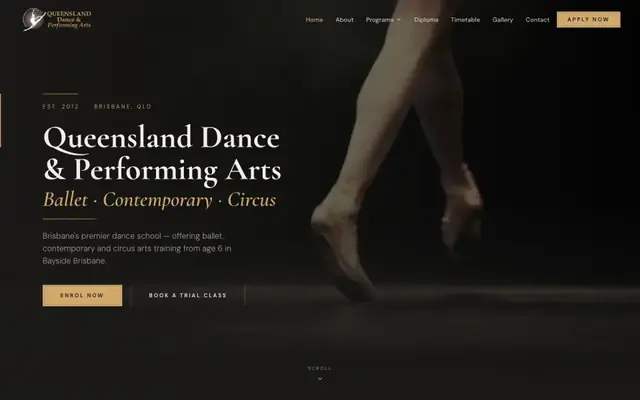
Home page of the Queensland Dance & Performing Arts website

Queensland Dance & Performing Arts

Community, creative & tourism · Thorneside, Brisbane's Bayside

A dance school on Brisbane's Bayside teaching ballet, contemporary and circus arts. Its 12 pages include a weekly class timetable, a page for each program, a filterable photo gallery and an online enrolment form, which is close to what a trainer running bootcamps or small-group classes would want.

“He was incredibly hands-on, always available to answer questions, and made every requested change promptly and without hesitation.”

Resolve Forward, Google review

★ 5.0 from 33 Google reviews (opens in a new tab)

How we set up Resolve Forward's packages and booking page is written up in the case study.

See all 14 recent client sites in our portfolio.

What a personal trainer's website costs

Where we'd start a solo trainer

One page

$399

Where you train, your packs and prices, client stories, qualifications and a booking button, on one scrolling page.

Up to 3 pages

$899

A home page, a packages page with prices and cancellation terms, and an about page covering your qualifications and how you coach.

Up to 8 pages

$1,499

For studios or trainers with several services: pages for one-on-one, small groups, online coaching and each client group, plus results and FAQs.

  • Payment. No deposit. We build your draft first, you ask for as many changes as you like, and you pay once you approve it. If you don't go ahead, you owe nothing.
  • GST. WebCraft Studio isn't registered for GST, so no GST is added.
  • Timing. Most sites are live within 5–10 days of us getting your words and photos; bigger sites (up to 8 pages) take 2–3 weeks.
  • Hosting. After launch, hosting is $30 a month: hosting, security monitoring, backups, email support and unlimited text and image changes on your existing pages. New pages or features are quoted first. No contract, cancel anytime.
  • Domain and email. We register your domain in your name (about $20 a year), connect it to your site and set up your business email.

See full pricing and what each package includes

Questions personal trainers ask us

Can clients book and pay for sessions on the website?

Yes. If you already take bookings through an app such as Mindbody, Acuity or Calendly, every Book button links to it, so your diary stays in one place. If you'd rather have booking and payment built into the website itself, we can do that as well; it's quoted per job, so mention it when you ask for a quote. Our booking websites page explains both options.

Should we put our prices on the site?

We'd suggest it. The Better Health Channel tells people choosing a trainer to ask what it costs, how they can pay, whether larger packages are discounted and what the cancellation policy is, so answering those on the page saves a round of messages. If you train clients in Western Australia, read Consumer Protection's guide to WA's fitness code (opens in a new tab) before you set up memberships; it covers price disclosure, a 7-day cooling-off period and how clients cancel.

Can we tell clients they can claim on their health fund?

Only if it's true for your services. AUSactive says some program-based personal training may be eligible for private health fund rebates under health management programs, for trainers with a Certificate IV in Fitness that wasn't done entirely online, 20 CPD hours a year, current insurance and current first aid and CPR. Check with the funds first, then send us the wording you've confirmed and we'll place it beside the relevant packages.

We train outdoors and travel to clients. How does the site show that?

With a list of the suburbs and parks you cover, a map if it helps, and a line about your council permit if you hold one. If you cover a wide area, the 8-page site has room for a page per area, which gives someone searching for a personal trainer in their suburb a page that matches what they typed.

Which package suits a personal trainer?

A solo trainer with a handful of packs usually fits the one-page site at $399. If you want packages, client results and your story on separate pages, the 3-page site is $899. A studio with several trainers, classes and online coaching suits the 8-page site at $1,499. A site that size takes 2–3 weeks once we have your words and photos.

Ready to put your training packages online?

Send us your packs and prices, your qualifications, a few client stories and your booking link if you have one. We'll quote it, build the draft, and you pay only once you've approved it.

We reply within 24 hours. Prefer email? info@webcraftstudio.com.au