Website Design for Occupational Therapists

Websites for paediatric, adult and mobile OT practices that send a parent and a support coordinator down different paths, take referrals with the details you need to triage them, and say plainly which funding you accept and how long the waitlist is.

What an occupational therapy website needs to do

Occupational therapy spans children's development, disability, hand injuries, mental health and ageing at home, so the first job of an OT website is sorting visitors. A parent worried about their child's handwriting, a support coordinator who needs a functional capacity assessment, someone recovering from a wrist fracture and a daughter asking about rails in her mother's bathroom each need a different page, and most arrive with a funding question.

  • Separate paths for children and adults

    Paediatric services, such as sensory processing, fine motor skills, handwriting and school readiness, get their own page written for parents, with where you see children: the clinic, home, kindy or school. Adult services, such as home modifications, assistive technology, hand therapy, mental health and return to work, get theirs. Each page has its own booking or referral button, so nobody has to read the other half of the practice to find what they came for.

  • An NDIS referral form built for coordinators

    Referrer name, role and organisation; the participant's first name, age and suburb; how the plan is managed and when it ends; what's being asked for, such as an initial assessment, a functional capacity assessment, an assistive technology or home modification report, or ongoing therapy; how urgent it is; and a tick box confirming the participant agreed to the referral. It reaches your inbox in the same order every time, so you can triage it between clients.

  • Registration status, said in one line

    If you're a registered NDIS provider, say so and link to your entry on the NDIS Provider Register. If you're not, say that too. Under the NDIS Commission's rules, participants with NDIA-managed funding can only use registered providers, while self-managed and plan-managed participants can choose unregistered ones. A coordinator shortlisting OTs for an NDIA-managed participant needs that answer before anything else.

  • The other ways clients pay

    Services Australia lists occupational therapists among the allied health professionals who can provide services under a GP chronic condition management plan, which covers up to five individual allied health services a calendar year for most eligible patients, shared across professions. Eligible OTs can also provide Better Access mental health services. My Aged Care lists occupational therapy among the clinical supports in Support at Home, which replaced Home Care Packages in November 2025. A short section for each pathway you take, including DVA, workers' compensation and transport accident schemes, tells clients what to bring and what they'll pay.

  • Waitlists and service areas, kept current

    If you have a waitlist, the site gives a rough wait time, says whether it differs for children and adults, and has a form to join it. Mobile OTs list the suburbs, schools and aged care homes they visit, and note which appointments work by telehealth. If you're listed in Occupational Therapy Australia's Find an OT directory, which filters by area of practice, funding scheme, telehealth and language, keep the details there matching the site. Changing the wait time is a text update covered by the $30 monthly hosting, so it needn't go stale.

  • Bios that stay inside the Ahpra rules

    Occupational therapy is registered through Ahpra, and anyone can check an OT's registration on Ahpra's public register, so each bio uses the name the OT is registered under, which makes them easy to find there. Ahpra says “specialises in” implies specialist registration and suggests wording such as “working primarily in”, which is why a bio reads “works mainly with children under eight”. A credential such as Accredited Hand Therapist from the Australian Hand Therapy Association is named the way the association awards it.

Referral-friendly sites we've built

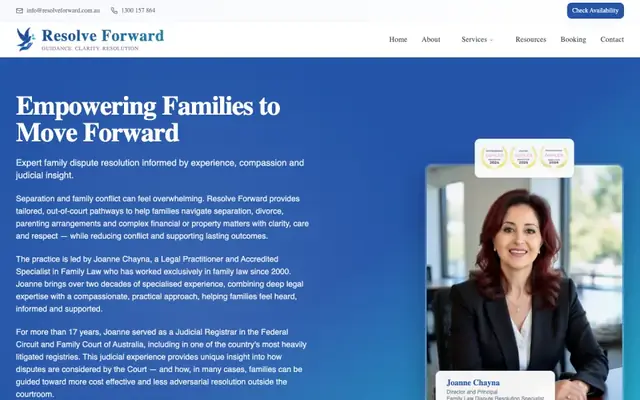
We haven't built a site for an occupational therapy practice, and none of our clients is an Ahpra-registered health service. The two closest projects share the jobs that matter most on an OT site: taking referrals from other professionals, and an intake form that collects details in steps.

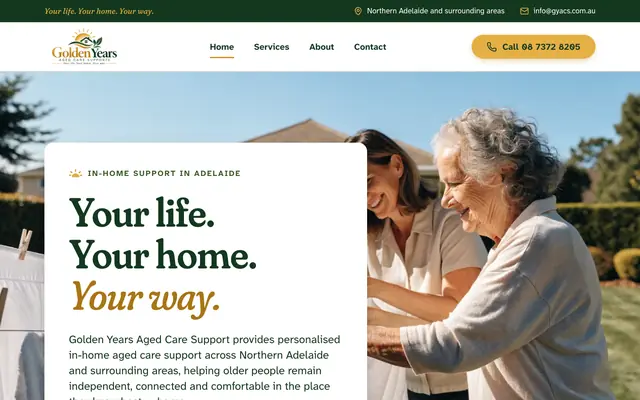
Home page of the Golden Years Aged Care Support website

Golden Years Aged Care Support

Home & care services · Northern Adelaide

In-home support for older people across Northern Adelaide, which is aged care rather than therapy. Its enquiry form gives aged care providers referring a client their own option, the way an OT site separates coordinators from parents, and the six pages use large readable text with tap-to-call on each one.

“My website is exactly how I wanted. I highly recommend Salem for any business wanting a professional website without the bull.”

Johannah Whilding, Google review

What an occupational therapy website costs

One page

$399

A sole or mobile OT: who you see, where you visit, funding and registration status, waitlist details and a referral form, on one page.

Our suggestion for most OT practices

Up to 3 pages

$899

A home page, a services page split into children and adults, and a referrals and funding page covering NDIS, Medicare, aged care and DVA.

Up to 8 pages

$1,499

Separate pages for paediatrics, adult rehabilitation, hand therapy, home modifications and assistive technology, plus the team, referrals and funding, and new clients.

  • Payment. No deposit. We build your draft first, you ask for as many changes as you like, and you pay once you approve it. If you don't go ahead, you owe nothing.
  • GST. WebCraft Studio isn't registered for GST, so no GST is added.
  • Timing. Most sites are live within 5–10 days of us getting your words and photos; bigger sites (up to 8 pages) take 2–3 weeks.
  • Hosting. After launch, hosting is $30 a month: hosting, security monitoring, backups, email support and unlimited text and image changes on your existing pages. New pages or features are quoted first. No contract, cancel anytime.
  • Domain and email. We register your domain in your name (about $20 a year), connect it to your site and set up your business email.

See full pricing and what each package includes

Questions occupational therapists ask us

Can parents and coordinators upload NDIS plans and reports through the form?

We can add file uploads, but think about whether you want them at first contact. The OAIC's guidance is that the Privacy Act covers health service providers regardless of turnover, and an NDIS plan or a paediatrician's report is sensitive health information. One option is to ask only for what you need to make first contact, then collect documents through your practice software's secure intake if it has one. You choose how the form works, and we build it that way.

Can new clients book online, or should they go through intake first?

Either, and you can mix the two. Returning clients can have a Book button that opens Cliniko, Halaxy, Splose or whatever you use. New clients, especially families with funding questions, often suit an enquiry form or a call first, so you can check fit and funding before an assessment goes in the diary. The site makes the difference obvious: Book for existing clients, Enquire or Refer for new ones. If you'd like booking built into the site itself, we quote that per job.

Can we offer a referral template for GPs to download?

Yes, as a blank template. Services Australia says it isn't appropriate for allied health professionals to give a GP or prescribed medical practitioner a partly completed referral for signing, or to pre-empt their decision about which services a patient needs. So the template leaves the patient's details, the clinical information and the choice of services for the GP to fill in. The Services Australia page on chronic condition plans (opens in a new tab) sets out the referral and reporting requirements.

Can we share stories about clients' progress?

Not as testimonials. The National Law doesn't allow testimonials in advertising a regulated health service, and Ahpra defines a testimonial as a recommendation or positive statement about the clinical aspects of that service, on your website or social pages you control. Ahpra says comments about customer service that don't touch on clinical aspects aren't testimonials, so a parent thanking your reception staff for fitting them in is fine; a parent describing their child's progress isn't. Ahpra gives patient stories, patient experiences and success stories as examples of testimonials. Its testimonial guidance (opens in a new tab) works through examples, and the Occupational Therapy Board's advertising page links the full guidelines.

Which package suits an OT practice?

A sole or mobile OT can start with the one-page site at $399. Most practices suit the 3-page site at $899: home, services split into children and adults, and referrals and funding. Practices with paediatric and adult teams, hand therapy or more than one location are better on the 8-page site at $1,499. A site that size takes 2–3 weeks once we have your words and photos.

We're interstate. How does the process work?

By phone and email. Our team is based at Ste 3/110 Hutt St, Adelaide, and works with practices Australia-wide; current clients are in SA, NSW, VIC and QLD. You send your services, funding details, referral questions, words and photos, we build the full draft, and you check it and ask for changes before paying anything.

Ready to start your OT practice's website?

Tell us who you see, how referrals reach you now and which funding you accept. We'll send a quote, and you don't pay until you've approved the full draft.

We reply within 24 hours. Prefer email? info@webcraftstudio.com.au