Website Design for Speech Pathologists

Websites for speech pathology practices and mobile speech pathologists that tell a worried parent, a classroom teacher or an adult relearning to talk after a stroke who you see, how the funding works and how long they might wait.

What a speech pathology website needs to cover

Most enquiries start with someone else noticing something: a kindy teacher who finds a four-year-old hard to understand, a GP who suggests an assessment, a support coordinator with therapy funding in a new NDIS plan, or a family member after a stroke. So the person reading your site is often not the client. They want to know whether you see this kind of difficulty, whether there's a wait, what it costs after any funding, and whether you'll come to the school or the home.

  • The difficulties you work with, in everyday words

    Parents rarely search for “phonological disorder”. They type that their child isn't talking yet, or stutters, or can't be understood by strangers. Group your caseload the way families describe it: late talking, unclear speech, stuttering, language and literacy, social communication, feeding and swallowing, voice, and communication after a stroke or brain injury. Then say which ages you see, including whether you take adults or toddlers.

  • NDIS and Thriving Kids details a coordinator can check

    Speech Pathology Australia reports that the NDIA's Therapy Supports Guideline, which covers participants aged 9 to 65, requires speech pathologists to hold Certified Practising (CPSP) status, provisional included, to deliver NDIS supports. Show each clinician's CPSP status on the team page and say whether the practice is a registered NDIS provider and which plan types you work with. For younger children, say whether you see NDIS early childhood clients and whether you work with families through Thriving Kids, the government program for children aged 8 and under with developmental delay or autism and low to moderate support needs, which started in October 2026.

  • Medicare and other funding, side by side

    Families often combine funding across a year, so set the options out together. Medicare's items for complex neurodevelopmental conditions cover people under 25: up to 20 allied health treatment services in a lifetime, on referral from a paediatrician or psychiatrist. Adults may come with a GP chronic condition management plan, which covers up to 5 individual allied health services a calendar year. Then private health extras and your private fees. A sentence or two each, in your words, with a link to the government page for the rules.

  • School, kindy and home visits

    Many parents would rather a session happen at school than lose half a day of work. List the schools, early learning centres or suburbs you visit and the days you're out, and say that visits need the school's agreement. Screening checks apply too: Victoria's Department of Education lists providing allied health or NDIS support among its examples of child-related work, which needs a valid Working with Children Clearance unless an exemption applies. If every clinician who visits holds a current check for your state, the school visits section can say so.

  • A referral form for whoever notices first

    One form with a “who's referring?” choice: parent, GP or paediatrician, teacher or school, support coordinator, or the adult client themselves. It asks for the client's age and suburb, the main concern, how the therapy will be funded and the best way to reach the family. When a teacher fills it in, a tick box confirms the parent has agreed to the referral.

  • Advertising that fits SPA's policy

    Speech Pathology Australia's advertising policy, revised in 2024, covers members' websites. It rules out testimonials and reviews in advertising you own or control, warns that “client stories” can count as testimonials, and bars terms such as “expert” and “specialist”, business names included. Outcomes have to be stated accurately and in a balanced way, and gifts, discounts or prizes can't be used to drum up therapy nobody needs. So the pages describe what therapy involves, not what it will achieve.

  • Pictures that don't show your clients

    The same policy requires fully informed written consent before a client's photo or video is used, strongly discourages client images even with consent, and suggests limiting how long any stay up, for example twelve months. Its suggested alternatives are therapy rooms and resources, hands working with a resource, staff photos taken with consent, stock images and diagrams. We plan the design around those, so the site never depends on a child's face.
Our closest work to a speech pathology site

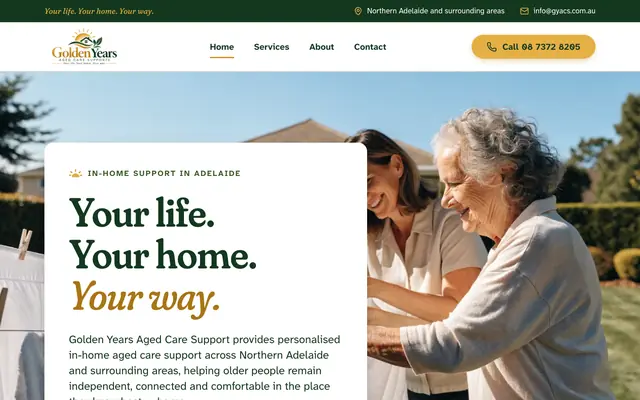
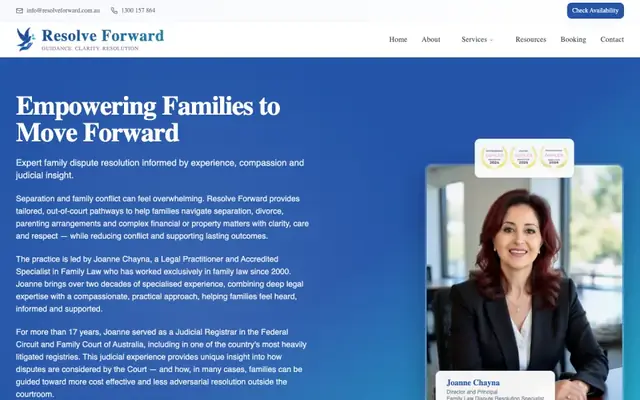
We haven't built a website for a speech pathology practice, and none of our clients is a health practice. Two sites have the parts that matter most here: an in-home support service in Northern Adelaide whose enquiry form takes referrals from other providers, and a Sydney practice with a multi-step intake form and online booking.

Home page of the Golden Years Aged Care Support website

Golden Years Aged Care Support

Home & care services · Northern Adelaide

In-home support for older people across Northern Adelaide, so aged care rather than therapy. Aged care providers referring a client get their own option on the enquiry form, and the six pages use large readable text with tap-to-call on each one. A referral form for GPs, teachers and coordinators follows the same pattern.

Home page of the Resolve Forward website

Resolve Forward

Professional services · Sydney

A family law dispute resolution practice in Sydney. Alongside six service pages and FAQs, it has a five-step intake form and priced packages linked to online booking. A speech pathology intake form can be split into short steps the same way: the client's age, the concern, the school or kindy, and the funding.

“From day one he was very professional and patient when making my website.”

Lucas Gutterres, Google review

What a speech pathology website costs

One page

$399

A sole practitioner or mobile speech pathologist: who you see, funding options, the areas and schools you visit, your waitlist and a referral form, on one page.

Our suggestion for most practices

Up to 3 pages

$899

A home page, a services page grouped by age and difficulty with the funding details, and a team and referrals page showing each clinician's CPSP status.

Up to 8 pages

$1,499

Larger practices: separate pages for early childhood, school-age children, adults, NDIS, school visits and telepractice, plus the team, fees and referrals.

  • Payment. No deposit. We build your draft first, you ask for as many changes as you like, and you pay once you approve it. If you don't go ahead, you owe nothing.
  • GST. WebCraft Studio isn't registered for GST, so no GST is added.
  • Timing. Most sites are live within 5–10 days of us getting your words and photos; bigger sites (up to 8 pages) take 2–3 weeks.
  • Hosting. After launch, hosting is $30 a month: hosting, security monitoring, backups, email support and unlimited text and image changes on your existing pages. New pages or features are quoted first. No contract, cancel anytime.
  • Domain and email. We register your domain in your name (about $20 a year), connect it to your site and set up your business email.

See full pricing and what each package includes

Questions speech pathologists ask us

Can we put parent feedback or reviews on the website?

Not if you're a member of Speech Pathology Australia. Its advertising policy says advertising you own, operate or control must not use testimonials or reviews, and that client stories may count as testimonials too. Comments people post on a site you don't own, operate or control, such as a health directory, sit outside the policy, but copying them onto your own website brings them back under it. Read SPA's advertising policy (opens in a new tab) before deciding what goes up.

Should families book online, or enquire first?

Usually both, depending on who's booking. A new family often needs a call or an intake form first, because you'll want the child's age, the concern and the funding before offering a time. Existing clients can book or reschedule through the online booking in your practice software, such as Cliniko or Splose. If you'd rather have booking and payment built into the site itself, we can do that too; it's quoted per job.

How much should the site say about NDIS and Medicare?

Enough for a family to work out which route might apply and what to ask their GP or coordinator. For Medicare, that's a few lines on the complex neurodevelopmental condition items, where reaching the full 20 treatment services takes two referrals of up to 10, and on GP chronic condition plans for adults, linked to the Department of Health's fact sheet (opens in a new tab). For the NDIS, say whether you're registered, since participants whose funding is NDIA-managed can only use registered providers. Thriving Kids supports are rolling out until 1 January 2028, when changes to NDIS access take effect, so expect to update this section; changing text on an existing page is covered by hosting. You confirm the wording; we set it out.

Can we use “speech therapist” on the site as well?

Yes. The Victorian Government's Better Health Channel describes speech pathologists as also known as speech therapists, and people may search with either term, so using both helps the site match what they type. Speech pathology isn't one of the professions registered through Ahpra, so families can't look a speech pathologist up on Ahpra's register, which is one more reason to show each clinician's qualification and CPSP status. SPA's policy still rules out “specialist” and “expert”, including in the practice name.

Which package suits a speech pathology practice?

A sole practitioner, including a mobile speech pathologist visiting schools and homes, can start with the one-page site at $399. Most practices suit the 3-page site at $899 because it gives funding and referrals room of their own. Practices with child and adult caseloads, several clinicians or telepractice clients are better on the 8-page site at $1,499; a site that size takes 2–3 weeks once we have your words and photos.

Ready to start your speech pathology website?

Send us the ages and difficulties you work with, the funding you accept, the areas and schools you visit and where your waitlist stands. We'll quote it, build the draft, and you pay only once you've approved it.

We reply within 24 hours. Prefer email? info@webcraftstudio.com.au