Registration with the Aged Care Quality and Safety Commission, the Support at Home pricing rules and published room prices are national, and our Sydney aged care page and main aged care page go through them. Screening is where South Australia differs: alongside the national options of a police certificate or an NDIS worker screening clearance, the Commonwealth's March 2026 screening guidance names the Aged Care Sector Employment Check, issued by the state's Department of Human Services, for people delivering funded aged care here. An Adelaide team can hold all three between them, which is why we'd rather list each by name than write “screened staff”. The NDIS Worker Check itself is explained on our Adelaide NDIS provider page.
Councils deliver less home support here than they once did. From 1 July 2025 the City of Adelaide stopped acting as a service broker for the Commonwealth Home Support Programme, and in late January 2026 the City of Unley announced that its involvement in CHSP was scheduled to end on 30 June 2026, with council staff working with the federal government, other aged care providers and active clients on the handover. The program itself is staying: in August 2026 the federal government extended CHSP grant funding by two years, to 30 June 2029, and said it would consult on the future of entry-level care. A provider taking CHSP clients in the city or the inner south can say so plainly, with how someone already assessed starts with you, without implying a council or the department picked you unless one did.
Some councils have moved the other way, into helping people find care. The City of Salisbury's care finder service covers Salisbury and Playford, with a focus on people who are homeless or at risk of homelessness and on culturally and linguistically diverse communities, and the City of Onkaparinga's covers its own council area. Resthaven, Anglicare SA, COTA SA and Community Transitions work across most of the metropolitan area, while the Hutt Street Centre and the Adelaide Day Centre for Homeless Persons help older people in and around the city who are homeless or at risk of homelessness. Care finders are for older people who are eligible for government-funded aged care, need intensive help to reach it and have no carer or support person they can rely on. Listing your coverage by council name, the way these services list theirs, lets a care finder match you to a client at a glance.
A feedback and complaints page for a South Australian provider has local contacts to add beside your own process and the Commission. The Aged Rights Advocacy Service (opens in a new tab) (ARAS) in Dulwich has supported older South Australians since 1990, is the state's member of the Older Persons Advocacy Network and helps with Support at Home, residential care and retirement village matters; it lists the national Aged Care Advocacy Line, 1800 700 600, alongside its own number. The Adult Safeguarding Unit, part of the state's Office for Ageing Well, takes reports of actual or suspected abuse of adults who may be vulnerable to it, including elder abuse, on 1800 372 310; in an emergency the number is 000. South Australia's Health and Community Services Complaints Commissioner also handles complaints about health and community services, nursing homes among them, when going to the provider directly hasn't worked, as our Adelaide allied health page sets out.
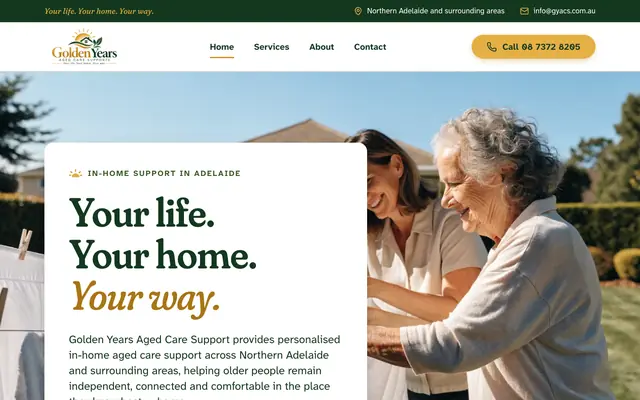
Our studio is at Ste 3/110 Hutt St in the city. Most projects run by phone and email, which suits managers and coordinators who are on the road between clients for much of the day, and an Adelaide provider who'd prefer to sit down first can arrange a meeting. Golden Years Aged Care Support, our one aged care client, works across Northern Adelaide, so a site for in-home support in the north, with a separate route for referrals from other providers, is one we've already built.