Website Design for Solar Installers in Melbourne

Websites for Melbourne solar retailers and installers that keep up with Victoria's moving parts: who still qualifies for a Solar Homes rebate under the lower income cap, what happens when Solar Victoria's panel support moves across to the Victorian Energy Upgrades program in July 2027, and whether a Kew or Hawthorn owner needs a permit for panels the street can see.

What Melbourne solar buyers check before they call

Victorian households have been through more than half a million Solar Victoria rebates and loans since 2018, so a lot of the people reading your site already know the vocabulary. They want to see whether you're on the authorised list, whether their income and address still qualify, and whether you've dealt with their network and their council before. Most of that fits on three or four well-labelled pages.

  • Authorised retailer status, stated and linked

    Every Solar Homes rebate has to go through a Solar Victoria authorised retailer, and the retailer only stays authorised while it holds New Energy Tech Approved Seller status. Buyers who check will look for the business name you're authorised under, so the site should use that same name, show your Approved Seller status beside it, and explain how the rebate application and QR code step work when they buy from you.

  • An eligibility section written for this year's rules

    Since 1 July 2026 the panel rebate's income cap has been a combined household taxable income under $150,000 (down from $210,000), and the property also has to be worth less than $3 million and have had no solar installed in the past ten years. Since 1 May 2026 the optional interest-free loan has to be chosen at application. A short checklist in your own words, linking to Solar Victoria for the detail, saves you quoting for people who won't qualify and points the rest towards the steps they'll need.

  • A note on what changes in July 2027

    Solar Victoria says residential solar panel support moves to the Victorian Energy Upgrades program on 1 July 2027, and households can apply for the remaining Solar Homes rebates until then. The rules for the new version haven't been published. A dated paragraph that says so, rather than guessing at the new discount, keeps your site honest through the changeover and is easy for us to rewrite once the details are out.

  • Network pages that mention flexible exports

    Melbourne is split between CitiPower, Jemena, Powercor, United Energy and AusNet Services, and some streets now get a very low or zero export limit at pre-approval. Powercor offers customers given a 0 kW limit a flexible exports connection instead, letting the system export up to 10 kW when the network has room; AusNet offers its own version to customers who would otherwise be held to 1.5 kW per phase. If you install those connections, say which networks and which inverters, because that's what a buyer with a zero-export letter is searching for.

  • A quote form that collects pre-approval details

    Your distributor's pre-approval sets the export limit for the address, and Solar Victoria expects the system to be online at commissioning where that's practical. The form asks for the address and NMI from a recent bill, single or three-phase supply, whether there's Wi-Fi near the switchboard, whether the household plans to apply for a rebate, and photos of the roof and meter box, so you can lodge pre-approval before the first visit.

  • Hot water alongside panels

    From 1 March 2027, gas hot water systems that reach the end of their life in existing Victorian homes have to be replaced with an electric option, and Solar Homes hot water rebates continue in 2026–27, with a higher amount for locally made products. If you install heat pumps, a page pairing them with daytime solar generation answers a question many Melbourne households will be asking in the next year.

Solar in Melbourne: the state program, networks, apartments and heritage overlays

The licensing side is the same for solar as for any electrical contracting in Victoria: the business needs to be a Registered Electrical Contractor with its REC number on its advertising, and a solar system or battery is prescribed work that a Licensed Electrical Inspector checks before it's switched on. Our Melbourne electricians page covers those rules and the emergency backstop that has applied to new systems since October 2024, and our solar installers page covers SAA accreditation and the federal battery discount. For rebate jobs, Solar Victoria's 2026–27 rules add their own list: installers with current SAA grid-connect accreditation and an A Grade Victorian licence, inverters on both the CEC and Solar Victoria lists that support CSIP-AUS, and a whole-of-system warranty of at least five years from the retailer.

The way you find customers is regulated too. Under the Solar Homes rules, retailers and anyone working for them can't sell eligible systems door to door (banned since September 2021) or by cold-call telemarketing (banned since May 2024), and that includes outsourcing those calls to a marketing company. Calls are allowed only when a consumer has asked for one. For a Melbourne solar business, that makes the website and the enquiry form the front door. Batteries are now mostly a federal story: Solar Victoria closed its interest-free battery loans in May 2025 after passing its target, and says the Commonwealth's Cheaper Home Batteries Program carries that support on. A battery page should say so, rather than mention a Victorian battery offer that has closed.

Melbourne's apartment market gets its own program. Solar for Apartments pays a per-apartment rebate, capped at $140,000 a building, to tier three and tier four owners corporations under the Owners Corporations Act 2006 with a shared common-property roof, generally up to eight storeys, for systems that supply 5 to 50 residential lots. Solar Victoria's page lists applications as open until 30 June 2027 or until the rebates run out, and says changes announced in September 2026 will remove the property value cap and widen eligibility for larger buildings. The authorised retailer has to get the network's pre-approval and tell the owners corporation about any export limits before submitting the quote, and once approved the system must be installed within 120 days. A page aimed at committee members and strata managers, saying which building sizes you handle and how you work with the owners corporation's meeting timetable, is something few residential installers bother to write.

Then there are heritage overlays, which cover large parts of inner and eastern Melbourne. Under the Victoria Planning Provisions, panels on a Heritage Overlay property don't need a planning permit if they can't be seen from a street (other than a lane) or a public park; visible panels do, and councils such as Stonnington put those applications through VicSmart, which Stonnington says usually takes ten working days once an application is complete. Stonnington lists what it wants: a current title, a site plan, elevations, street photos and panel dimensions, colours and fixings. Places on the Victorian Heritage Register need a permit or exemption from Heritage Victoria instead. The rule came under review in 2026: in July, Boroondara councillors, whose area takes in about 14,800 heritage overlay properties in Kew, Hawthorn, Canterbury and Camberwell, voted to seek a change removing the permit for visible panels, and a notice of rescission was lodged after the meeting. We'd word your heritage section so it sends owners to their council for the current position.

Melbourne households will also be asking about the Victorian Midday Power Saver, which since 1 October 2026 has given opted-in customers with a smart meter free electricity from 11 am to 2 pm through their retailer. It changes the conversation about batteries and timers, so a short, dated explanation on your batteries page, pointing to the government's page, helps. WebCraft Studio is an Adelaide team, and our Victorian clients, including a Melbourne coaching practice, work with us by phone and email.

Client sites with the parts a Melbourne solar site needs

We haven't built a site for a solar or battery company yet. These three show the pieces instead: an upload form that shows a price range, a large trade site with guides and service-area pages, and one of our Melbourne clients.

Home page of the Simple Engineers website

Simple Engineers

Professional services · Adelaide

Adelaide structural engineers. Their quote form gives an indicative fee range and accepts attachments, which on a solar site would take a bill showing the NMI, the network's pre-approval letter or meter box photos. Four service pages and 16 articles sit behind it.

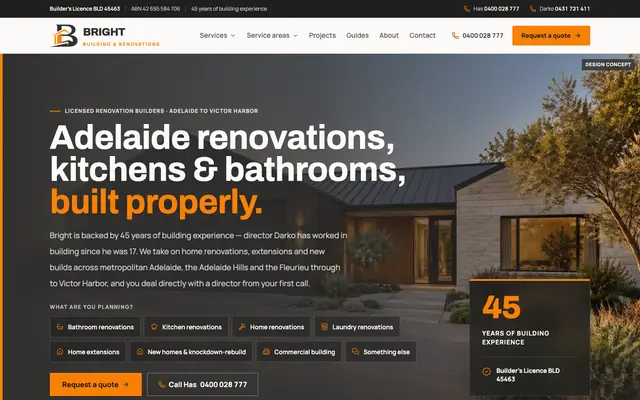
Home page of the Bright Building & Renovations website

Bright Building & Renovations

Trades & construction · Adelaide, Adelaide Hills & Fleurieu

A licensed South Australian renovation builder with a 30-page site: seven service pages, seven service-area pages, five planning guides and a seven-step quote form. Guides like those suit a Melbourne installer explaining flexible exports, apartment rebates or heat pump hot water.

“He listened to my feedback and made no hesitations to revise and adjust my website until we were completely happy with it.”

Tony Bleijswijk, Google review

★ 5.0 from 33 Google reviews (opens in a new tab)

Want numbers from a trade site? Western Sydney Stump Grinding has landed at least 62 jobs, about $46,500 of work, from a single-page site we built. Read the case study.

See all 14 recent client sites in our portfolio.

What a solar installer's website costs in Melbourne

One page

$399

For an electrician who fits solar on the side: your REC number, SAA accreditation, authorised retailer status, the suburbs you cover and a quote form asking about the NMI, phase and Wi-Fi.

Room for rebates and batteries

Up to 3 pages

$899

A home page, a page on Solar Homes eligibility and the 2027 changeover, and a batteries page covering the federal discount, flexible exports and midday pricing.

Up to 8 pages

$1,499

Separate pages for panels, batteries, heat pump hot water, apartment buildings, heritage-overlay homes, commercial roofs and servicing, plus an about page naming your installers.

  • Payment. No deposit. We build your draft first, you ask for as many changes as you like, and you pay once you approve it. If you don't go ahead, you owe nothing.
  • GST. WebCraft Studio isn't registered for GST, so no GST is added.
  • Timing. Most sites are live within 5–10 days of us getting your words and photos; bigger sites (up to 8 pages) take 2–3 weeks.
  • Hosting. After launch, hosting is $30 a month: hosting, security monitoring, backups, email support and unlimited text and image changes on your existing pages. New pages or features are quoted first. No contract, cancel anytime.
  • Domain and email. We register your domain in your name (about $20 a year), connect it to your site and set up your business email.

See full pricing and what each package includes

Questions from Melbourne solar businesses

How should our site handle the move from Solar Homes to the VEU program?

Say what's confirmed and nothing more: Solar Victoria says panel support moves to the Victorian Energy Upgrades program on 1 July 2027, and eligible households can apply for the remaining Solar Homes rebates until then. Date the paragraph and link to Solar Victoria's panel rebate page (opens in a new tab). When the new rules come out, send us your wording; text changes on existing pages are part of the $30 monthly hosting.

Can we advertise that we'll call people back about solar?

Yes, when they've asked for it. Solar Homes retailers can't cold-call or door-knock for eligible systems, but a customer who fills in your form and asks for a call has given permission. We label the form's call-back option clearly and keep a record of the request in the email you receive.

Is it worth a page for owners corporations?

If you're an authorised retailer that quotes on shared roofs, yes. Solar for Apartments is lodged by the owners corporation, not individual residents, so the reader is a committee member or strata manager. Tell them which building sizes and system types you handle, what you need for a quote (roof access, the plan of subdivision, any embedded network) and how the network pre-approval affects the timeline. We'd link to Solar Victoria for eligibility rather than restate it.

What should we say about heritage overlays?

That panels hidden from the street often need no permit, that visible ones usually do, and that the owner's council confirms which applies to their house. If you prepare the site plan, elevations and photos for VicSmart applications, say so and show a couple of finished heritage-area roofs from photos you send us. With the rules under review in Boroondara in 2026, we'd avoid printing a firm answer.

You're in Adelaide. How does that work for a Melbourne installer?

We're a web design team at Ste 3/110 Hutt St, Adelaide, working with businesses Australia-wide by phone and email, and our current clients are in SA, NSW, VIC and QLD. You send your REC number, SAA details, product list, suburbs and photos; we build the draft and send a link to check on your phone. We reply within 24 hours, and you pay once you've approved the site.

Ready to start your Melbourne solar website?

Send us your REC number, your installers' SAA accreditation, your Solar Victoria authorised retailer details, the networks and suburbs you cover and a few photos of finished roofs. We'll quote first and build the draft before you pay anything.

We reply within 24 hours. Prefer email? info@webcraftstudio.com.au