Website Design for Solar and Battery Installers

Websites for solar retailers and installers that tell a homeowner who will actually do the install, which accreditations sit behind the quote, and what the federal battery discount depends on, before they compare you with three other quotes.

What a solar installer's website needs to cover

Solar buyers do their homework. A typical one has last quarter's power bill on the table and a couple of competing quotes open, and is trying to work out three things: whether your company does the installation itself, whether you'll still be answering the phone when a warranty claim comes up, and whether the battery discount they read about applies to their house.

  • Accreditation named as it stands today

    Accreditation for installers and designers of small-scale solar moved from the Clean Energy Council to Solar Accreditation Australia (SAA) in 2024, and a battery claiming the federal discount has to be installed by an SAA installer with a battery endorsement. If your current site still says “CEC accredited installer”, it's out of date. We name the accreditation your installers hold, and say whether they're employees or subcontractors, because buyers ask.

  • Approved Seller status, if you have it

    The New Energy Tech Consumer Code replaced the Clean Energy Council's Approved Solar Retailer program in 2023, and the Clean Energy Council administers it. If you've signed up and hold NET Approved Seller status, the site says so in plain words and links to the code, so a buyer can read what they're protected by. In Victoria it matters more: Solar Victoria only keeps retailers authorised for its rebates while they hold that status.

  • Electrical licence details where the law wants them

    The business contracting for the install needs an electrical contractor licence in its state, and some states spell out what advertising must show. In NSW, electrical wiring is specialist work and the licensee's name and licence number must appear in all advertising. Queensland's Electrical Safety Regulation 2026 asks for the licensed or registered business name, a statement that you're licensed under the Act, and the contractor licence number. Those details go in the footer of each page.

  • A battery page that won't go stale

    Since 1 July 2025, batteries installed by an SAA installer with a battery endorsement can earn small-scale technology certificates under the Cheaper Home Batteries Program, which the Clean Energy Regulator says works out at around a 30% discount on upfront cost. The battery has to be on the Clean Energy Council's approved list, certificates are worked out on usable capacity at a lower rate above 14 kWh, and the certificate factor steps down at set points out to 2030. So we date any figure on the page and link to the regulator rather than fixing a number that will be wrong in a few months.

  • A quote form built around the power bill

    The form asks for the postcode, roof material and how many storeys, single or three-phase power (with a “not sure” option), whether they want panels, a battery or both, and lets them upload a recent bill plus photos of the roof and switchboard. You can size a system before the site visit, and spot early the enquiries you can't help with, like a renter without the landlord's say-so.

  • Products and warranties listed by name

    Buyers compare brands and models, so each system you sell lists the panel, inverter and battery you'd normally fit, who holds each product warranty, and your own workmanship warranty and how long it runs. When you change suppliers, send us the new models and we update the page.

  • A page for people who already own a system

    Inverter faults, panel cleaning, system health checks and adding a battery to existing panels are jobs people search for separately from new installs. A servicing page gives owners of older systems, including ones you didn't install, a reason to contact you.

The closest examples from our client work

We haven't built a site for a solar or battery company yet, so there's no solar job in our portfolio to show you. The two sites below have the parts a solar site borrows: a quote form that takes uploads and shows a fee range, and a long multi-step form backed by service-area pages and planning guides.

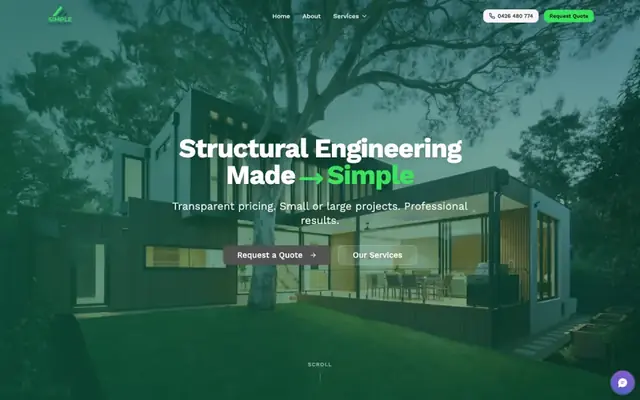
Home page of the Simple Engineers website

Simple Engineers

Professional services · Adelaide

Adelaide structural engineers, not a solar business. Their quote form shows an estimated fee range and accepts file uploads, the same mechanics a solar form needs for a power bill and roof photos. The site also has four service pages and 16 articles.

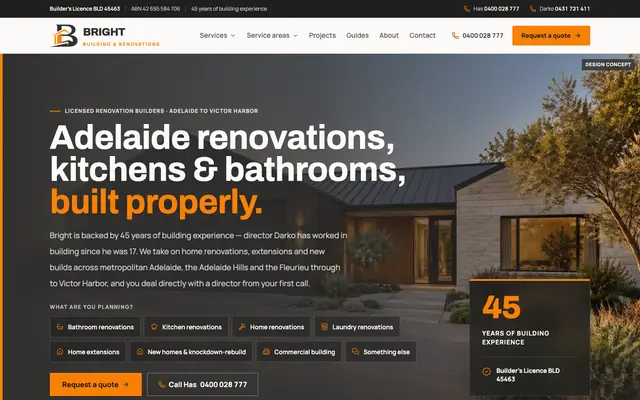
Home page of the Bright Building & Renovations website

Bright Building & Renovations

Trades & construction · Adelaide, Adelaide Hills & Fleurieu

A licensed South Australian renovation builder. The 30-page site has seven service pages, seven service-area pages, five planning guides and a seven-step quote form. Guides like those are where a solar company can explain batteries, export limits or system sizing at length.

“…Salem walked us through everything, gave us a fixed quote so we knew exactly what we were paying, and turned around the build faster than we thought possible.”

SA Tiling Pro Pty Ltd, Google review

What a solar installer's website costs

One page

$399

An electrician who installs solar alongside other work: the systems you fit, accreditation and licence details, the regions you cover and a quote form that takes a power bill.

Our suggestion for most installers

Up to 3 pages

$899

A home page, a solar and batteries page with the federal discount explained and dated, and an about page naming your installers, accreditations and warranties.

Up to 8 pages

$1,499

Separate pages for residential solar, batteries, EV chargers, commercial systems and servicing, plus about, questions and quote pages.

  • Payment. No deposit. We build your draft first, you ask for as many changes as you like, and you pay once you approve it. If you don't go ahead, you owe nothing.
  • GST. WebCraft Studio isn't registered for GST, so no GST is added.
  • Timing. Most sites are live within 5–10 days of us getting your words and photos; bigger sites (up to 8 pages) take 2–3 weeks.
  • Hosting. After launch, hosting is $30 a month: hosting, security monitoring, backups, email support and unlimited text and image changes on your existing pages. New pages or features are quoted first. No contract, cancel anytime.
  • Domain and email. We register your domain in your name (about $20 a year), connect it to your site and set up your business email.

See full pricing and what each package includes

Questions solar businesses ask us

We used to be CEC accredited. What should the site say now?

The accreditation your installers hold today. The Clean Energy Regulator approved Solar Accreditation Australia as the accreditation scheme operator on 29 February 2024, and accredited installers and designers had three months to transfer to keep creating small-scale technology certificates. The Clean Energy Council still keeps the approved product lists and administers the New Energy Tech Consumer Code, so references to those can stay where they're accurate.

Can the site have a rebate or savings calculator?

We can build a quote form that shows an indicative price range you set, as Simple Engineers' form does for engineering fees, and it's quoted with the rest of the site. We'd steer you away from a calculator that promises a rebate or a bill saving. The battery certificate factor changes on a published schedule and depends on usable capacity, and a figure that's out of date or doesn't fit the customer's roof and usage is hard to stand behind. A dated paragraph linking to the Clean Energy Regulator's battery page (opens in a new tab) is easier to keep right.

Should we publish package prices?

If your pricing is steady enough, it helps buyers short-list you. Each package should say what's included (panel and inverter models, a standard install), what usually costs extra (a steep or tiled roof, a switchboard upgrade, three-phase work), and whether the certificate discount has already been taken off. When prices change, send us the new figures: text changes on existing pages are covered by the $30 monthly hosting.

We're a Solar Victoria authorised retailer. What should the site say?

That you're authorised, and that buyers who want a Solar Homes rebate or loan have to go through an authorised retailer. Solar Victoria's 2026–27 Notice to Market keeps NET Approved Seller status as a condition and bans door-to-door and cold-call telemarketing sales of systems under the program, so a site that answers questions and takes enquiries is the right channel. We link to Solar Victoria for eligibility, because rules such as the household income limit can change with each year's notice.

Which package suits a solar company?

An electrician who does some solar can start with the one-page site at $399. Most solar retailers are better on the 3-page site at $899 because batteries and your accreditations get room of their own. If you also sell EV chargers or commercial systems, or want a servicing page, the 8-page site at $1,499 fits; a site that size is live 2–3 weeks after we have your words and photos.

Do you work with installers outside South Australia?

Yes. We're a web design team at Ste 3/110 Hutt St, Adelaide, and everything with interstate clients runs by phone and email. Our current clients are in SA, NSW, VIC and QLD. You send your licence and accreditation details, product list and service regions, and we send back a link to the draft.

Ready to start your solar company's website?

Send us your accreditation and licence details, the systems and brands you install and the regions you cover. We'll quote the site and build the draft, and you pay only after you've approved it.

We reply within 24 hours. Prefer email? info@webcraftstudio.com.au