Website Design for Solar Installers in Adelaide

Websites for South Australian solar and battery businesses, built by a team in Adelaide. About half of South Australian homes had rooftop solar by late 2025, so many of your buyers have heard of an export limit and a remote switch-off. What they want from your site is how Flexible Exports, the Relevant Agent and a battery on an older system work at their own address.

What an Adelaide solar site should cover

In South Australia the first-time buyer is no longer the typical reader. More often it's a household in Modbury Heights with a 2012 system and an old inverter, a family in Mount Barker asking whether a battery is worth it under the federal discount, or a farm on a rural line that was stuck at 5 kW. Each of them needs a different page, and none of them needs a stock photo of a sunrise.

  • Flexible Exports compared with a fixed limit

    SA Power Networks offers Flexible Exports as a standard connection option across the state for new and upgraded systems. The export limit moves with network conditions, up to 10 kW per phase when there's room, and drops to a lower bound (1.5 kW at most sites, 0 kW on SWER lines and low-capacity sites) if the inverter goes offline. Customers who don't opt in choose a fixed limit instead, 1.5 kW or 0 kW depending on the area. Set the two side by side in a short table, and say which inverters and gateways you fit for each option.

  • The Relevant Agent, explained without jargon

    Every system installed since 28 September 2020 has to be able to be switched off and back on remotely by a Relevant Agent the customer appoints. Buyers hear “remote disconnection” and worry. A plain paragraph saying who the agent is for the brands you install, why the rule exists, and that it's recorded on the certificate of compliance turns that worry into a question you've already answered.

  • A page for adding a battery to existing panels

    With so many roofs already covered, a lot of your Adelaide work is storage added to a system that's years old. That reader wants to know whether their inverter can stay, whether the upgrade changes their export arrangement, and what you check on the switchboard. We'd give it its own page, written in your words, and link it from the home page.

  • Virtual power plants, named honestly

    South Australians have been hearing about VPPs for years: the state government backs the Tesla and Energy Locals virtual power plant, planned as a network of potentially 50,000 homes with solar and Powerwall batteries. ESCOSA lists VPPs among the residential activities under the Retailer Energy Productivity Scheme, while making clear that REPS doesn't pay solar or battery rebates. If your batteries can join a VPP, name the programs you've set customers up with and link to the provider for the terms.

  • A quote form built around the Portal application

    SA Power Networks approves small systems (inverters up to 30 kVA in total) through its online Portal before the install, and it asks for the NMI, the meter number and the system details. Your form asks for those from a recent bill, plus single or three-phase supply, whether there's reliable Wi-Fi near the inverter spot, and photos of the roof and meter box.

  • Commercial roofs, with a note on 2027

    From 1 October 2026 the federal small-scale scheme covers eligible solar systems up to 1 MW, and SA Power Networks says a Flexible Exports option for medium systems is planned for early 2027. If you quote on factory or shopping-centre roofs, a dated page saying what's confirmed and what's still coming suits the business owner reading it.

Solar in Adelaide: one network, tight rules and a crowded market

The licence side is shared with all electrical work in South Australia. The business contracting for the install needs a CBS electrical contractor licence and has to show its licence number in public advertising, a website included, and the work is certified with an electronic certificate of compliance. Our Adelaide electricians page goes through those rules, and our solar installers page covers SAA accreditation, Approved Seller status and the federal battery discount.

What's different here is how far the state has gone. In September 2025 the head of SA Power Networks said half of South Australian households had rooftop solar, with about 100 home batteries a day going in under the federal rebate. On mild, sunny days with little demand, the network can have more solar than it can safely carry. SA Power Networks says that if the market operator directs it, it would switch off large solar and wind farms first, then large commercial systems, then household exports through the Relevant Agent and dynamic export functions, and only after that any remaining rooftop systems. It describes this as rare and a last resort. Because buyers read about it in the news, a battery page that explains it calmly, and says what happens to their own use of power, earns trust.

Every metropolitan roof, from Gawler and Playford in the north to Onkaparinga in the south and the Adelaide Hills to the east, sits on the one distribution network. That keeps a site simple: one set of connection rules and one Portal to explain, instead of the network-by-network pages a Melbourne or Sydney installer needs. The variation is in the export limit each address gets. SA Power Networks' Service Performance Checker shows past flexible limits at an address, and it warns that these aren't a reliable guide to the future. Point buyers to it with that caveat, rather than printing a typical export figure.

Further out the rules change. Rural customers on single wire earth return (SWER) lines can now have up to 10 kW of solar and 10 kW of battery each, up from the 5 kW they were historically held to, under SA Power Networks' Flexible Exports offer. Some SWER areas are still limited, and some customers can't export at all. If you work in the Barossa, the Fleurieu or the Murraylands, a short page for SWER properties tells farmers and lifestyle-block owners you know the difference.

WebCraft Studio is an Adelaide team at Ste 3/110 Hutt St. We haven't built a site for a solar company yet, so the examples below are South Australian businesses whose sites have the same moving parts. Projects run by phone and email, which suits installers who spend the day on roofs, and if you'd rather meet first in Adelaide, that can be arranged.
South Australian sites with what a solar site needs

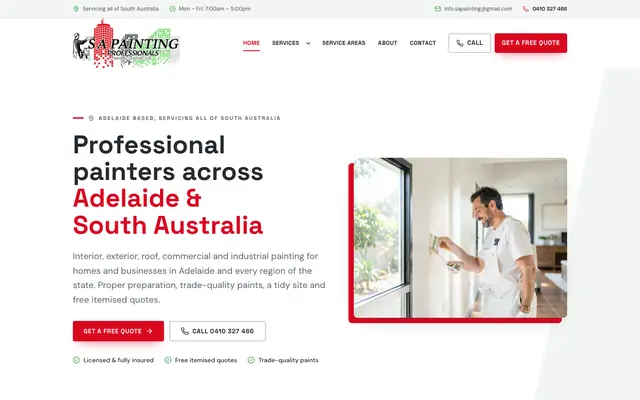
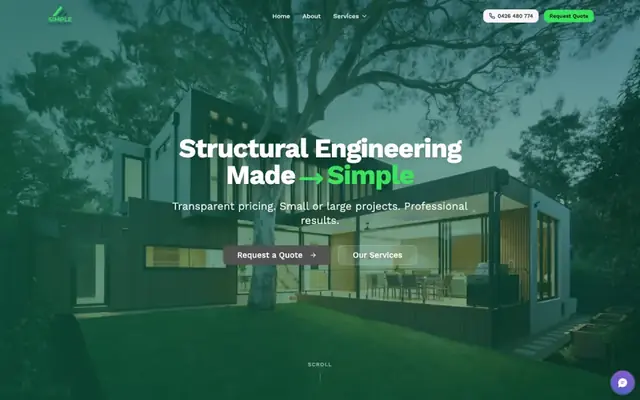
Three Adelaide clients: a quote form that takes file uploads, a large trade site with guides and service-area pages, and a site that searches suburbs and postcodes across the state.

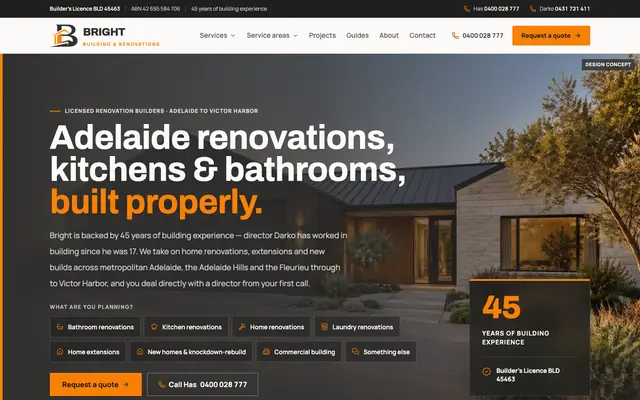
Home page of the Bright Building & Renovations website

Bright Building & Renovations

Trades & construction · Adelaide, Adelaide Hills & Fleurieu

An Adelaide, Hills and Fleurieu renovation builder with 30 pages, including five planning guides and seven service-area pages. Guides like those suit explanations of Flexible Exports, Relevant Agents or adding a battery to older panels.

“From day one he was very professional and patient when making my website.”

Lucas Gutterres, Google review

★ 5.0 from 33 Google reviews (opens in a new tab)

Want numbers from a trade site? Western Sydney Stump Grinding has landed at least 62 jobs, about $46,500 of work, from a single-page site we built. Read the case study.

See all 14 recent client sites in our portfolio.

What a solar installer's website costs in Adelaide

One page

$399

For an electrician who does some solar: your licence number, SAA accreditation, the areas you cover, a short Flexible Exports explainer and a quote form asking for the NMI and phase.

Room for exports and batteries

Up to 3 pages

$899

A home page, a page on Flexible Exports and the Relevant Agent, and a batteries page covering add-ons to older systems, the federal discount and VPPs.

Up to 8 pages

$1,499

A home page, then separate pages for panels, batteries, battery add-ons, SWER properties, commercial roofs, servicing and inverter replacement, plus an about page naming your installers.

  • Payment. No deposit. We build your draft first, you ask for as many changes as you like, and you pay once you approve it. If you don't go ahead, you owe nothing.
  • GST. WebCraft Studio isn't registered for GST, so no GST is added.
  • Timing. Most sites are live within 5–10 days of us getting your words and photos; bigger sites (up to 8 pages) take 2–3 weeks.
  • Hosting. After launch, hosting is $30 a month: hosting, security monitoring, backups, email support and unlimited text and image changes on your existing pages. New pages or features are quoted first. No contract, cancel anytime.
  • Domain and email. We register your domain in your name (about $20 a year), connect it to your site and set up your business email.

See full pricing and what each package includes

Questions from Adelaide solar businesses

Should our site quote an export figure for Flexible Exports?

We'd avoid one. SA Power Networks says the limit can reach 10 kW per phase when capacity allows, but some sites never get there and some can't export at all. Explain the range, the fall-back to 1.5 kW (or 0 kW on SWER lines) when the inverter drops offline, and link to SA Power Networks' solar page (opens in a new tab) for the detail.

How do we talk about curtailment without scaring people?

State it plainly and in order: it's a last resort, directed by the market operator, with large generators switched off before homes. Then say what the household notices, which SA Power Networks says is usually nothing, and who to call if a system doesn't come back on. Keep it on the batteries or FAQ page, not the home page.

Is it worth having a page for SWER properties?

If you travel outside the metro area, yes. SWER customers were historically held to 5 kW of solar and 5 kW of battery, and some rural owners may not know Flexible Exports now allows 10 kW of each. Say which regions you cover and what you check before quoting, and link to SA Power Networks for the current limits.

Can you keep the site current when the rules change again?

Yes. Send us the new wording and we update the existing page; text and image changes on existing pages are part of the $30 monthly hosting. A new page, such as one for medium commercial systems when that option opens in 2027, is quoted first.

Do we need to meet you?

No, though we're on Hutt St if you'd like to. Most installers send their licence and accreditation details, product list, suburbs and roof photos by email, and check the draft on their phone between jobs. We reply within 24 hours, and you pay only once you've approved the site.

Ready to start your Adelaide solar website?

Send us your CBS licence number, your installers' SAA accreditation, the inverters and batteries you fit, the areas you cover and a few photos of finished roofs. We'll quote first and build the draft before you pay anything.

We reply within 24 hours. Prefer email? info@webcraftstudio.com.au