Website Design for Pest Control in Melbourne

Websites for Melbourne pest controllers that put each technician's name and Victorian licence number where a customer can check them against the Department of Health register, list the authorisations printed on each card, give termite and rodent work pages set out to suit Victorian rules, and speak to renters, rental providers and owners corporation managers in the terms Consumer Affairs Victoria uses.

What a Melbourne pest control site has to get right

The people reading a Melbourne pest site rarely want the same thing. A renter in Coburg with fleas wants to know whether the rental provider pays. An owners corporation manager in Southbank needs a date for the common areas and a notice to pass on to residents. A buyer with an auction on Saturday wants a termite inspection before the hammer falls. Someone in the foothills has swept up a pile of shed wings from the windowsill. Each of them should reach an answer within a tap or two of your home page.

  • Red cards, green cards and the register

    Victorian pest control licences are photo ID cards issued to individual technicians by the Department of Health: red for fully qualified technicians, green for trainees, who apply pesticides only under a technician's supervision. The department keeps a register of licensed operators that shows each holder's name and licence expiry date. Better Health tells householders that the authorisations are on the back of the card, and to check that the person who will apply the pesticide holds a valid Victorian licence. A team page listing each technician, their licence number and their authorisations lets customers do that before you knock, and keeping it current when staff change is a text edit under hosting.

  • Termite work tied to the timber pest authorisation

    The 2019 regulations added a separate authorisation for timber pests, so the general authorisation now comes in two forms, one excluding timber pests and one including them, with transitional arrangements that ran to 31 December 2021 while operators gained the new units of competency. A termite page that says which of your technicians hold the timber pest authorisation, and whether you inspect, bait, treat the soil or fit physical barriers, settles the question a careful buyer asks first. The department avoids the term "white ants", since termites are neither white nor ants, but plenty of people still type it, so the page can use it once and explain.

  • Inspection bookings that start with the auction date

    Consumer Affairs Victoria tells buyers there is no cooling-off period once they are the successful bidder at auction, and none for a pre-auction offer accepted in the few days just before the auction. The inspection has to happen first. A multi-step form that asks for the address, the auction or contract date, whether the house sits on a slab or on stumps, and whether a written report is needed gives you enough to price the job on the first call back. Add a photo upload, so a homeowner can send you the mud tubes or damaged skirting they found.

  • Rodent pages that fit Victoria's glue trap ban

    Victoria prohibits the sale and use of glue traps for trapping animals, and the Department of Health spells out that this covers commercial pest controllers dealing with rodents; insect glue boards are allowed only inside a cage or cover that keeps animals off the adhesive. Its rodent guidance also says baits shouldn't sit where children, pets or wildlife can reach them, with lockable bait stations as one way to prevent that, that everyone in the building should be told when pesticides are used, that baits must be kept away from food and food-handling areas, and it suggests trapping where chemicals aren't accepted, such as food premises. If an old flyer of yours mentions glue boards, the draft is the moment to drop them, and a short section on food premises speaks straight to café and takeaway owners.

  • Renters, rental providers and owners corporations

    Consumer Affairs Victoria says responsibility for pests in a rental depends on the cause. Fleas from an untreated pet, or mice drawn to rubbish the renter didn't remove, point to the renter; pests already there at move-in, or let in by a hole in the roof, point to the rental provider; and VCAT decides when the two can't agree. Apartment blocks are run by owners corporations, and when one authorises entry to a lot it must give the occupier at least seven days' written notice, unless it's an emergency or the occupier agrees to less; for a rented lot, the tenancy rules apply instead. A page using those Victorian terms, with your lead times and the report each party receives, reads as though you work here, because you do.

  • Answers to the questions Better Health tells people to ask

    Victoria's Better Health Channel tells householders to ask for the full chemical name of the product and to raise pregnancy, young children or allergies before work starts, so a suitable method can be chosen. The department's operator guidelines list what clients look to you for: the product, its toxicity rating, how and where it goes on, the withholding period, and what to do before and after. People are told to stay out until the treatment is dry, generally four to six hours, and to warn the neighbours before an outdoor job. One page per treatment, in your words, gives you a link to send with every booking confirmation.

  • Seasonal notices for wasps and mosquitoes

    The department says about 80% of European wasp nests are in the ground, and that the wasps forage up to half a kilometre from the nest, so it may be over the back fence. Better Health notes that in most years mosquito numbers in Victoria can climb between October and March, and that residents can have residual barrier treatments applied by a licensed operator. A banner we switch on in spring and off in autumn, pointing to your wasp or mosquito page, takes one email to us.

Pest control in Melbourne: Victorian licences, wildlife rules and local conditions

Licences. Under the Public Health and Wellbeing Act 2008 (opens in a new tab), using a pesticide in the business of a pest control operator needs a licence covering it, apart from listed exemptions such as agriculture and weed control. The Department of Health issues those licences under the Public Health and Wellbeing Regulations 2019, in force since 14 December 2019, which also removed the old grandfather clause on qualifications. A licence carries one or more of four authorisations: general (excluding timber pests), general (including timber pests), pest animals, and fumigants. Technician licences last three years. Trainee licences last 12 months and can be issued up to three times; a trainee works within direct sight and hearing of the supervisor until they've completed at least four satisfactory applications for a given pest, after which phone or two-way radio contact can be enough. Every application is recorded, from the product's trade name and batch number to the re-entry period, the areas treated and, outdoors, the temperature and wind, and the records stay at the business address (opens in a new tab) for at least three years. None of that has to appear on your website, but a sentence saying you keep a full record of every treatment tells a facilities manager what to expect.

Interstate licences, and what a pest licence doesn't cover. Technicians who live in New South Wales, the ACT, the Northern Territory, Tasmania, South Australia or Western Australia can work in Victoria under automatic mutual recognition (opens in a new tab) after notifying the department's Pesticide Safety Team, generally within the scope of their home licence. Queensland hasn't joined the scheme, and the department says the notification requirement runs until at least 2032. Wildlife is a separate regime under the Wildlife Act 1975. The department says a pest controller who will control wildlife, giving possums as its example, also needs a wildlife licence or an Authority to Control Wildlife. The pest animal authorisation covers established pest animals under the Catchment and Land Protection Act 1994, such as foxes and rabbits, not native animals. So if your site offers possum work, it should name the approval you hold, and if you pass those calls on, it should say that instead.

Termites around Melbourne. The department's termite guidance (opens in a new tab) counts five species that damage buildings in Victoria. Coptotermes is found across the state and causes more than 80 per cent of termite damage to buildings; its colonies nest in eucalypts, stumps, under concrete floors and in wall cavities, and travel at least 50 metres through underground tunnels to find food. Porotermes, sometimes called the dampwood termite, is most common in wet mountain country but also turns up in the dry foothills of Melbourne, while Schedorhinotermes occurs only in the north of the state. The department describes piles of shed wings as a good clue to an infestation, which is one more reason for an inspection form that accepts photos, and its advice to homeowners (keep soil away from timber, keep subfloors dry and ventilated, fix leaking plumbing) is the outline of a prevention page in your own words.

Mosquitoes, possums and Buruli ulcer. Better Health says a range of councils trap mosquitoes every week and send samples for identification and virus screening, while landowners are responsible for mosquitoes on their own land. Better Health's Buruli ulcer page (opens in a new tab) lists areas where cases have been identified, including the Mornington Peninsula, Frankston and Langwarrin, the south-eastern bayside suburbs, and the inner suburbs of Essendon, Moonee Ponds, Brunswick West, Pascoe Vale South, Coburg, Ascot Vale and Strathmore. It reports increasing evidence that mosquitoes and possums play a part, while saying no one knows exactly how people become infected. If you treat for mosquitoes in those areas, expect customers to ask. A service page that describes what the treatment does, links to Better Health for the medical questions and makes no promise of protection is the honest way to handle it.

Where you work, and how we work with you. A same-day wasp or rodent job usually covers less ground than a termite inspection booked a week ahead, so we'd set out a short list of suburbs for urgent work and a longer one for inspections, grouped under council names people recognise, such as Moonee Valley, Darebin, Knox or the Mornington Peninsula. For property managers, it helps to know that one of the rental minimum standards Consumer Affairs Victoria lists is a rubbish bin and a recycling bin that are vermin-proof and meet council collection standards. If you service cafés and restaurants, our Melbourne café page explains how councils register and classify food premises. We're an Adelaide team on Hutt St and work with Melbourne businesses by phone and email; our Melbourne client is Dr Tabara Dione Coaching. You send licence numbers, authorisations, pests and suburbs, we send a draft link, and you pay once you approve it.

Client sites a Melbourne pest firm can borrow from

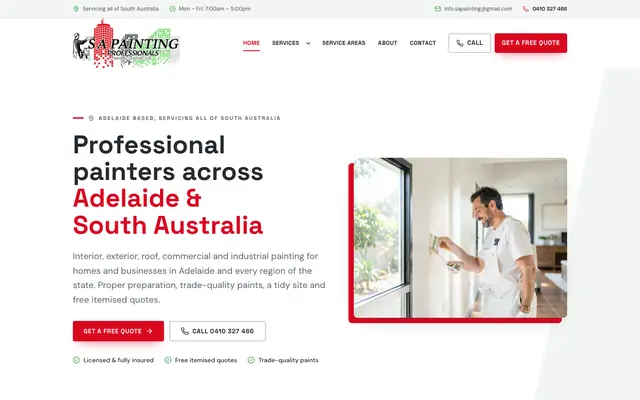
We haven't built a site for a Melbourne pest controller yet. Dr Tabara Dione Coaching is our Melbourne client, and its about page and booking link show how we present credentials and a next step on every page. SA Painting Professionals, in Adelaide, shows how we organise a trade business with a long list of services and a wide service area.

Home page of the Dr Tabara Dione Coaching website

Dr Tabara Dione Coaching

Professional services · Melbourne

Confidential coaching for doctors, led by a Melbourne specialist anaesthetist. Her qualifications sit on an about page people read before they commit, and a discovery-call link appears on every page: the same layout as a team page carrying licence numbers with a booking button beside it.

Home page of the SA Painting Professionals website

SA Painting Professionals

Trades & construction · Adelaide & all of SA

An Adelaide painting company with 12 service pages, region pages across South Australia, a suburb and postcode search and an online quote form. A pest guide with a page per pest, and a search that tells someone in Frankston or Footscray whether you cover them, would be organised the same way.

“Salem walked us through everything, gave us a fixed quote so we knew exactly what we were paying, and turned around the build faster than we thought possible.”

SA Tiling Pro Pty Ltd, Google review

★ 5.0 from 33 Google reviews (opens in a new tab)

Want numbers from a trade site? Western Sydney Stump Grinding has landed at least 62 jobs, about $46,500 of work, from a single-page site we built. Read the case study.

See all 14 recent client sites in our portfolio.

What a Melbourne pest control website costs

One page

$399

Your pests and suburbs, each technician's licence number and authorisations, a short before-treatment note, a quote form and a call button, on a single page.

Where we'd start most Melbourne operators

Up to 3 pages

$899

A home page built for urgent calls, a termite page whose inspection form asks for the auction date and accepts photos, and a page for renters, rental providers and owners corporations.

Up to 8 pages

$1,499

Room for termites and pre-purchase inspections, rodents and food premises, wasps and mosquitoes, possums (or who you refer them to), renters and owners corporations, before-treatment answers, and your team with their licences.

  • Payment. No deposit. We build your draft first, you ask for as many changes as you like, and you pay once you approve it. If you don't go ahead, you owe nothing.
  • GST. WebCraft Studio isn't registered for GST, so no GST is added.
  • Timing. Most sites are live within 5–10 days of us getting your words and photos; bigger sites (up to 8 pages) take 2–3 weeks.
  • Hosting. After launch, hosting is $30 a month: hosting, security monitoring, backups, email support and unlimited text and image changes on your existing pages. New pages or features are quoted first. No contract, cancel anytime.
  • Domain and email. We register your domain in your name (about $20 a year), connect it to your site and set up your business email.

See full pricing and what each package includes

Questions Melbourne pest controllers ask us

Which licence details belong on a Victorian pest control site?

Each technician's, because Victorian licences are issued to people, as photo ID cards. We'd list names, licence numbers and authorisations, and mark anyone on a trainee licence, so a customer checking the Department of Health register finds the same names. When someone joins or leaves, the change is a text edit covered by the $30 monthly hosting.

We're licensed in South Australia. Can the site say we work in Melbourne?

It can say what's true. The department says technicians living in SA, NSW, the ACT, the NT, Tasmania or WA can work in Victoria under automatic mutual recognition once they've notified its Pesticide Safety Team, with scope generally limited to their home licence, and it encourages people to contact the team first to confirm they're eligible. Queensland isn't in the scheme. The site can then name the state that issued your licence and the Victorian suburbs you cover.

Our rodent section mentions glue boards. Does that matter in Victoria?

Yes. The Department of Health says the sale and use of glue traps for trapping animals is prohibited in Victoria, including by pest controllers dealing with rats and mice, and insect glue traps need a cage or cover that keeps animals off the glue. Send us new wording for that section and it goes into the draft; after launch, wording changes on existing pages are part of hosting.

Should we offer possum removal on the website?

Only if you hold the right approval. The department says a pest control licence doesn't authorise wildlife control, and that a controller dealing with wildlife such as possums also needs a wildlife licence or an Authority to Control Wildlife. If you hold one, show it next to your pest licence. If you don't, a line saying you refer possum calls on is honest and keeps those calls off your phone.

Can customers book an inspection and pay online?

Yes. We can link the booking or job management tool you already use from every page, or build booking and payment into the site itself, which we quote per job once we've seen how your diary and pricing work.

How does an Adelaide team build a Melbourne site?

By phone and email, which is how we work with every client outside Adelaide; our current clients are in SA, NSW, VIC and QLD. You send licence details, your pest list, suburbs and photos. We arrange them into a draft and send you the link, you ask for as many changes as you like, and you pay once you approve it. If you don't go ahead, you owe nothing.

Ready to start your Melbourne pest control website?

Email us the licence numbers on your team's cards, the authorisations printed on the back, your pest list and the suburbs you reach. We'll reply with a quote, build a draft you can check on your phone, and you pay only once you're happy with it.

We reply within 24 hours. Prefer email? info@webcraftstudio.com.au