Website Design for Start-ups and New Businesses in Hobart

For makers getting ready for Salamanca Market, food vans joining the City's Food Truck Program, consultants working from a spare room in Sandy Bay or New Town, and founders with a product to explain. Your first site, a .com.au registered to you and an email address on it, with nothing paid until you approve the draft.

What a first website does for a new Hobart business

Plenty of Hobart businesses start somewhere other than a shopfront: a spare room, a Saturday stall, a van moving between permitted spots, a couple of rooms let to visitors. The site has to tell people where to find you, and it has to sit within the Tasmanian rules on what you can put out the front.

  • A small sign, so the site does the talking

    Tasmania's planning exemption for working from home allows one unlit sign of no more than 0.2 square metres, and no goods for sale on show from the road. That's a nameplate by the door. Put your web address on the car, the invoice and the market table instead, and let the site explain what you do, where you work and how to get in touch.

  • Photos you took, not stock

    Salamanca Market wants photos of every product you plan to sell before it will assess an application, and it won't accept AI-generated or stock images. Those same photos belong on your website, because someone who met you on a Saturday will recognise the work. Send us clear phone shots and we'll arrange them into a gallery or a product list.

  • Where the van is today

    A van in the City of Hobart's Food Truck Program must trade at least 50 metres from existing food and beverage businesses and public events, and Salamanca Plaza runs on a roster. Your customers won't know any of that; they want to know where you'll be on Thursday. A weekly list near the top of the page, changed whenever you email us, tells them.

  • Hosted stays described as hosted

    Letting rooms in the house you live in is treated differently from turning a whole house over to visitors. If you're starting a bed-and-breakfast style business, the site should say plainly that you live there, how many rooms you let and what guests share, so the listing matches what the planning rules allow. The City's 2026 proposal on whole-home stays is covered below.

  • Bought a business? Find out who holds the domain

    City of Hobart food registrations don't pass to a new owner when a café or bakery is sold; the buyer applies for their own. Treat the website the same way: ask whose name the domain is in and who controls the email accounts, and have both moved to you at settlement. If that can't happen, we'll register a fresh .com.au in your name and set up email on it.

  • Name the council area, not just "Hobart"

    Greater Hobart is several councils. A kitchen in Moonah answers to Glenorchy, a studio in Bellerive to Clarence and a café in Kingston to Kingborough, each with its own food registration and planning staff, and the City's free Hello Hobart listing is only open to businesses inside the City of Hobart. Say which suburb you work from, so customers and programs can place you.

Starting out in Hobart: free advice, planning, food permits and the market

Free advice on the business side. Business Tasmania, the state government's front door for business questions, is on 1800 440 026 or ask@business.tas.gov.au. Its two free advisory services have taken over from the Enterprise Centres Tasmania program, which has closed. The New Business Support service gives up to two hours of independent advice to people planning a business or holding an ABN for less than 12 months, provided the business has 19 or fewer full-time equivalent staff. It covers structure, viability, financial forecasting and new opportunities, in person, by phone or online. Once you're past the first year, the Tasmanian Business Advice Service offers up to five hours each financial year. The City of Hobart's start-up support page points founders to Enterprize, which has coworking spaces in Hobart and Launceston and runs Elevate, a 15-week incubator for founders; to Startup Tasmania, a group for the state's entrepreneurs; and to Many Rivers, a not-for-profit that helps people start small businesses. Business South, a not-for-profit supporting start-ups and self-employment in southern and south-eastern Tasmania, gives free, confidential small business advice and runs free or low-cost training. The City's own Digital Growth Program has closed, and the council suggests subscribing to its business newsletter to hear about future programs.

Working from home under the new planning scheme. The Tasmanian Planning Scheme took effect in the City of Hobart on 26 September 2025, replacing the Hobart Interim Planning Scheme 2015 and the Sullivans Cove Planning Scheme 1997, so the exemptions in the State Planning Provisions now apply in Hobart. Under the July 2022 State Planning Provisions, a home occupation needs no planning permit if no more than 40 square metres of the dwelling is used for the business, the person running it lives there, nobody but residents is employed, no goods are displayed where they can be seen from the road, there's at most one unlit sign of up to 0.2 square metres, and no more than one commercial vehicle, of two tonnes or less, is on the property, parked on site. Sorell Council's information sheet on the same scheme explains that a home-based business may have two non-resident employees and two commercial vehicles but needs a permit, and suggests talking to the council before you set up either way.

Short stays. The same provisions exempt visitor accommodation in a dwelling the owner or occupier lives in, with guests in no more than four bedrooms, or one let only while the occupier is away on holiday. Whole homes are another matter. On 10 June 2026 the City's planning authority endorsed a draft amendment for public exhibition that would stop existing dwellings in the Inner Residential, General Residential and Low Density Residential zones being converted into new whole-home short stays, Pulse Tasmania reported. Hosted stays, business and mixed-use areas, Battery Point (which has its own rules) and existing lawful operators sit outside it. After exhibition closed, the planning authority voted on 26 August 2026 to send the amendment, PSA-25-3, to the Tasmanian Planning Commission for assessment, Pulse later reported, and the City lists it on its current planning scheme amendments page. If a whole-home let is the plan, check where it stands before building a booking site around it.

Food from a home kitchen or a van. Everyone selling food in the City of Hobart must notify the City online (there's a fee), and the council will contact you if you also need to register. A first registration includes an inspection by an Environmental Health Officer, and you need the Certificate of Registration before you open. Registrations can't be transferred, they expire on 31 May each year, and the City asks anyone thinking of a home-based food business to contact it first. A van or trailer is registered as a mobile food business with the council where it's garaged; to trade around the City of Hobart it also needs a Food Truck Program permit, annual or quarterly, applied for online; the City asks you to allow five working days for processing. The City recommends calling its Events and Activations team before you apply, particularly if you want Salamanca Plaza. If your kitchen or van is based in Glenorchy, Clarence or Kingborough, that council handles the registration.

Salamanca Market, a free listing, and working with us. Salamanca Market runs every Saturday from 8.30am to 3pm. A licensed site carries a five-year licence and has to be bought from an existing licensed stallholder, and the market must approve the buyer's product line before the transfer goes ahead. Casual stallholders join a pool of about 120 through a competitive intake, on agreements of up to two years, according to the market's 2024 information pack. The market lists dairy, fresh meat and fish, children's toys and musical instruments among the products it's looking for, and isn't taking new distilled alcohol applications. Businesses inside the City of Hobart can also list free on Hello Hobart, the council's site promoting local shops, cafés and restaurants and the people behind them. We're an Adelaide team on Hutt St, half an hour behind Hobart all year because both states change their clocks on the same dates, and a Hobart project runs by phone and email. Our current clients are in SA, NSW, VIC and QLD, and we haven't built for a Tasmanian start-up yet. Setting up in the north? Our Launceston page covers that council's food rules and the Harvest market.

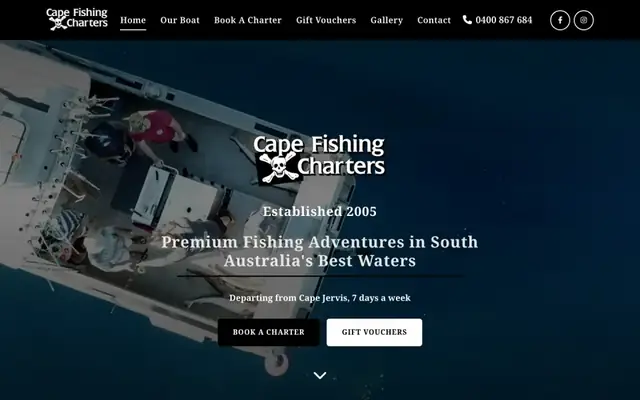
Two small sites that fit a business starting out

Fiona Dixon works in New South Wales and Cape Fishing Charters runs out of South Australia; we haven't built for a Hobart business, and we can't say how long either client had been trading before they came to us. They're here because they match two common Hobart starts: one person working from home, and a visitor business that sells from a single page.

Home page of the Fiona Dixon Voiceover Artist website

Fiona Dixon Voiceover Artist

Community, creative & tourism · NSW

A voiceover artist recording from a professional home studio. One page holds four demo reels that play in the browser, sections on her background and studio, a contact form that asks what kind of project it is, and tap-to-call. Clients never need to visit, which suits a business run from a spare room.

“My website is exactly how I wanted. I highly recommend Salem for any business wanting a professional website without the bull.”

Johannah Whilding, Google review

Prices for a Hobart start-up

Our suggestion for a stall, van or home business

One page

$399

A single page with what you make or offer, photos, where to find you (the stall, the van's spots or your suburb), hours and an enquiry form, set up alongside your .com.au and business email.

Up to 3 pages

$899

A home page, a products or services page and an about page. It suits a maker with a range to show, or a consultant whose background is what clients are buying.

Up to 8 pages

$1,499

For a business opening with several strands, such as a café with catering and classes, or rooms plus tours: a page for each, a gallery and a news page for market and event dates.

  • Payment. No deposit. We build your draft first, you ask for as many changes as you like, and you pay once you approve it. If you don't go ahead, you owe nothing.
  • GST. WebCraft Studio isn't registered for GST, so no GST is added.
  • Timing. Most sites are live within 5–10 days of us getting your words and photos; bigger sites (up to 8 pages) take 2–3 weeks.
  • Hosting. After launch, hosting is $30 a month: hosting, security monitoring, backups, email support and unlimited text and image changes on your existing pages. New pages or features are quoted first. No contract, cancel anytime.
  • Domain and email. We register your domain in your name (about $20 a year), connect it to your site and set up your business email.

See full pricing and what each package includes

Questions from people starting a business in Hobart

We work from a spare room in New Town. Does our street address need to be on the site?

No. If clients don't come to you, your suburb and the areas you cover are enough, with a phone number and a contact form for the rest. If people will visit, check you're inside the home occupation limits (no staff other than residents, no goods on show from the road, one small sign) or ask the City's planners whether you need a permit. We add a street address and map only when you want visitors.

We're applying for a stall at Salamanca Market. Should the website come first?

They can happen together. The market's product pre-approval asks for photos of everything you'll sell and rejects AI-generated and stock images, so take those photos once and use them for both. A one-page site showing what you make and how to order between Saturdays can go live while you wait, and your stall details go on later as a text change under hosting.

Our food van is joining the Food Truck Program. What should the site show?

Your menu as text rather than a photo, prices if you want them shown, and where you'll be each day this week, because the 50-metre rule and the Salamanca Plaza roster mean your spots will move. Email us the new list and we'll change it; that's covered by the $30 monthly hosting. Hold off announcing a start date until your mobile food business registration and the program permit are both in hand.

Can guests book a room in our house through the website?

Yes. Under the state rules, letting up to four bedrooms in the home you live in is generally exempt from a planning permit, and the site should make clear you live on site. We build booking and payment systems into sites, quoted for your setup, or we can link a booking tool you already use. A whole home is different: first check where the City's proposed limit on new whole-home stays in residential zones has got to.

Where does a new Tasmanian business get free advice?

Start with Business Tasmania on 1800 440 026. If you're planning a business or have had an ABN for under a year, its New Business Support service connects you with an independent adviser for up to two hours. We stick to the website: arranging your words and photos into the pages, registering the domain in your name and setting up your email.

How does a Hobart start-up work with a team in Adelaide?

By phone and email. We talk through what you'll sell and who it's for, you email your words and photos, and we send a draft link to open on your phone or pass to a business partner. Ask for as many changes as you like; you pay once you approve it. We reply within 24 hours, and we're half an hour behind you.

Starting something in Hobart?

Tell us the business name, what you'll sell and where you'll trade: a stall, a van, a spare room or a shopfront. We'll check the .com.au is free, quote the pages and send a draft link, and you owe nothing until you approve it.

We reply within 24 hours. Prefer email? info@webcraftstudio.com.au