Website Design for NDIS Providers in Darwin

Websites for disability support providers in Darwin, Palmerston and the Litchfield rural area, including those whose workers also travel to the Tiwi Islands or other Top End communities. Families, coordinators and plan managers can see what you deliver, where your workers go, how your team is screened in the Territory and how to send you a referral. We're an Adelaide team, and we'd work with you by phone and email.

What a Darwin provider's website has to answer

About four in five plans in the NDIA's Darwin Urban district are plan-managed, and most of the district's participants live in the northern suburbs, Palmerston and the rural area rather than close to the CBD. So the person reading your site is often a plan manager checking how you invoice, a coordinator working out whether your workers reach Humpty Doo, or a parent wanting to know who can work with their child. We'd plan the pages around those questions.

  • Screening, described in Territory terms

    SAFE NT carries out both the NDIS worker screening check and the Working with Children Clearance, known as the Ochre Card, and they are separate checks. SAFE NT currently lists the NDIS clearance as lasting five years, recognised nationally and issued without a card, since successful applicants are told by email. The Ochre Card lasts two years, counts only in the Territory and is a physical card, and the scheme is being changed to line up with a national framework. Workers in NDIS roles who deal with children need both, so a line such as "our support workers hold NDIS worker screening clearances, and those working with children also hold a current Ochre Card" answers the question a parent is about to ask, while durations and fees are best left to a link to SAFE NT.

  • Invoicing details plan managers can find

    On the NDIA's June 2026 figures, 3,142 of the 3,955 plans in the Darwin Urban district were plan-managed, about 79%, compared with roughly 69% across Australia. Give plan managers a short section of their own: your ABN, the business name printed on invoices, how often you bill, what each invoice lists and an email for accounts questions. Only 158 plans in the district were agency-managed, so an unregistered provider loses little by saying so near the top of the page.

  • Suburbs grouped the way Greater Darwin spreads out

    In the NDIA's statistical areas, Palmerston – South (256 participants), Rosebery – Bellamack (225), Karama (206), Humpty Doo (199) and Lyons (193) had the most participants in June 2026; the Darwin City area had 66. Group your coverage under the northern suburbs, Palmerston and the rural area, then list suburbs beneath each heading so a family in Moulden or Howard Springs can spot theirs without ringing.

  • Community trips, named and dated

    Beyond Darwin Urban, the NDIA's Darwin Remote district covers the Tiwi Islands, West Arnhem, West Daly, Victoria Daly and Roper Gulf council areas, with 656 participants between them in June 2026. If your workers fly or drive out, name the communities, how often you go, the supports you deliver on those trips and whether travel is charged. If you stay in town, a sentence saying so is just as useful.

  • Languages and interpreters

    More than half the Territory's participants are First Nations people. If any of your workers speak an Aboriginal language, name it beside the services they deliver. If you book interpreters, say how, because the NDIS Commission says registered providers must support participants who need an interpreter, and the NT Government runs an Aboriginal Interpreter Service. Photos of participants or communities go on the site only with permission.

  • A notice spot for the wet season

    The official tropical cyclone season runs from 1 November to 30 April. A short notice at the top of the home page, which you change by emailing us, is one more place to tell families that Thursday's visits have moved or that the office is closed for a cyclone watch, alongside the calls and texts you already make.

  • Pages that work with a screen reader and on mobile data

    Headings in order, labelled form fields, keyboard access and strong colour contrast, which cover a good part of what WCAG 2.2 asks for, with photos compressed so pages open quickly on a phone. Our accessibility guide for NDIS and aged care sites explains what that covers and where an independent audit fits.

Disability support in the Top End: screening, coordination and the Territory's rules

Worker screening through SAFE NT. Provider registration is national, so we haven't repeated it here: our main NDIS providers page covers how registered and unregistered providers should describe themselves. Screening is run by each state and territory. In the NT it sits with SAFE NT (Screening Assessment for Employment NT), a unit of NT Police. Workers in risk-assessed roles for a registered provider need a clearance, and the provider identifies which roles those are; unregistered providers and self-managing participants can ask their workers to apply, but don't have to. A clearance can be renewed from 90 days before it expires, and one issued interstate is accepted in the Territory until it runs out. The NT also lets a new worker start NDIS work while their application is assessed, but only when it is complete and paid, the employer has verified it and agreed, and risk controls and a cleared supervisor are in place. The Ochre Card works differently: the NT Government says anyone working with children needs a valid clearance, and an employer can apply for a short-term exemption so a worker can start while their application is processed. Which of those applies to a role, and whether you allow work on application, is worth a line on a careers page. SAFE NT's NDIS Worker Screening Check page has the detail.

Where Darwin's participants live. On 30 June 2026 the NDIA counted 3,955 participants in its Darwin Urban district, more than half the Territory's 6,894. The district takes in the City of Darwin (1,974), Palmerston (1,371), Litchfield (572) and the small Coomalie, Wagait and Belyuen council areas. Of the three main councils, Litchfield has grown fastest: it had 340 participants in June 2022, so numbers rose by about two thirds in four years. Over the same period the Howard Springs area went from 83 to 181 and Humpty Doo from 133 to 199. A provider with an office in Winnellie whose workers spend half the week on rural blocks should say so on the home page, not only on the contact page.

Who refers. The NDIS lists APM as the local area coordination partner for Greater Darwin, meaning Darwin, Palmerston and Litchfield, and the NT Branch of Early Childhood Australia as the early childhood partner there, for children younger than 6 with developmental delay or younger than 9 with disability. Outside those three council areas, NDIA staff connect people to the scheme, and the NDIS Commission lists remote community connectors among the people a participant can ask about an Aboriginal interpreter. Support coordinators refer as well. A referral form that opens by asking who is referring, then the participant's age group and suburb or community, suits all of them without separate forms.

Behaviour support and the Senior Practitioner. In the Territory, a registered NDIS provider that plans to use a restrictive practice in a participant's behaviour support plan applies to the NT Senior Practitioner for authorisation under the Territory's National Disability Insurance Scheme (Authorisations) Act 2019. NT Health lists what the application must include, among them the behaviour support plan that specifies the practice and evidence that the provider consulted the participant and their family, carers or guardian. A behaviour support practice's website doesn't need to explain the process. A sentence saying your plans go through NT authorisation, with a link to NT Health's restrictive practices authorisation page, is enough.

First Nations participants, the wet and working with us. In June 2026 the NDIA counted 3,731 First Nations participants in the Territory: 1,385 in Modified Monash category 2, the regional-centre category that takes in Darwin, and 2,319 in remote and very remote areas. The core module of the NDIS Practice Standards, which many registered providers are audited against, includes emergency and disaster management, with plans for telling workers, participants and their support networks when supports change, which is where a website notice can help between November and April. We're at Ste 3/110 Hutt St, Adelaide, and work with businesses outside Adelaide by phone and email. We haven't built a site for a Territory business, or for a business whose main work is NDIS supports. Darwin keeps the same clock all year, so from the first Sunday in October to the first Sunday in April we're an hour ahead of you, and we book calls in Darwin time.
Two sites with parts a Darwin provider can use

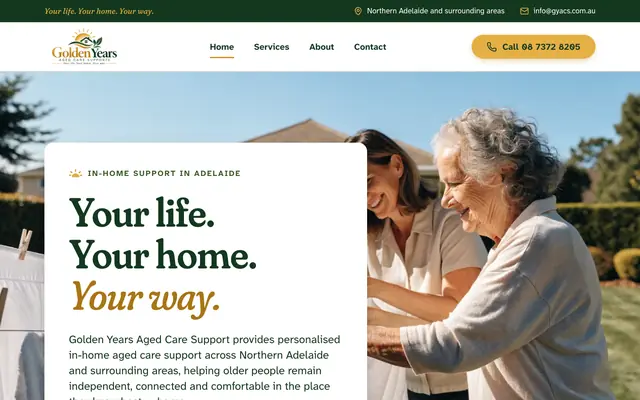
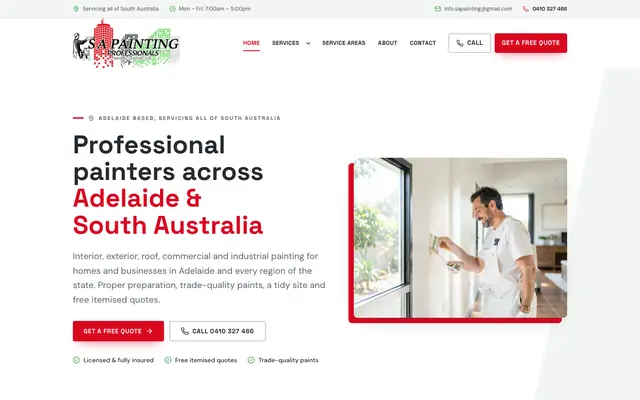
Neither client is an NDIS provider, and neither is in the Territory; both are in South Australia. Golden Years shows a referral path for organisations sitting beside an enquiry form for families. SA Painting Professionals shows a large service area split into regions with a suburb search, which suits a provider covering Greater Darwin and communities further out.

Home page of the Golden Years Aged Care Support website

Golden Years Aged Care Support

Home & care services · Northern Adelaide

In-home support for older people in Northern Adelaide, so aged care rather than disability support. Nine services are explained in plain words on one page, the enquiry form gives aged care providers their own referral option, the text is large and tap-to-call is on every page. A Darwin version would offer options for local area coordinators, the early childhood partner, NDIA planners and support coordinators.

Home page of the SA Painting Professionals website

SA Painting Professionals

Trades & construction · Adelaide & all of SA

An Adelaide painting company whose site has region pages across South Australia and a suburb and postcode search. A Darwin provider could use the same pattern for the northern suburbs, Palmerston, the rural area and the communities it visits, so a family types their suburb and sees straight away whether your workers come to them.

“He listened to my feedback and made no hesitations to revise and adjust my website until we were completely happy with it.”

Tony Bleijswijk, Google review

What a Darwin NDIS provider's website costs

One page

$399

Your supports, the suburbs and communities you reach, registration status, how your workers are screened, invoicing details for plan managers and a referral form, on one page.

Suits most Darwin providers

Up to 3 pages

$899

A home page with a notice spot for service changes, a supports page in plain words, and a referrals and invoicing page for coordinators and plan managers.

Up to 8 pages

$1,499

A page per support, a page for community trips, careers covering SAFE NT clearances and Ochre Cards, an Easy Read page and, for behaviour support, how you work.

  • Payment. No deposit. We build your draft first, you ask for as many changes as you like, and you pay once you approve it. If you don't go ahead, you owe nothing.
  • GST. WebCraft Studio isn't registered for GST, so no GST is added.
  • Timing. Most sites are live within 5–10 days of us getting your words and photos; bigger sites (up to 8 pages) take 2–3 weeks.
  • Hosting. After launch, hosting is $30 a month: hosting, security monitoring, backups, email support and unlimited text and image changes on your existing pages. New pages or features are quoted first. No contract, cancel anytime.
  • Domain and email. We register your domain in your name (about $20 a year), connect it to your site and set up your business email.

See full pricing and what each package includes

Questions Darwin NDIS providers ask us

Our workers have no card for their NDIS clearance. How do we show families they're screened?

In the Territory, SAFE NT confirms an NDIS worker screening clearance by email and doesn't issue a card, so there's nothing for a worker to hold up at the door. The site can state it plainly instead: your support workers hold current NDIS worker screening clearances, and those who work with children also hold an Ochre Card. Deciding which roles need a clearance is part of running a registered provider, with guidance from SAFE NT and the NDIS Commission; the website simply says what's true for your team.

We fly to the Tiwi Islands once a month. Should that go on the website?

Yes, if you take referrals for it. Name the communities, the week you usually go, the supports you deliver on those trips and how a family, planner or community connector can get on your list. On the 8-page site it can have a page of its own; on a smaller site it's a section on the supports page. When the schedule changes, email us the new dates: text changes on existing pages are part of the $30 monthly hosting.

Most of our participants are plan-managed. What do plan managers look for?

Your ABN and the exact business name on your invoices, how often you bill, what each invoice shows and who to email about a payment. In June 2026 about four in five plans in the Darwin Urban district were plan-managed, so this short section gets read more than you'd expect. We set it out as text on the page rather than a PDF, so it reads properly on a phone and with a screen reader.

Should our website say anything about cyclone season?

If the wet changes how you deliver supports, a short note helps: how you'll contact participants before a cyclone, what happens to visits when roads close and where you'll post updates. For registered providers audited against the core module, the NDIS Practice Standards already ask for plans to communicate changes to supports in an emergency or disaster. Household preparation advice is the job of the Territory's emergency services, so we'd link to Secure NT, which the NDIS also points Territory participants to, rather than write a checklist for you.

We provide behaviour support. What should the site say about the Senior Practitioner?

One or two sentences is plenty: that restrictive practices in your plans go through the NT authorisation process, with a link to NT Health's page. Keep the detail of any participant's plan off the website. What the Authorisations Act requires of your practice is a question for NT Health's Restrictive Practices Authorisation Unit, and we'd use your wording rather than paraphrase the law.

How does an Adelaide team build a site for a Darwin provider?

By phone and email. You send your supports, the suburbs and communities you cover, your registration and screening details and any photos you have permission to use. We build a draft you can open on your phone, you ask for changes until it reads right, and you pay once you approve it: $399 for one page, $899 for up to 3 pages or $1,499 for up to 8, with no GST added. We reply within 24 hours, and our current clients are in SA, NSW, VIC and QLD.

Ready to start your Darwin NDIS provider website?

Send us the supports you deliver, the suburbs and communities your workers reach, your registration status and how your team is screened. We'll reply with a quote, then build a draft for you to check before you pay anything.

We reply within 24 hours. Prefer email? info@webcraftstudio.com.au