Website Design for Landscapers in Hobart

Websites for landscape builders, garden designers and maintenance crews across Greater Hobart, from hillside blocks under kunanyi to new gardens in Kingston and on the eastern shore. Your walls, paving and planting captioned by suburb, the approval questions owners ask answered in plain words, and a quote form that takes photos of the slope.

What a Hobart landscaping website needs to answer

None of CBOS's four builder licence classes, Domestic to Open, is a landscaping class, so a Hobart owner has no landscaping register to check and judges you on what your site shows instead: whether you know where a garden wall stops being low-risk work, whether your plantings suit a fire-prone hillside, and whether you'll cross the Derwent for their job. Answer those on the page and the people who ring already know you fit.

  • Walls sorted by who is allowed to build them

    Tasmania draws the line by height, not by trade. A wall holding back up to 500 mm of soil within 1.5 m of a boundary, or up to 1.2 m further in, is low-risk work an owner or any competent person may do; an engineer-designed wall retaining up to 1.8 m is kept for a licensed builder. Say which kinds you build, and if you hold a CBOS builder licence, put the number where owners will see it.

  • Hillside jobs with the hazard overlays in mind

    On land mapped for landslip, bushfire, flooding or coastal hazards, some work that would otherwise be low-risk becomes notifiable and needs a building surveyor. A project page showing a terraced garden on a slope, with a line on who checked the overlays and who designed the walls, tells an owner in Lenah Valley or Taroona that you've handled ground like theirs.

  • Planting choices backed by local fire testing

    The City of Hobart, working with the other Greater Hobart councils and the University of Tasmania's Fire Centre, has published a garden plant flammability guide: more than 100 common garden plants were tested in a fire lab and rated from low to very high. If you design gardens on the bush edge, say you work from it, and name the low-rated plants you used in each project caption.

  • Verge gardens built to the City's guidelines

    In the City of Hobart, a resident can turn a grassed nature strip into a garden without applying, provided the work meets the council's guidelines. A nature strip package promising planting kept under 600 mm, set back 500 mm from kerb and footpath, finished in bark mulch with no irrigation or rocks, is simple to describe and simple for an owner to say yes to.

  • Big trees checked before the excavator arrives

    The Tasmanian Planning Scheme for Hobart has a Significant Tree Code covering trees from the National Trust's register and others nominated by the public, and the council maps them. A sentence in your process saying you look up the register before quoting near a large tree, and that street trees are left to the council, answers a question many owners don't know to ask.

  • Watering advice that changes across the river

    Bureau of Meteorology records give Hobart's Ellerslie Road station about 610 mm of rain a year, while Hobart Airport West, near Cambridge, averaged about 490 mm between 1958 and 2022. If you install irrigation or plant dry gardens on the eastern shore, say so, and group your suburbs by council so an owner in Lauderdale or Midway Point finds theirs in a second.

  • A quote form that asks Hobart questions

    Suburb and council, how steep the block is, how a bobcat or barrow gets in, the height of any wall, whether the property is mapped for bushfire or landslip, and whether a sewer or water main crosses the work area, since low-risk building work has to stay 2 m clear of TasWater infrastructure. Photos, plans and survey drawings attach to the enquiry.

Landscaping rules in Tasmania, and what's particular to Hobart

Who may build what. CBOS licenses builders in four classes, Domestic, Low Rise, Medium Rise and Open, and none of them is a landscaping class. What decides who can build a garden structure is the Director of Building Control's Determination on categories of building and demolition work (version 1.4, applying since April 2021). Category 1 low-risk work, which an owner, a competent person or a licensed builder may do without a permit, includes a retaining wall holding up to 500 mm of ground within 1.5 m of a boundary, road or right of way and up to 1.2 m elsewhere, set back from any building by at least its own height; masonry or concrete fences and walls to 1.2 m and other fences to 2.1 m; unroofed decks less than 1 m above the ground; pergolas, arches and trellis up to 36 m² and 3.5 m high, left open or covered with a permeable material such as shade cloth, and without masonry; and gazebos or garden shelters up to 18 m². Category 2 covers low-risk work reserved for a licensed builder, with a few items open to a competent person; an engineer-designed wall retaining up to 1.8 m is one of the builder-only items. Bigger structures are notifiable work, which a building surveyor has to assess and certify before it starts. Swimming pools and spas are notifiable work too, and the Determination says a pool's access barrier must be built by a licensed builder. Stormwater drainage is plumbing work for a licensed plumber. Residential contracts for building work of $20,000 or more carry rules of their own, set out on our page for Hobart builders.

The limits that catch garden jobs. Low-risk work also has to meet the Determination's standard limitations. Cut or fill within 1.5 m of a boundary is capped at 500 mm, and further in at 1.2 m, or 1.8 m for a licensed builder. Work in a bushfire, landslip, flood or coastal hazard area can be lifted from low-risk to notifiable. Nothing may be built over an existing drain or within a metre of one without the council general manager's written consent, inside a service easement without the consent of whoever it was created for, or within 2 m of TasWater infrastructure. On Hobart's hillsides the hazard rules matter more than most: our builders page explains the Landslip Hazard Code and the declared landslip areas, and owners can check their own block's overlays on LISTmap. A site that says you check them before quoting, and bring in an engineer or building surveyor when a wall needs one, reads as experience rather than caution.

Nature strips and trees in the City of Hobart. The adjoining resident looks after the nature strip, and the council's guidelines allow lawn, native grasses such as poa, lomandra and dianella, or low shrubs and groundcovers, with no application needed when the rules are met. Plants stay under 600 mm, or 300 mm on a corner, and sit 500 mm back from both the kerb and the footpath; where there's no footpath, 1.5 m from the property line stays as lawn or mulch. Digging is done by hand after a Dial Before You Dig enquiry, and bark mulch of 12 to 25 mm can go down 75 mm deep. Irrigation, artificial turf, concrete, rocks, sleepers, pavers, retaining walls and prickly or woody plants are not allowed, and residents may not plant, prune or remove street trees. Beyond the verge, the Significant Tree Code in the Tasmanian Planning Scheme for Hobart lists trees from the National Trust's register and public nominations, shown on the council's interactive map. Glenorchy, Clarence and Kingborough are separate councils with their own rules, so a verge or tree page should name the council it describes.

Fire, wind and rain. Tasmania Fire Service puts about 98% of the state's land area in bushfire-prone areas, and our page for Hobart tradies covers hazard management plans and BAL ratings. For a landscaper, the useful part comes after the house is finished. Kingborough Council notes that permit conditions often leave owners responsible for keeping their property to the approved bushfire hazard management plan, and that work beyond the plan can need a new permit and a revised plan from an accredited practitioner. Maintaining a hazard management area, or reworking a garden inside one, is a service worth naming, and the Greater Hobart flammability guide, in print from the City of Hobart and online through the Sparking Conversations, Igniting Action program, gives you a local reference to cite. The Bureau's Ellerslie Road records, kept since 1882, average 610.5 mm of rain a year and about 1.3 nights a year at or below freezing, but that station has also logged a 150 km/h gust, and Hobart Airport West averaged 491.8 mm a year between 1958 and 2022.

Plants from the mainland. Biosecurity Tasmania requires plants brought into the state to be free of soil, pests, diseases and weeds, labelled with their scientific names, and covered by a notice of intention lodged at least 24 hours before they leave. If you bring advanced trees or particular cultivars from interstate, a line saying you handle that paperwork helps; if you grow or buy in Tasmania, say that instead. We're an Adelaide team and work with Hobart landscapers by phone and email, at the same prices as anywhere else. Our current clients are in SA, NSW, VIC and QLD, and we haven't yet built a site for a Tasmanian business.

The closest work we've done to a Hobart landscaping site

We haven't built for a Tasmanian landscaper. These two are the nearest fit: a structural landscaping and excavation business in the Bega Valley, and an Adelaide engineering firm whose site takes retaining-wall enquiries with plans attached.

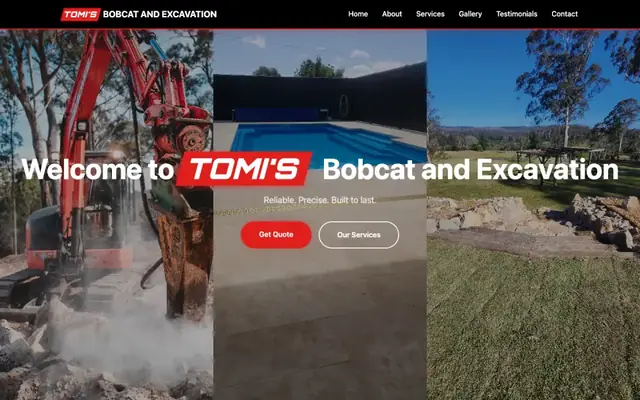
Home page of the Tomi's Bobcat and Excavation website

Tomi's Bobcat and Excavation

Trades & construction · South Pambula & Bega Valley

Bobcat and excavator work around South Pambula: structural landscaping, licensed pool building and earthworks. The one-page site carries three service sections, 42 job photos that swipe on a phone, testimonials and a contact form. For a Hobart crew we'd keep the gallery and caption each shot with the suburb and the wall, terrace or path it shows.

Home page of the Simple Engineers website

Simple Engineers

Professional services · Adelaide

Adelaide engineers who design retaining walls, slabs and stormwater systems. Its quote form shows fee ranges and accepts file uploads, which suits a Hobart landscaper who wants a site survey, a contour plan or an engineer's wall drawing to arrive with the first enquiry.

“They were very helpful and envisioned exactly what I was wanting for my website. They created the site very promptly and cost efficient.”

Michael Debney, Google review

★ 5.0 from 33 Google reviews (opens in a new tab)

Want numbers from a trade site? Western Sydney Stump Grinding has landed at least 62 jobs, about $46,500 of work, from a single-page site we built. Read the case study.

See all 14 recent client sites in our portfolio.

What a Hobart landscaper's website costs

One page

$399

Services, a gallery captioned by suburb, the councils you cover, a short note on walls and approvals, and a quote form that takes photos, all on one page. Suits a maintenance round or a small planting crew.

Our suggestion for most Hobart landscapers

Up to 3 pages

$899

A home page, a projects page sorted into walls, paving and planting, and a page on fire-aware gardens and nature strips, each with the enquiry form that fits it.

Up to 8 pages

$1,499

A home page, then pages for walls and terraces, paving and decks, planting design, bushfire-area gardens and nature strips, and maintenance, plus projects and an about page with your licence and qualifications.

  • Payment. No deposit. We build your draft first, you ask for as many changes as you like, and you pay once you approve it. If you don't go ahead, you owe nothing.
  • GST. WebCraft Studio isn't registered for GST, so no GST is added.
  • Timing. Most sites are live within 5–10 days of us getting your words and photos; bigger sites (up to 8 pages) take 2–3 weeks.
  • Hosting. After launch, hosting is $30 a month: hosting, security monitoring, backups, email support and unlimited text and image changes on your existing pages. New pages or features are quoted first. No contract, cancel anytime.
  • Domain and email. We register your domain in your name (about $20 a year), connect it to your site and set up your business email.

See full pricing and what each package includes

Questions Hobart landscapers ask us

Can our site say a garden wall doesn't need a permit?

Only in terms the Determination supports. A wall retaining up to 500 mm near a boundary, or 1.2 m elsewhere, is low-risk work when the standard limitations are met, but a hazard overlay, an easement or a nearby drain can change that. If your own wording says most garden walls under those heights are low-risk work and that you check every site first, we can link it to the Determination on the CBOS site. The ruling on any particular job stays with you or a building surveyor.

Should our CBOS licence number be on the site?

If you hold one, yes. The old Tasmanian rule requiring licence numbers in advertising was repealed in 2017, but owners can look builders up on the CBOS licence search, and the bigger garden jobs are where a licence counts: an engineer-designed wall retaining up to 1.8 m is builder-only work under the Determination, and a pool's access barrier must be built by a licensed builder. We show the number and licence class exactly as they appear on your licence.

Can we offer nature strip gardens in Hobart?

Yes, worded to the City of Hobart's guidelines: low plants under 600 mm, the kerb and footpath setbacks, bark mulch, hand digging and no irrigation or hard landscaping. No council approval is needed in the City of Hobart when those are met. If you also work in Clarence, Glenorchy or Kingborough, check each council's rules before the page promises the same there.

Is it worth linking to the plant flammability guide?

For gardens on the bush edge, yes. It's a local, tested reference owners can read for themselves, and it saves your site from making fire-safety claims of its own. We'd link it from your bushfire-area page and let project captions show which low-rated plants you chose. We don't add fire advice beyond what you give us.

We work on both sides of the Derwent. How should the service area read?

Group suburbs by council: Hobart, Glenorchy, Clarence and Kingborough first, then Brighton, Sorell, the Derwent Valley and the Huon Valley for jobs further out. Owners find their suburb faster, and you can note which areas you'll travel to for construction but not for mowing. Changing the list later is a text edit on an existing page, covered by the $30 monthly hosting.

You're based in Adelaide. How does a Hobart project run?

By phone and email. We're an Adelaide (South Australia) web design team working with businesses Australia-wide, and our current clients are in SA, NSW, VIC and QLD. You send photos of finished gardens, your own description of each service and the suburbs you cover; we send a draft link you can open on your phone, make the changes you ask for, and you pay once you approve it. We reply within 24 hours.

Start your Hobart landscaping website

Send us photos of finished gardens, the suburbs and councils you cover, your own words for each service, and any licence or qualification you'd like shown. We quote first, build the draft before you pay anything, and you pay only once you approve it.

We reply within 24 hours. Prefer email? info@webcraftstudio.com.au