Website Design for Landscapers in Canberra

Websites for Canberra landscape builders, garden designers and maintenance crews. Your work shown by district, from first gardens in Whitlam and Strathnairn to reworked backyards in Tuggeranong, your process around protected trees and nature strips set out in plain words, and a quote form that takes photos of the block.

What a Canberra landscaping website should answer

There's no landscaping licence in the ACT for an owner to look up, so they size you up on other things: whether you know the territory's rules on trees and nature strips, whether your gardens come through a Canberra winter, and whether you'll drive to their district. A site that answers those questions before anyone calls does the first round of sorting for you.

  • Proof that stands in for a licence number

    Owners can check a builder or plumber on the Access Canberra register, but not a landscaper. What does that job on your site: finished projects with the suburb and the year, the public liability cover you carry, a Certificate III in Landscape Construction or Horticulture if you hold one, membership of The Landscape Association, and reviews with names. If you also hold an ACT builder licence, its number goes in the footer.

  • First gardens that meet the new-home tree rules

    A new house on a single block has to have trees in the ground, in a deep soil zone, before the final compliance certificate, or the owner signs a declaration promising to plant them. If you plant those trees and lay out the planting area for owners in Whitlam, Strathnairn or Macnamara, a page that says what your new-home package covers gives them, and the builders who pass the garden on, a reason to pick you.

  • Protected trees checked before anyone digs

    Paving under a big eucalypt, a trench for irrigation past a street tree or a wall that cuts into the root zone can all need approval first. A line on your process page saying you check whether a tree is protected before quoting, and who lodges the tree activity application, shows owners you've done this before.

  • Nature strip work kept to the guidelines

    Canberra lessees look after the verge outside their block, and plenty would rather plant it than mow it. If you design low native plantings or gravel verges, say that you work to the ACT Government's guidelines, and whether you prepare the scaled site plan an approval needs for anything beyond the basics, such as irrigation.

  • A planting calendar built around frost

    Frosts arrive in April and can still turn up in October, and about ten days a year reach 35°C or more, most of them in January. A short seasons section says when you plant frost-tender stock, when walls and paving fill your diary, and when to book an irrigation service ahead of 1 September, when the daytime sprinkler limit returns.

  • Districts first, then the NSW side

    Canberra people place themselves by district: Belconnen, Gungahlin, Molonglo Valley, Inner North, Inner South, Woden, Weston Creek and Tuggeranong. List the ones you cover, then put Queanbeyan, Googong, Jerrabomberra and Bungendore in a group of their own, because NSW rules apply over the border.

  • A quote form that asks Canberra questions

    Suburb, block size, slope, bobcat access, whether it's a new build still waiting on its compliance certificate, whether a large tree stands within a few metres of the work (on the block, next door or on the street), and whether the job takes in the nature strip. Photos, plans and survey drawings attach to the form, so you know what you're pricing before the site visit.

Landscaping in the ACT: licensing, walls, trees, verges and water

Landscape construction isn't a licensed trade in the ACT. Access Canberra's construction licences cover builders, electricians, plumbers, drainers and gasfitters, building surveyors and a few related assessor, certifier and gas roles, and in March 2025 The Landscape Association, which represents landscapers in the ACT and NSW, told Region Canberra that licensing was the top issue for its ACT members. The ACT Government is exploring licences for more trades, including brick and block laying, concreting and carpentry, though landscape construction isn't on its list, and it says no changes are expected before 2027. If you hold an ACT builder licence, read the Act's rules on advertising a licensed service before your site goes live; our page for Canberra tradies sets them out. Over the border, NSW licenses structural landscaping: walls, paving, fences, decks and pergolas on a residential job worth more than five thousand dollars need a contractor licence, as our Sydney landscapers page explains.

Retaining walls come up on most sloping blocks, and the ACT sets out when one is exempt. For development approval, a cut-in wall can be up to 1.2 m and a fill wall up to 1 m above datum ground level on its lower side, but only 0.4 m between the front boundary and the building line or within 1.5 m of a side or rear boundary, and a wall that both cuts and fills has to meet both sets of limits. For building approval, a wall up to 1.2 m, measured from the top of the wall to the lowest ground beside it, is exempt; one up to 1.5 m can be, if it complies with the exempt building code and the building code. Past those limits the wall needs approval. Your site doesn't have to repeat the numbers. A sentence saying you check each wall against them before you quote, linked to the ACT Planning page, tells an owner the question has been asked.

Trees are covered by the Urban Forest Act 2023, which replaced the Tree Protection Act on 1 January 2024. Every tree on public land is protected, street trees included, and so is a tree on a private block that is 8 m or taller, has a canopy 8 m wide, or has a trunk at least 1 m around at 1.4 m above the ground. Its tree protection zone takes in the ground under the canopy, a 2 m band beyond the canopy's edge and a 4 m band around the trunk. City Services lists groundwork in that zone that needs approval, such as digging more than 10 cm deep over 4 square metres or more, raising the soil by more than 10 cm over the same area, compacting a tenth or more of the zone or cutting roots thicker than 50 mm. That approval comes through a tree activity application, which the owner or someone acting for them can lodge, or, on a development or building application, through the tree management plan lodged with it. For a homeowner, an approved removal usually comes with an obligation to plant two new trees on the block for each protected tree removed, or pay a contribution for each one not replanted.

New houses carry living infrastructure rules. The ACT's Planning (Residential Zones) Technical Specifications 2026, in force from 1 July 2026, set out a planting area for a single dwelling of 15% of a compact block, 20% of a mid-sized block and 30% of a large block, counted only in pieces at least 2.5 m wide, with no artificial turf, and with retaining walls, rainwater tanks, hot water systems and heating or cooling units kept out of it. Tree numbers follow block size, from one small tree on a compact block to a small and a medium tree on a large block up to 800 m², and more beyond that. A small tree goes in from at least a 45 litre pot and a medium or large one from 75 litres, except eucalypts, which are capped at 45 litres. The nature strip has rules of its own. City Services says the resident or lessee of the block beside it maintains it, and that groundcovers, native grasses and shrubs up to 50 cm (20 cm in a bushfire prone area), organic mulch, edging up to 15 cm and compacted gravel over up to half the strip, clear of tree drip lines, need no approval. Irrigation needs a Nature Strip Development application with a site plan drawn to scale, while the July 2025 guidelines list synthetic turf, pavers, retaining walls, boulders and new trees as unlikely to be approved. Residents can't plant, prune or remove a street tree. With no local councils in the ACT, these rules are the same in every suburb.

Icon Water's Permanent Water Conservation Measures apply in Canberra and Queanbeyan and are enforceable. From 1 September to 31 May, sprinklers and irrigation, drip systems included, may only run before 9am or after 6pm; hand watering with a trigger nozzle is allowed at any time; in winter, any method is fine at any hour, so long as nothing pools or runs off. The Bureau of Meteorology's figures for Canberra Airport from 2008 to 2026 average 58.8 days a year at or below zero, 6.5 of them in September, and about 10 days a year at 35°C or above. The ACT Government's Canberra Plant Selector filters plants by frost tolerance, watering need and fire retardance, and its climate-wise landscape guide, Gawari Ngilanmanyin, is worth a link from a native garden page. We're an Adelaide team and work with Canberra landscapers by phone and email. We haven't built for an ACT business yet; our current clients are in SA, NSW, VIC and QLD.

Earthworks and engineering sites we've built

Our nearest work to a Canberra landscaping site is an excavation and structural landscaping business on the NSW far south coast, and an Adelaide engineering firm that designs retaining walls. Neither is in the ACT.

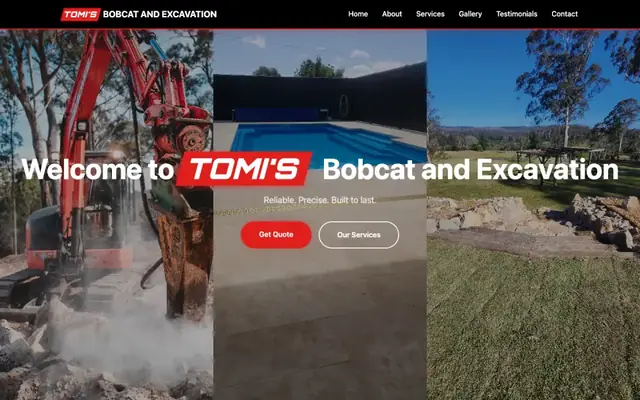
Home page of the Tomi's Bobcat and Excavation website

Tomi's Bobcat and Excavation

Trades & construction · South Pambula & Bega Valley

A bobcat and excavator business in South Pambula that builds structural landscaping, licensed pools and general earthworks around the Bega Valley. One page carries three service sections, a 42-photo gallery a client can swipe through on a phone, a carousel of testimonials and a contact form leading to a thank-you page. A Canberra crew doing walls, paving and planting could use the same layout with a section per district.

Home page of the Simple Engineers website

Simple Engineers

Professional services · Adelaide

Adelaide structural engineers designing retaining walls, slabs and stormwater systems for homeowners and builders. Its quote form shows fee ranges and accepts file uploads, the set-up we'd give a Canberra landscaper who wants survey plans, a garden design or an engineer's wall drawing to arrive with the enquiry.

“He listened to my feedback and made no hesitations to revise and adjust my website until we were completely happy with it.”

Tony Bleijswijk, Google review

★ 5.0 from 33 Google reviews (opens in a new tab)

Want numbers from a trade site? Western Sydney Stump Grinding has landed at least 62 jobs, about $46,500 of work, from a single-page site we built. Read the case study.

See all 14 recent client sites in our portfolio.

What a Canberra landscaper's website costs

One page

$399

Your services, gardens captioned by suburb, the districts you cover, a sentence on how you deal with protected trees, and a quote form that takes photos, on a single page. Enough for a maintenance round or a small planting crew.

Our suggestion for most Canberra landscapers

Up to 3 pages

$899

A home page, a projects page sorted by kind of job, and a new-home gardens page covering trees, planting area and the nature strip, each with the enquiry form that suits it.

Up to 8 pages

$1,499

Separate pages for walls and paving, new-home gardens, planting and irrigation, nature strips and maintenance, plus projects, an about page with your qualifications and memberships, and a page for the NSW towns you cover.

  • Payment. No deposit. We build your draft first, you ask for as many changes as you like, and you pay once you approve it. If you don't go ahead, you owe nothing.
  • GST. WebCraft Studio isn't registered for GST, so no GST is added.
  • Timing. Most sites are live within 5–10 days of us getting your words and photos; bigger sites (up to 8 pages) take 2–3 weeks.
  • Hosting. After launch, hosting is $30 a month: hosting, security monitoring, backups, email support and unlimited text and image changes on your existing pages. New pages or features are quoted first. No contract, cancel anytime.
  • Domain and email. We register your domain in your name (about $20 a year), connect it to your site and set up your business email.

See full pricing and what each package includes

Questions Canberra landscapers ask us

There's no landscaping licence in the ACT. What should our site show instead?

The things an owner would otherwise check on a register: finished jobs with the suburb and year, the insurance you carry, your qualifications, any membership of The Landscape Association, and reviews from named clients. If you hold an ACT builder licence, or a NSW contractor licence for structural landscaping over the border, those details go in the footer exactly as they appear on the licence.

Should our site explain tree protection zones?

Briefly. Owners don't need the whole Urban Forest Act, but a sentence saying you check whether a tree is protected before quoting work near it, and that you'll lodge the tree activity application or work with their arborist, answers a worry many of them have. We link to the City Services page on tree protection rather than restating it, and we don't give legal advice.

Is a page for new-home gardens worth it?

If you want work in the newer suburbs, usually yes. New houses need trees planted in a deep soil zone and a minimum planting area, and the final compliance certificate is a natural deadline for the first garden. A page setting out what your new-home package includes, with a finished example from Whitlam, Strathnairn or wherever you've worked, speaks to owners and to the builders who refer them. It needs the 3-page or 8-page site.

Can our site offer nature strip makeovers?

Yes, worded to fit the ACT Government's guidelines. Low plantings, mulch, edging and gravel on part of the strip don't need approval, so those can be offered as they are. For irrigation, the page can say that approval is needed and whether you prepare the site plan and application. It shouldn't offer synthetic turf, pavers or new trees on the verge, which the ACT Government's guidelines list as unlikely to be approved.

We also work in Queanbeyan and Googong. How should the site handle that?

Give those suburbs their own group on the service-area list, with your NSW licence details beside them if you do structural work there. Icon Water's watering rules cover Queanbeyan as well as Canberra, so irrigation advice can stay the same, but tree and approval questions on that side go to Queanbeyan-Palerang Regional Council. Updating the list later is a text change, covered by the $30 monthly hosting.

You're in Adelaide. How does working together run?

By phone and email. We're an Adelaide (South Australia) team working with businesses Australia-wide, and our current clients are in SA, NSW, VIC and QLD. You send photos of finished gardens, your own words for each service and the districts you cover; we send a draft link you can open on your phone, make as many changes as you ask for, and you pay once you approve it. We reply within 24 hours.

Start your Canberra landscaping website

Send us photos of a dozen finished gardens, the districts you work in, your own description of each service and any qualifications or memberships you'd like shown. We quote first, build the draft before you pay anything, and you pay only once you approve it.

We reply within 24 hours. Prefer email? info@webcraftstudio.com.au