Website Design for Builders in Hobart

Websites for Hobart builders and renovators that show the CBOS licence number and category an owner can check, keep heritage alterations, hillside homes and new builds in separate galleries, and take drawings, a budget and the property's overlays with the first enquiry.

What a Hobart builder's website should cover

An owner choosing a builder in Hobart is rarely comparing prices alone. One may be inside a heritage precinct, another up the hill may have a landslip band on the property report, and nearly all of them will sign a contract shaped by Tasmania's own rules on deposits, cooling-off and warranties. Your site can answer those points in your own words before anyone books a site visit.

  • Licence number and category, as CBOS shows them

    Tasmanian builders are licensed through CBOS, and a builder's licence is issued in one of four categories: Domestic, Low Rise, Medium Rise or Open. Your residential contracts already have to quote the licence number, so we put the number and category in the footer of every page, copied from the Occupational Licensing search, with a link that lets an owner look you up.

  • Heritage alterations shown on their own

    Hobart's planning scheme lists local heritage places and heritage precincts, and work on them usually needs a planning permit. The council's precinct datasheets class each building as contributory, non-contributory or neutral, which affects how much change is allowed, though alterations, additions and often rear-yard dwellings can still go ahead. A separate gallery of that work, with the street and the building's class in each caption, speaks directly to owners facing that process.

  • Hillside builds and the landslip overlay

    On sloping Hobart blocks, the planning scheme's Landslip Hazard Code maps landslip hazard bands, and building work inside them is assessed against that code. If you've built on piers, poured retaining walls or cut in a steep driveway, caption those projects with what the site needed. An owner who has just seen a landslip band on their property is looking for exactly that.

  • Your deposit and stages under Tasmanian law

    Residential contracts here have a capped deposit, a cooling-off period that starts once the owner holds the signed contract and the consumer guide, and progress payments tied to work done on site. A short process page stating your deposit, your stages and how you handle variations answers the money questions before an owner has to raise them.

  • Granny flats described by what you build

    In mid-2026 a draft amendment to the State Planning Provisions proposed lifting the maximum floor area of a secondary residence to 90 square metres, and HIA supported it in its submission. A page for granny flats and backyard studios should show finished ones and how you handle approvals, and leave out a maximum size, so a change to the rules doesn't leave the page wrong.

  • Enquiries that arrive with the drawings

    Alongside suburb, budget and hoped-for start, the form asks whether a building surveyor has been engaged, whether the property is heritage listed or in a precinct, and whether a landslip, flood or bushfire overlay applies. Plans, engineering and any planning permit attach as PDFs, so you know what you're pricing before you drive out.

  • Award entries with category and year

    Master Builders Tasmania's Awards for Excellence include renovation and addition categories split by price, restoration of heritage-listed or period buildings and a Small Builder award, and HIA runs Tasmanian Housing and Kitchen & Bathroom awards. Put the program, year and category under the project that earned it, where an owner reading about that build will see it.

Building in Hobart: Tasmanian contracts, the new planning scheme and the hills

Builders are licensed by Consumer, Building and Occupational Services (CBOS) under the Occupational Licensing Act 2005, and anyone can check a licence on its Occupational Licensing online search. The Act's old rule requiring licence numbers in advertisements was repealed from 1 January 2017, as our page for Hobart tradies explains, but a visible number still matters to owners who check. Under the Building Act 2016, notifiable and permit building work must be designed by a designer, carried out by a builder licensed for that work and inspected by a building surveyor, and it's the owner, not the builder, who must engage the building surveyor before notifiable work starts. A line in your process on how you work with the owner's surveyor saves explaining it at every first meeting.

Residential building contracts worth twenty thousand dollars or more come under the Residential Building Work Contracts and Dispute Resolution Act 2016. The contract must be written and signed, state your licence number, set out the statutory warranties and include a plain-language checklist, and the owner must also get the residential building consumer guide. The owner can withdraw within five working days of receiving both the signed contract and the guide. Deposits are capped at 5% of the price from fifty thousand dollars up, 10% below that, and 20% where more than half the work's value is done off site, as with a home built in a factory and delivered. Additions and variations the owner asks for must be written up and signed by both parties before that work starts, and owners have six years from practical completion to bring a claim for breach of a statutory warranty, a benefit later owners can also rely on. Disputes begin with a notice to the Director of Building Control, and since 1 July 2024 the Tasmanian Civil and Administrative Tribunal deals with the matters the Act sends to it.

Home warranty insurance is the point to be careful with. Parliament passed the Residential Building (Home Warranty Insurance Amendments) Act 2023, but its provisions start on days to be proclaimed, and in October 2026 the version of the contracts Act in force on Tasmanian Legislation Online still did not contain the new insurance part. Until it does, a Hobart builder's site shouldn't promise a home warranty policy. Describe the statutory warranties and any cover you do hold, and if the scheme starts, changing that wording is a text edit on an existing page.

In Hobart itself, the Tasmanian Planning Scheme and the Hobart Local Provisions Schedule have replaced the Hobart Interim Planning Scheme 2015. The change added 42 local heritage places, a historic landscape precinct for the southern Queens Domain and detailed datasheets for each heritage precinct, and introduced a new overlay for potentially flood-prone land; specific area plans such as the Lower Sandy Bay Escarpment plan add rules of their own. Places on the Tasmanian Heritage Register are of state significance, and proposals for them are referred to the Tasmanian Heritage Council. On the slopes, the Landslip Hazard Code overlay sits alongside the A and B landslip areas declared under the Mineral Resources Development Act 1995, and the Building Act 2016 bars erecting, altering or adding to a building in a declared landslip area unless the work is authorised under that Act. Tasmania Fire Service says about 98% of the state's land area is designated bushfire-prone, and our tradies page covers how BAL work should be described. Glenorchy, Clarence and Kingborough are separate planning authorities with their own maps, so check each job against the council it sits in.

Master Builders Tasmania has its head office at Cambridge, and its 2026 Awards for Excellence drew 196 entries. We're an Adelaide team and work with Hobart builders by phone and email, at the same prices as anywhere else. Our current clients are in SA, NSW, VIC and QLD, so the examples below come from Adelaide.
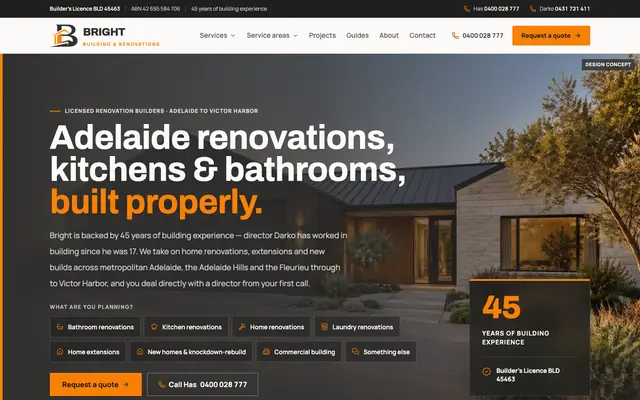

A builder's site and an engineer's site we've built

Neither of these is a Tasmanian business. Bright Building & Renovations is the closest match to a Hobart builder. Simple Engineers designs the retaining walls and slabs that hillside jobs depend on, and its quote form takes file uploads.

Home page of the Bright Building & Renovations website

Bright Building & Renovations

Trades & construction · Adelaide, Adelaide Hills & Fleurieu

A licensed South Australian builder doing renovations, extensions, new homes and commercial fit-outs across Adelaide, the Adelaide Hills and the Fleurieu. The 30 pages we built include separate pages for each service and each area, five planning guides, a project gallery, an FAQ and a seven-step quote form. A Hobart builder could follow the same plan with a heritage gallery and a page for each council area.

Home page of the Simple Engineers website

Simple Engineers

Professional services · Adelaide

Adelaide structural engineers who design retaining walls, concrete slabs and stormwater systems and prepare structural adequacy assessments for homeowners and builders. Its quote form shows fee ranges and accepts uploads, the set-up we'd use so an owner can send drawings and a landslip report with the first enquiry.

“My website is exactly how I wanted. I highly recommend Salem for any business wanting a professional website without the bull.”

Johannah Whilding, Google review

What a Hobart builder's website costs

One page

$399

Licence number and category, the build types you take on, five or six captioned projects, the councils you work in and a form that accepts drawings, on one scrolling page.

Up to 3 pages

$899

A home page, a projects page split into new homes and alterations, and a page on how a job runs: surveyor, contract, deposit, stages and handover.

Suits a builder with several kinds of work

Up to 8 pages

$1,499

A home page, pages for new homes, heritage alterations, sloping-site builds and granny flats, plus projects, your process and an about page with your memberships.

  • Payment. No deposit. We build your draft first, you ask for as many changes as you like, and you pay once you approve it. If you don't go ahead, you owe nothing.
  • GST. WebCraft Studio isn't registered for GST, so no GST is added.
  • Timing. Most sites are live within 5–10 days of us getting your words and photos; bigger sites (up to 8 pages) take 2–3 weeks.
  • Hosting. After launch, hosting is $30 a month: hosting, security monitoring, backups, email support and unlimited text and image changes on your existing pages. New pages or features are quoted first. No contract, cancel anytime.
  • Domain and email. We register your domain in your name (about $20 a year), connect it to your site and set up your business email.

See full pricing and what each package includes

Questions Hobart builders ask us

Do Tasmanian builders have to put a licence number on their website?

The advertising rule in the Occupational Licensing Act was repealed in 2017, so ask CBOS what applies to your own licence. Your residential contracts must still state the number, and owners can look it up on the CBOS online search. We'd show the number and licence category on every page, so the site and the contract match.

Should our site mention home warranty insurance?

Not as something you provide, unless you actually hold a policy for the job. As of October 2026, the 2023 Act that creates a Tasmanian scheme still hadn't been added to the in-force contracts Act. Describe the statutory warranties, which owners can enforce for six years from practical completion, and any cover you do hold, and point owners to CBOS for the rules. If the scheme starts, we update the wording; text changes on existing pages are covered by the $30 monthly hosting.

We do a lot of heritage work. How should it show?

As its own gallery or page. Caption each job with the street, whether the place was locally listed, on the Tasmanian Heritage Register or in a precinct, and what the brief was, such as a rear addition kept below the roofline or a façade restored. If an entry was a finalist in the Master Builders heritage restoration category, add the year. We leave planning rulings to the council and your designer.

Can owners send plans and reports with their enquiry?

Yes. The form accepts PDFs and photos and asks whether a building surveyor is engaged, whether the property is in a heritage precinct and whether a landslip, flood or bushfire overlay applies. The answers and attachments reach you by email, so you know the site before you price it.

Should our granny flat page quote a maximum size?

We'd leave it out. The limit is set in the State Planning Provisions, and a 2026 draft amendment proposed raising it to 90 square metres, so a number on your page could go out of date. Show finished secondary residences and studios, how you handle the planning and building approvals, and the services you connect, and point owners to their council for the current rule.

Do you need to come to Hobart to build our site?

No. We're an Adelaide (South Australia) web design team working with businesses Australia-wide by phone and email. Our current clients are in SA, NSW, VIC and QLD, and you'd pay the same prices as anyone else. You send your licence details, your wording and photos of finished jobs; we send a draft link, make the changes you ask for, and you pay once you approve it. We reply within 24 hours.

Start your Hobart builder's website

Send us your CBOS licence number and category, the councils you build in, your own wording and photos of finished jobs. We'll quote, build a draft you can check on your phone, and only ask for payment once you've approved it.

We reply within 24 hours. Prefer email? info@webcraftstudio.com.au