Website Design for Cabinet Makers

Websites for cabinet makers and joinery workshops that show finished kitchens, wardrobes and vanities room by room, let people book a showroom visit or a measure, and take plans from builders and designers along with the enquiry.

What a cabinet maker's website needs to show

Custom joinery is a slow, considered purchase. A homeowner may collect pictures of kitchens and robes for weeks before asking anyone to quote. A builder wants a workshop that turns up when the program says it will. A designer wants someone who'll make exactly what's drawn. Each of them judges you on two things: the finished work, and how easy you'll be to deal with.

  • A gallery sorted by room and finish

    Kitchens, butler's pantries, laundries, vanities, wardrobes and walk-in robes, entertainment units, studies and shop fit-outs each in their own group, so someone planning a robe isn't scrolling past twenty kitchens. Captions name the board or timber, the door profile, the benchtop and the handle style, which are the details people bring to a first meeting. A filter lets visitors narrow the gallery to the room they care about.

  • Showroom visits and measures people can book

    If you have a showroom or a display area at the workshop, give the address, the opening hours and whether visits are by appointment. A Book a visit button can open the scheduling tool you already use, or we can build booking into the site, quoted per job. For in-home measures, a request form asks for the suburb, the rooms involved and whether it's a renovation or a new build.

  • An enquiry form that takes drawings

    Builders and designers send architectural or joinery drawings; homeowners send phone photos of the space and rough measurements. The form accepts PDF plans and images alongside the rooms, the stage of the build or renovation and the date the joinery is needed on site, so you can price from real information instead of a vague description.

  • Design to install, step by step

    Set out how a job runs with you: first meeting, design and drawings, quote and sign-off, manufacture in your workshop, installation, and any trades you coordinate, such as the benchtop supplier, plumber or electrician. A typical lead time for each stage helps a builder slot you into a program and lets a family plan when the old kitchen comes out.

  • Licence and deposit terms stated clearly

    Fitting joinery on site can bring licensing in. Queensland's QBCC has a cabinet making licence class for installing, refurbishing, restoring or repairing fitted cabinets on site, and expects your licensed name and number on advertising, websites included. Its deposit guidance says up to 20% can be allowed where more than half the work by value is custom-built or fabricated off site, and gives bespoke kitchen cabinetry as an example. In NSW, residential building work over $5,000 including GST needs a contractor licence, and NSW Fair Trading's guidance says a licensee's name and licence number must be shown in all their advertising. We show the licence and deposit terms you give us.

  • Benchtop materials you can still supply

    If benchtops come with your cabinetry, list only what you can legally fit. Since 1 July 2024 it has been an offence for a business to manufacture, supply, process or install engineered stone benchtops, panels or slabs, and since 1 January 2025 they have been prohibited imports. The definition in the model WHS Regulations excludes sintered stone and porcelain products, provided they contain no resin. Old brochures and gallery captions are worth a check as well.

  • Memberships and designer credentials

    If you belong to the Australian Cabinet and Furniture Association, or one of your designers holds the Kitchen & Bathroom Designers Institute's Certified Kitchen Designer (CKD Au) or Certified Bathroom Designer (CBD Au) title, say so and name the person. KBDi is now a division of ACFA, and its certification involves a peer-reviewed assessment and ongoing professional development.

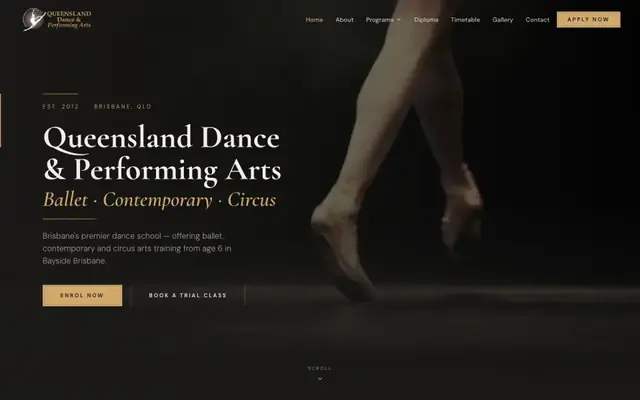
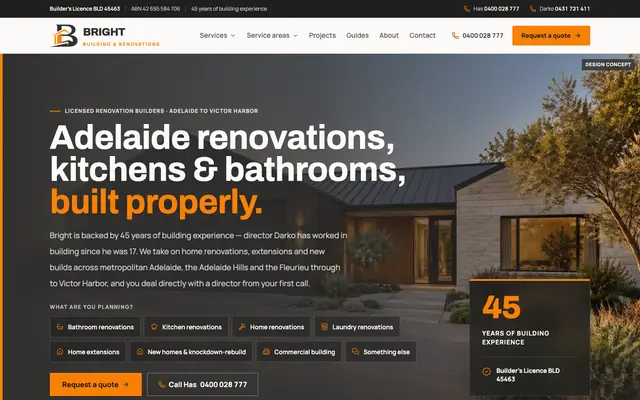
Our nearest work to a joinery website

No cabinet maker is in our portfolio yet, so we won't pass anything off as one. Bright Building & Renovations comes closest: an Adelaide renovation builder whose kitchen page explains how it works alongside the client's own cabinetmaker. Queensland Dance & Performing Arts is a different field altogether, but its filterable photo gallery is the kind of gallery a joinery workshop needs.

Home page of the Bright Building & Renovations website

Bright Building & Renovations

Trades & construction · Adelaide, Adelaide Hills & Fleurieu

A licensed South Australian builder. Its kitchen renovation page says plainly that Bright doesn't design kitchens or build cabinetry: the client's cabinetmaker installs the cabinets, and before rough-in Bright checks the cabinet drawings against plumbing, gas, power and ducting positions. It's the builder's half of a job that a cabinet maker's site describes from the other side.

Home page of the Queensland Dance & Performing Arts website

Queensland Dance & Performing Arts

Community, creative & tourism · Thorneside, Brisbane's Bayside

A dance school on Brisbane's bayside with a 12-page site, a weekly class timetable and an online enrolment form. Its photo gallery can be filtered, so visitors see only the kind of photo they're after. A cabinet maker's gallery would filter by room and finish instead of by class.

“My website is exactly how I wanted. I highly recommend Salem for any business wanting a professional website without the bull.”

Johannah Whilding, Google review

★ 5.0 from 33 Google reviews (opens in a new tab)

Want numbers from a trade site? Western Sydney Stump Grinding has landed at least 62 jobs, about $46,500 of work, from a single-page site we built. Read the case study.

See all 14 recent client sites in our portfolio.

What a cabinet maker's website costs

One page

$399

A gallery grouped by room, your process, licence details, showroom hours and an enquiry form that takes plans, on one page.

Our suggestion for most joinery workshops

Up to 3 pages

$899

A home page, a gallery page sorted by room and finish, and a page on your design process, showroom visits and sending plans.

Up to 8 pages

$1,499

For workshops doing kitchens, robes, bathrooms and commercial joinery: a page for each, the gallery, your process and showroom, and a trade page for builders and designers.

  • Payment. No deposit. We build your draft first, you ask for as many changes as you like, and you pay once you approve it. If you don't go ahead, you owe nothing.
  • GST. WebCraft Studio isn't registered for GST, so no GST is added.
  • Timing. Most sites are live within 5–10 days of us getting your words and photos; bigger sites (up to 8 pages) take 2–3 weeks.
  • Hosting. After launch, hosting is $30 a month: hosting, security monitoring, backups, email support and unlimited text and image changes on your existing pages. New pages or features are quoted first. No contract, cancel anytime.
  • Domain and email. We register your domain in your name (about $20 a year), connect it to your site and set up your business email.

See full pricing and what each package includes

Questions cabinet makers ask us

Can people book a showroom visit through the website?

Yes. A Book a visit button can open the scheduling tool you already use, set to the hours someone is in the showroom, or we can build booking into the site and quote it per job. If visits depend on who's free that week, a request form can collect preferred days, the rooms being planned and any drawings, and you confirm by phone.

Should we show prices for kitchens and wardrobes?

That's up to you. Some workshops give a starting price, or a range by size, so people can tell whether they're in the right place before calling. If you do, say what the figure includes. NSW Fair Trading's advertising guidance for building trades says you can't advertise only part of a cost unless the full single price is also clearly stated. Changing prices later is a text update covered by the $30 monthly hosting.

We sell to builders as well as homeowners. Should they get their own page?

If trade work is a real part of the business, yes. A trade page covers the jobs you take on (custom homes, multi-unit developments, shop fit-outs), how you work from architectural drawings, your insurance, and how to send a set of plans for pricing, written in your own words. Homeowners see the retail side first, and builders go straight to what they need.

What photos should we send?

Finished rooms photographed in daylight with the lights on, then a few close-ups of joins, handles, drawer interiors and edging, plus before photos wherever you have them. Phone photos are fine; we crop and size them so the gallery loads quickly. Clear benches of personal items before shooting, and skip anything showing a client's family or address.

Which package suits a cabinet maker?

A small workshop that gets most of its work through builders can start on the one-page site at $399. If you sell to homeowners, the 3-page site at $899 gives the gallery a page of its own. If you make kitchens, robes, bathrooms and commercial joinery and want a page for each plus a trade page, the 8-page site at $1,499 fits. A site that size takes 2–3 weeks once we have your words and photos.

Do you work with cabinet makers outside South Australia?

Yes. We're on Hutt St in Adelaide and work with businesses across Australia by phone and email; our current clients are in SA, NSW, VIC and QLD. You send the wording, photos and licence details for the site, and we send back a link to the full draft.

Ready to start your cabinet maker's website?

Send us photos of a few finished rooms, how your showroom visits or measures work, and your licence details. We'll quote first, build the draft, and you pay once you've approved it.

We reply within 24 hours. Prefer email? info@webcraftstudio.com.au