Website Design for Manufacturers

Websites for fabricators, machine shops, contract manufacturers and product makers that tell an engineer or buyer what you can make, in which materials and quantities, show the certifications their supplier list asks for, and take a request for quote with the drawings attached.

What a manufacturer's website needs to show

People reading a manufacturer's site are usually checking fit, not browsing. A design engineer wants to know whether you can hold the tolerance and handle the material. A procurement officer has a supplier form to fill in and needs your certifications. Someone with a product idea wants to know if you'll take a short run. Each of them decides on specifics, so the specifics belong on the page rather than in a brochure they have to request.

  • Capabilities described as processes and limits

    List what you do the way a drawing calls it up: CNC milling and turning, laser or waterjet cutting, press brake folding, MIG and TIG welding, powder coating, injection moulding, assembly. For each process, give the materials you work in, the largest part or sheet you can take, typical tolerances, and the run sizes you accept, from one-off prototypes to production batches. A buyer learns nothing from “precision engineering solutions”, and a great deal from your actual sheet sizes and thicknesses.

  • An equipment list engineers can read

    Machine make and model, bed or working envelope, number of axes, press tonnage, and inspection gear such as a coordinate measuring machine. Engineers use the list to judge capacity before sending a drawing, and it shows the investment in your plant. We set it out as a table that stays readable on a phone, and it's a simple page to keep current when a new machine arrives.

  • A request-for-quote form that takes drawings

    Quantity (with annual volume for ongoing work), material and finish, the date needed, delivery location, and an upload field for PDF drawings, DXF or STEP files and photos of an existing part. CAD models can be large, so the form also accepts a link to a file-sharing folder. A tick-box asking whether they'd like an NDA in place before sending full drawings tells customers you're used to protecting their designs.

  • Certifications named exactly

    Give the standard and the edition shown on the certificate, its scope, the certification body that issued it and the expiry date: ISO 9001 for quality, ISO 14001 for environmental management, ISO 45001 for health and safety. A buyer checking a supplier compares those details against the certificate, so “ISO certified” on its own doesn't help them. Structural steel fabricators certified by Steelwork Compliance Australia can name their AS/NZS 5131 construction category and AS/NZS ISO 3834 part, and link to SCA's list of certified companies.

  • Australian Made claims that hold up

    The green-and-gold kangaroo is a registered certification trade mark. It can only appear on products registered with the not-for-profit Australian Made Campaign Ltd, and always with a descriptor such as “Australian Made”, which means the product's last substantial transformation happened in Australia. So the logo sits beside the registered products rather than across the whole site. A product designed here but made offshore doesn't meet that test, so it's described as designed in Australia, without the logo.

  • Industries and jobs, written up with permission

    Buyers look for proof you've made parts like theirs. Group your work by the industries you supply, such as mining, agriculture, food processing or construction, and write up a handful of jobs: the part, the material, the quantity and what made it tricky. Where a customer's design is confidential, describe the job without naming them or showing the part, or use components you designed yourself.

  • Products, datasheets and where to buy

    If you make your own product line, each item needs specifications, a datasheet to download and a clear next step: an enquiry form, a list of distributors and stockists, or an online store. If you chase major-project work, link your supplier profile on Gateway by ICN, the Industry Capability Network's tool for major projects across Australia and New Zealand, from your about page.
The closest work in our portfolio

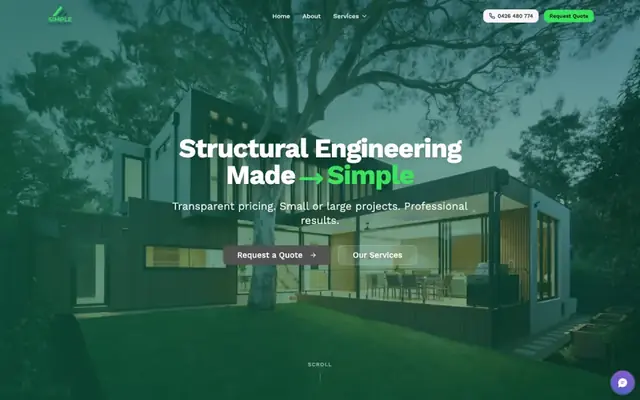
We haven't built a website for a manufacturer, and we'd rather say so than pass another client off as one. The nearest match is Simple Engineers, whose quote form takes uploaded files with each request, the part a manufacturer's RFQ form depends on, and shows a likely fee range. Under it is a Google review from a business client on how we quote.

Home page of the Simple Engineers website

Simple Engineers

Professional services · Adelaide

Structural engineers in Adelaide who design retaining walls, concrete slabs and stormwater systems and prepare structural adequacy assessments. Requests come through a quote form that shows a likely fee range and accepts uploaded files, backed by four service pages and 16 articles. For a fabricator, the same form becomes an RFQ that arrives with the drawing, quantity and material in one message.

“…Salem walked us through everything, gave us a fixed quote so we knew exactly what we were paying, and turned around the build faster than we thought possible.”

SA Tiling Pro Pty Ltd, Google review

What a manufacturer's website costs

One page

$399

A small job shop or sole fabricator: processes, materials, key machines, certifications, the industries you supply and an RFQ form, on one page.

A common fit for job shops and fabricators

Up to 3 pages

$899

A home page, a capabilities page with your processes and equipment list, and an RFQ page with the upload form, certifications and quality details.

Up to 8 pages

$1,499

A page for each process or product line, plus the equipment list, industries and case studies, quality and certifications, the plant, and the RFQ form.

  • Payment. No deposit. We build your draft first, you ask for as many changes as you like, and you pay once you approve it. If you don't go ahead, you owe nothing.
  • GST. WebCraft Studio isn't registered for GST, so no GST is added.
  • Timing. Most sites are live within 5–10 days of us getting your words and photos; bigger sites (up to 8 pages) take 2–3 weeks.
  • Hosting. After launch, hosting is $30 a month: hosting, security monitoring, backups, email support and unlimited text and image changes on your existing pages. New pages or features are quoted first. No contract, cancel anytime.
  • Domain and email. We register your domain in your name (about $20 a year), connect it to your site and set up your business email.

See full pricing and what each package includes

Questions manufacturers ask us

Can the quote form accept CAD files?

Yes. We set which file types it accepts, such as PDF, DXF, DWG and STEP, along with photos, and add a field for a file-sharing link when a model is too big to upload. The files arrive with the request, so whoever prices the job has the drawing, quantity, material and due date together.

How do we show our work when customers' designs are confidential?

Describe the job rather than the part: the industry, the process, the material, the batch size and the problem you solved. Use photos of the shop floor, your machines and parts whose design you own, and name customers only with their written OK. A line saying you'll sign an NDA before quoting reassures engineers sending sensitive drawings.

Should our ISO certificate go on the website?

Yes, stated in words on your quality page (the standard and edition, the scope and the certification body) with the certificate itself as a download. When you're recertified or move to a new edition of the standard, send us the new certificate. Updating the details on your existing quality page is covered by the $30 monthly hosting.

Can we sell products or spare parts online?

Yes. Our online stores start at $799 for up to 25 products with one payment gateway and basic order management, or $1,999 for unlimited products, multiple payment options, customer accounts and advanced shipping. For made-to-order items, a product page with an enquiry button often suits better than a cart.

Which package suits a manufacturer?

A small job shop can start with the one-page site at $399. Most fabricators and machine shops suit the 3-page site at $899: home, capabilities and equipment, and the RFQ page. Manufacturers with several processes or product lines, case studies and a quality page are better on the 8-page site at $1,499. A site that size takes 2–3 weeks once we have your words and photos.

We're not in Adelaide. Can you still build our site?

Yes. We're an Adelaide web design team working with businesses Australia-wide by phone and email, and our current clients are in SA, NSW, VIC and QLD. Send your capability statement, equipment list and photos of the plant, and we'll arrange them into pages and send you a link to the draft.

Ready to start your manufacturing website?

Send us your capability statement, equipment list and certificates, with a few photos of the plant and parts you're allowed to show. We'll quote it, build the full draft, and you pay once you've approved it.

We reply within 24 hours. Prefer email? info@webcraftstudio.com.au