Website Design for Transport and Logistics Companies

Websites for freight carriers, couriers, linehaul operators and warehousing businesses that let a shipper send what you need to price a load, show what your trucks can carry and where they run, and answer the safety questions a procurement team asks before it adds you to its carrier list.

What a transport company's website needs to do

Two kinds of customer read a carrier's website. A small business with a one-off pallet or a machine to shift wants to know whether you go to their postcode and how to get a price. A larger shipper's logistics or procurement team is checking capacity, regular lanes and how you manage safety. And drivers looking for their next job are reading it too.

  • A quote form that captures the freight

    Pickup and delivery suburbs or postcodes, what's being moved (pallets, cartons, machinery, a container, building materials), how many items with their dimensions and weight, whether any of it is dangerous goods, and what's at each end: a forklift, a dock, or the need for a tail-lift or hand unload. Then the date, any delivery window and whether it's a one-off or regular freight. Customers can attach a packing list or photos, so you can price the job without three follow-up calls.

  • The fleet, described by what it can carry

    A shipper doesn't need your truck brands; they need to know what you can take. Vans and small rigids for courier work, tautliners and flat tops by pallet spaces, tail-lift trucks, refrigerated units, tilt trays or crane trucks, with payload and deck length where it matters. Photos of your own vehicles in your livery say more than stock pictures of a highway at sunset.

  • Routes and coverage set out like a timetable

    Metro zones, regional runs and interstate linehaul, written as the days and transit times you actually run, plus the areas you don't cover. A business in a country town wants to see its town named; a shipper with weekly freight wants to know which nights the truck leaves. On a bigger site, a depot or a busy lane can have a page of its own.

  • Accreditation worded for the scheme you're in

    Updates to the Heavy Vehicle National Law and the new Heavy Vehicle Accreditation (HVA) scheme took effect on 1 August 2026. The NHVR no longer grants new NHVAS accreditation, but existing operators can keep working under NHVAS until theirs expires, and an operator can only be accredited in one scheme at a time. So the site names the one you hold: your NHVAS modules, such as mass, maintenance and basic or advanced fatigue, or your HVA accreditation, starting with General Safety Accreditation, the scheme's foundation tier. The HVNL hasn't commenced in Western Australia or the Northern Territory, and in WA, Main Roads' WA Heavy Vehicle Accreditation is mandatory for anyone who uses a permit or order.

  • Answers for shippers about chain of responsibility

    The NHVR lists consignors, consignees, packers, loading managers, loaders and unloaders among the parties in the chain of responsibility, alongside operators, schedulers and employers. Each has a primary duty to ensure, so far as is reasonably practicable, the safety of its transport activities. That's why a customer's procurement team asks how you manage fatigue, maintenance, mass and load restraint. A page setting out your approach in your own words, with a named contact for compliance questions, answers much of that before the questionnaire arrives.

  • Dangerous goods, stated exactly

    If you carry dangerous goods, say which classes, whether you take packaged or bulk loads, and the licences your vehicles and drivers hold for it. The NTC lists Edition 7.9 as the current Australian Dangerous Goods Code, mandatory from 1 October 2025, so when a shipper asks which edition you work to, the answer is already on the page. If you don't carry DG at all, one plain line saying so saves you a pointless quote request.

  • A careers page that recruits drivers

    Drivers want the licence class each role needs (HR, HC or MC for heavier work), whether it's local, regional or linehaul, the roster, the start location and the vehicles they'll drive. A short application form asks for licence class, experience and availability with a résumé attached, and each opening gets its own listing you can update or take down with an email to us.

The closest work we have for a transport business

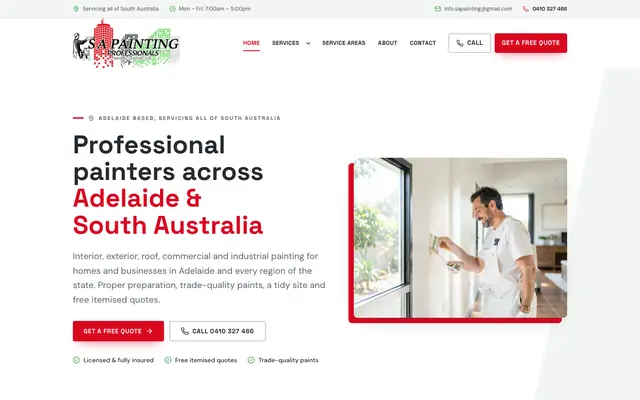
We haven't built a website for a transport or logistics company, and we'd rather tell you that than dress something else up. Two client sites cover parts a carrier relies on: SA Painting Professionals lets visitors check their suburb or postcode against the regions it serves, and Simple Engineers' quote form takes file uploads.

Home page of the Simple Engineers website

Simple Engineers

Professional services · Adelaide

Adelaide structural engineers designing retaining walls, slabs and stormwater. Their quote form shows fee ranges and accepts uploaded files, which is how a freight form can take a packing list, a consignment schedule or photos of an awkward load.

“Rebuilt two websites for our businesses and saved us a fortune on hosting etc. Nothing is ever a problem, will email back on a Saturday night if need be.”

Lockyer Valley Batteries, Google review

What a transport company website costs

One page

$399

An owner-driver or small courier: what you carry, where you go, your vehicles, accreditation and a freight quote form, on one page.

Our suggestion for most carriers

Up to 3 pages

$899

A home page, a fleet and services page with your routes and coverage, and a quote page with the freight form and your safety and accreditation details.

Up to 8 pages

$1,499

Separate pages for linehaul, metro and regional work, warehousing, dangerous goods, safety and compliance, depots and driver careers.

  • Payment. No deposit. We build your draft first, you ask for as many changes as you like, and you pay once you approve it. If you don't go ahead, you owe nothing.
  • GST. WebCraft Studio isn't registered for GST, so no GST is added.
  • Timing. Most sites are live within 5–10 days of us getting your words and photos; bigger sites (up to 8 pages) take 2–3 weeks.
  • Hosting. After launch, hosting is $30 a month: hosting, security monitoring, backups, email support and unlimited text and image changes on your existing pages. New pages or features are quoted first. No contract, cancel anytime.
  • Domain and email. We register your domain in your name (about $20 a year), connect it to your site and set up your business email.

See full pricing and what each package includes

Questions transport companies ask us

Can customers track their freight through our website?

Yes, through the tracking your transport management system already provides. We put a Track a consignment button in the header that opens your system's tracking page or customer portal, and account customers get a login link in the same spot. Your system keeps the consignment data and the proof of delivery; the website just gets people there in one tap.

What should we say about accreditation now NHVAS is closed to new operators?

Exactly what you hold today. If your NHVAS accreditation is current, list the modules and keep them on the site until it expires or you move across. If you've moved to the Heavy Vehicle Accreditation scheme, name that instead. The NHVR's NHVAS transition page (opens in a new tab) sets out the options by expiry date. When your status changes, send us the new wording: text updates are covered by the $30 monthly hosting.

Should every depot or route have its own page?

Only the ones customers search for or ask about. A depot in another city, with its address, hours, a contact and the area it serves, earns a page on a bigger site, and so does an interstate lane you run on a fixed schedule. Occasional runs fit better as a list on your routes page. A one-truck operator rarely needs more than a clear list of suburbs and towns.

Can customers book and pay for small consignments online?

Yes. We build booking and payment systems into websites, quoted per job, which can suit a courier or a business sending parcels and single pallets at set rates. If your transport software already has a customer booking page, we can link to that instead. Freight that needs a custom price stays on the quote form.

Which package suits a transport company?

An owner-driver or courier can start with the one-page site at $399. Most carriers suit the 3-page site at $899: home, fleet and routes, and a quote page. Operators with linehaul, warehousing, dangerous goods or several depots are better on the 8-page site at $1,499. A site that size takes 2–3 weeks once we have your words and photos.

We're not in South Australia. Can you still build our site?

Yes. We're a web design team at Ste 3/110 Hutt St, Adelaide, working with businesses Australia-wide by phone and email, and our current clients are in SA, NSW, VIC and QLD. You send your fleet list, routes, words and photos, and we send back a link to the draft to check on your phone or at the depot.

Ready to start your transport company's website?

Tell us what you carry, where you run and which accreditation you hold, and send a few photos of the fleet. We'll quote it, build the full draft, and you pay once you've approved it.

We reply within 24 hours. Prefer email? info@webcraftstudio.com.au