Website Design for Flooring Businesses

Websites for flooring installers, floor sanders and flooring showrooms that help a homeowner choose between hybrid, timber, laminate, vinyl and carpet, then book a measure with the rooms and rough sizes already filled in.

What a flooring website needs

Most people shopping for new floors start with the product, not the installer. They want to know whether hybrid or laminate is better with a big dog, whether engineered boards can go straight over a slab, or whether the old pine under the carpet is worth sanding back. A site that answers those questions in your words, shows rooms you've finished and makes the measure easy to book saves you having the same conversation on the phone over and over.

  • A section for each floor type you lay

    Hybrid, laminate, engineered timber, solid timber, bamboo, vinyl plank, carpet, epoxy, and sanding and polishing each draw different searches and different customers. Each gets a short explanation, written by you, of where it suits, what it's like to live with and what the subfloor needs, next to photos of rooms where you laid it. On the 8-page site, the floor types you most want to sell get a page each.

  • Book a measure and quote

    The form asks for the suburb, which rooms and their rough size, what's on the floor now and what's under it, any stairs, whether furniture needs moving, when they'd like the job done and which days suit for a measure. Customers can attach photos of each room. If you already book measures through a scheduling tool, the button can open it, or we can build appointment booking into the site, quoted per job.

  • What the square-metre price covers

    If you quote per square metre, list what that includes and what's extra: underlay, trims and scotia or new skirting, lifting and disposing of the old floor, moving furniture, levelling, and stairs if you price them separately. Spelling it out up front heads off arguments when the invoice arrives.

  • Showroom hours, samples and the ranges you stock

    If you have a showroom, its address, opening hours (Saturdays especially), parking and a map go on every page, along with whether people can borrow samples to try at home. If you stock particular ranges, name them with the supplier's agreement and follow their rules on logos, and give product names and colours so customers can ask for a sample by name.

  • Subfloor checks and older homes

    Say what happens before a floor goes down: moisture readings on a concrete slab, grinding or levelling high spots, and leaving timber to acclimatise. Older houses need a line too. The Asbestos and Silica Safety and Eradication Agency says buildings constructed or renovated before 1990 are likely to contain some asbestos, and lists underneath carpet or vinyl flooring among the places it turns up. Saying what you do if you find suspect material, such as stopping work and referring that part of the job to a licensed removalist, tells a careful buyer you've thought about it.

  • Licence and association details in the footer

    Queensland's QBCC has a floor finishing and covering (hard sector) licence, covering sanding and coating timber floors, laying engineered and pre-finished timber, parquetry, cork and epoxy, and it counts a website as advertising, so the licensee's name and licence number go on it. In NSW, non-structural floor coverings haven't been licensed since 2009, although load-bearing timber floors come under the carpentry licence. If you belong to the Australasian Timber Flooring Association, your membership goes here as well.

  • Finished rooms with the product named

    When someone sees a floor they like, the first thing they ask is what it is. Caption each finished room with the floor type, range or colour and the suburb, and pair sanding jobs as before and after: grey, worn boards beside the same room freshly coated. Original boards brought back in an old cottage tell a different story from hybrid planks in a new townhouse, and both are worth showing.

Sites we've built that a flooring business can learn from

We haven't built a site for a flooring business. The two closest are an Adelaide renovation builder whose site gives each type of work its own page, and an engineering firm whose quote form takes photos and shows a fee range, which is close to how a measure-and-quote form works. The review is from SA Tiling Pro Pty Ltd, a tiling company, about working with us.

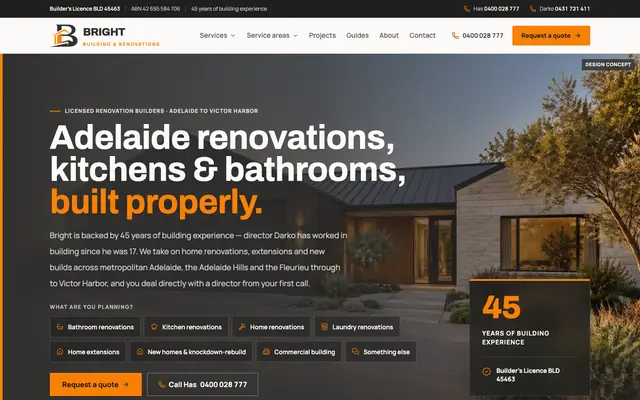
Home page of the Bright Building & Renovations website

Bright Building & Renovations

Trades & construction · Adelaide, Adelaide Hills & Fleurieu

Kitchen, bathroom, laundry and whole-home renovations across Adelaide, the Adelaide Hills and the Fleurieu. The 30-page site has seven service pages, seven service-area pages, planning guides and a project gallery, and its seven-step quote form gathers the job details before the first call. A flooring business would follow the same pattern with a page per floor type.

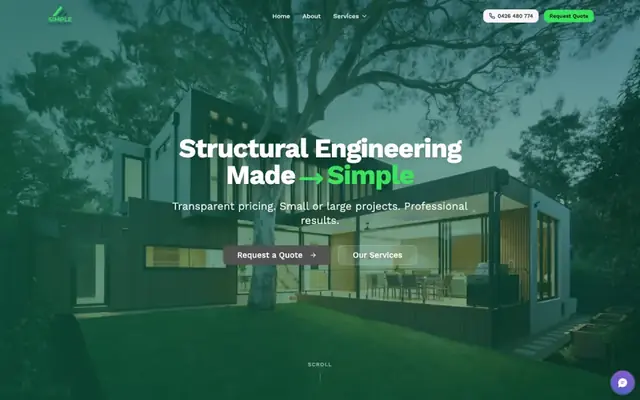
Home page of the Simple Engineers website

Simple Engineers

Professional services · Adelaide

Adelaide structural engineers working on retaining walls, slabs and stormwater. Their quote form shows customers an estimated fee range and accepts up to five uploaded photos, plans or documents. For flooring, the same idea becomes a price range per square metre and a photo of each room.

“…Salem walked us through everything, gave us a fixed quote so we knew exactly what we were paying, and turned around the build faster than we thought possible.”

SA Tiling Pro Pty Ltd, Google review

★ 5.0 from 33 Google reviews (opens in a new tab)

Want numbers from a trade site? Western Sydney Stump Grinding has landed at least 62 jobs, about $46,500 of work, from a single-page site we built. Read the case study.

See all 14 recent client sites in our portfolio.

What a flooring website costs

One page

$399

For a floor sander or installer working alone: floor types, finished rooms, what the square-metre price covers, licence details and a book-a-measure form.

Our suggestion for most flooring businesses

Up to 3 pages

$899

A home page, a page on the floors you lay with photos of each, and a page covering pricing, measure bookings and your showroom.

Up to 8 pages

$1,499

For showrooms and installers with several crews: a page each for timber, hybrid and laminate, carpet, and sanding and polishing, plus about, showroom, gallery and booking pages.

  • Payment. No deposit. We build your draft first, you ask for as many changes as you like, and you pay once you approve it. If you don't go ahead, you owe nothing.
  • GST. WebCraft Studio isn't registered for GST, so no GST is added.
  • Timing. Most sites are live within 5–10 days of us getting your words and photos; bigger sites (up to 8 pages) take 2–3 weeks.
  • Hosting. After launch, hosting is $30 a month: hosting, security monitoring, backups, email support and unlimited text and image changes on your existing pages. New pages or features are quoted first. No contract, cancel anytime.
  • Domain and email. We register your domain in your name (about $20 a year), connect it to your site and set up your business email.

See full pricing and what each package includes

Questions flooring businesses ask us

Does a flooring business need its licence number on the website?

In Queensland, if you hold a QBCC licence, yes. The QBCC's advertising rules (opens in a new tab) list websites and social media pages as advertising, and they require the name you're licensed under and your licence number; unlicensed contractors have to state the value of work they're limited to instead. In NSW, non-structural flooring isn't licensed, but structural timber floors fall under carpentry. Other states set their own rules, so check with your regulator, and we'll show whatever details apply.

Can customers book a measure online?

Yes, in one of three ways: a request form where they choose preferred days and you confirm by phone, a button that opens the scheduling tool you already use, or a booking calendar built into the site, which we quote per job. The request form is the simplest place to start, because a measure often needs a quick call anyway to talk through the product.

Should we publish prices per square metre?

If your prices are fairly steady, a starting price for each floor type, with what it includes, helps people set a budget before you visit. Supply-and-install prices move with supplier costs, so keep them broad and change them whenever you need to; text changes are covered by the $30 monthly hosting.

We do commercial floors as well. Should they have their own page?

If commercial work is a real part of the business, yes. Epoxy in warehouses and garages, sheet vinyl in clinics or carpet tiles in offices are bought by builders, fit-out managers and facility managers, who want project photos, the systems you install and your insurance, not advice on which floor suits a family with a dog. A separate page keeps both audiences reading what's relevant to them.

Which package suits a flooring business?

A floor sander or installer working alone can start with the one-page site at $399. Most flooring businesses suit the 3-page site at $899 because the floor types get room for photos and the measure booking gets a page of its own. Showrooms and installers with several floor types to sell are better on the 8-page site at $1,499. A site that size takes 2–3 weeks once we have your words and photos.

Do you work with flooring businesses outside Adelaide?

Yes. We're a web design team based in Adelaide, working with businesses across Australia by phone and email, and our current clients are in SA, NSW, VIC and QLD.

Ready to start your flooring website?

Send us the floor types you lay, a few photos of finished rooms and the areas you cover. We'll quote it and build the draft, and you pay once you've approved it.

We reply within 24 hours. Prefer email? info@webcraftstudio.com.au