Website Design for HVAC and Air Conditioning in Adelaide

Websites for Adelaide split system installers, ducted reverse cycle contractors and evaporative cooling specialists, made by a team on Hutt St. Your BLD licence number and your ARC refrigerant trading authorisation sit where a careful customer looks for them, the work you want more of is named plainly, and someone in Salisbury with a dead unit on a 45-degree afternoon can ring you with one tap.

What an Adelaide air conditioning website has to do

Adelaide asks a lot of a cooling system in January and a fair bit of a heater in July, often in the same house. Before ringing anyone, a customer wants three answers: whether you're licensed in South Australia for the job, whether you come out to their suburb, and whether you handle what they have in mind, from one split in a Unley bedroom to replacing a tired roof-mounted evaporative unit in Golden Grove with ducted reverse cycle.

  • Your BLD number and ARC details, on every page

    CBS treats air-conditioning on a house as domestic building work, so the business contracting for it needs a building work contractor's licence, whose number begins with BLD and has to appear in any advertisements. We set it in the footer of every page beside your Australian Refrigeration Council details: the refrigerant trading authorisation the business holds to buy and store refrigerant, and whether your technicians hold the full refrigerant handling licence or the restricted one for single-head splits.

  • A REPS page that sticks to what you actually deliver

    If you're an activity provider under the Retailer Energy Productivity Scheme, or you install for one, a page can name the provider, say who the offer is for, list which of the four heating and cooling activities you carry out, and describe the visit from booking to removal of the old unit. Linking to ESCOSA for the scheme's own rules keeps the page accurate when they change.

  • Evaporative work in its own section

    People with a roof-mounted ducted evaporative cooler search for pad changes, pump and motor repairs and replacement units, not for split systems. If you service them, give that work a heading of its own, photos of your own jobs, and a line on who connects the water and the drain. If you also convert evaporative homes to ducted reverse cycle, say so on the same page.

  • A breakdown form for heatwave week

    When the forecast shows a run of 40-degree days, calls arrive faster than anyone can answer them. A short form asking for the suburb, the system type, the error code on the controller and a picture of the rating plate lets you separate urgent breakdowns from new install enquiries, and call back the elderly customer in Elizabeth before the quote request from Norwood.

  • Winter heating, especially for the Hills

    Reverse cycle heating has its own season of searches. A heating page covering swapping old fixed electric heaters for an efficient unit, adding a head to a cold back bedroom, or ducted heating for a home in Stirling or Mount Barker gives you something to send people to from April, when the cooling enquiries have gone quiet.

  • Brand appointments, explained for warranty claims

    Name the manufacturers that have appointed you as a dealer or specialist installer, and say what that changes when a customer needs a warranty repair or parts. Brands you can supply without an appointment go in the services text instead, and a manufacturer's logo goes on the page only where your dealer agreement allows it.

  • Service plans for spring and autumn

    A pre-summer clean in September and a heating check in March or April keep the vans moving between the two peaks. A page setting out what each visit covers, how long it takes, the price if you choose to publish it and whether you send reminders turns a one-off install customer into a regular, and gives property managers one link to forward to their landlords.

Licences, REPS, heat and noise: the South Australian detail

Who may contract, and who may do the work. Consumer and Business Services (CBS) licenses air conditioning businesses in South Australia. Its building licence FAQs list air-conditioning as domestic building work, and a building work contractor's licence carries conditions stating the type of work the holder may contract for. The licence number starts with BLD and has to appear on domestic building contracts and in any advertisements. CBS's factsheet for electricians adds that a building work contractor's licence can authorise electrical work as well as other building work, while an electrical contractor's licence suits a business whose only contract work is electrical. Whoever does the hands-on electrical work needs worker registration, which CBS says may be restricted to refrigeration and air conditioning equipment, covering tasks such as disconnection, reconnection and finding and repairing faults, and the work is certified with an electronic certificate of compliance. Our Adelaide electricians page covers the advertising rule for electrical contractors, and our Adelaide plumbers page covers gas fitting, if you connect gas heating. Refrigerant is a separate, national matter run by the Australian Refrigeration Council (ARC). A business that buys, stores or disposes of refrigerant needs a refrigerant trading authorisation, and each technician who handles it needs a refrigerant handling licence: either the full licence for air conditioning and refrigeration work outside the automotive industry, or a restricted licence for installing and decommissioning single-head splits, and two-part hot water and pool heat pumps, under 18 kW. ARC's Look for the Tick site lets customers search for an authorised business and check a technician's licence. CBS does take unlicensed work to court: in 2017 it reported an air-conditioning company pleading guilty to carrying on business as a building work contractor and an electrical contractor without a licence, after taking deposits to install and remove air-conditioning units in Adelaide and on Yorke Peninsula.

REPS upgrades. The Retailer Energy Productivity Scheme sets energy productivity targets for retailers, and ESCOSA's target table shows a first stage from 2021 to 2025 and a second from 2026 to 2030. For the second stage the table keeps a priority group target but sets the household sub-target to zero, so check with the retailer or provider you work with who qualifies before a page suggests an upgrade is open to every home. Households reach the scheme through an obliged retailer or an activity provider, and ESCOSA's list of providers shows four heating and cooling activities: HC2A, an efficient non-ducted reverse cycle air conditioner; HC2B, ducted or multi-split reverse cycle; HC2C, connecting a new or existing system to an approved demand response aggregator; and HC3, an efficient ducted evaporative air conditioner. The 2026 specifications go into detail. Under HC2A the unit must be single phase, rated at no more than 15 kW of cooling, carry a warranty of at least two years and have demand response capability under AS/NZS 4755; multi-splits aren't eligible, and where an old room air conditioner or fixed electric heater is being replaced, it has to be decommissioned and taken off the property. Under HC3 the evaporative cooler must be at least 7 kW and run through ductwork rated R1.0 or better, it must not discharge water to a drinking supply such as a household water tank, and the plumbing has to be done by a licensed plumber. ESCOSA tells households that taking part is voluntary, that a provider or installer must not pressure, harass or coerce them, and that fixed upgrades such as air conditioners aren't suitable for a rental unless the landlord has given written permission. It also doesn't set or publish prices for REPS activities, so any price on your page is yours to state and explain.

Heat across the plains. On 24 January 2019 the Bureau of Meteorology recorded 46.6°C at the official West Terrace / ngayirdapira site, a new record there that beat 46.1°C from January 1939, and 47.7°C at both Kent Town and Parafield Airport. The same afternoon reached 47.5°C at Edinburgh RAAF, 46.2°C at Noarlunga, 45.8°C at Adelaide Airport near the coast and 44.5°C at Mount Barker. The spread is a reminder that the city behaves like several when the phones start ringing. We group your suburbs the way customers think of them, from the northern suburbs and the coast to the foothills and the Hills, with Gawler or the Fleurieu added if you travel that far, and note which areas get same-day breakdown visits. Heating earns space on the site too: in 2019 Parafield Airport fell to −1.8°C on 24 June, and the coldest day at Mount Lofty only reached 4.9°C.

Noise from the outdoor unit. In South Australia, a neighbour unhappy with an air conditioner is encouraged to talk to the owner first, and a complaint can then go to the local council under the Local Nuisance and Litter Control Act 2016. For fixed machines on domestic premises, such as an air conditioner or a pool pump, the test isn't limited to particular hours: it turns on whether the noise travels into a habitable room, an outdoor courtyard or an entertainment area next door and unreasonably interferes with the neighbours' enjoyment of their home. The City of Holdfast Bay lists air conditioning units among the sources of local noise nuisance. On a townhouse site or a tight infill block, a sentence about how you pick the spot for the condenser, and a quote form that asks how close the neighbour's windows are, shows a buyer you've considered it.

Where we fit. WebCraft Studio is an Adelaide team at Ste 3/110 Hutt St. Most projects run by phone and email, Adelaide ones included, which suits an installer who spends the day in roof spaces; if you'd like to meet before we start, that can be arranged. We haven't built a site for an air conditioning or HVAC business yet, so the work below is the closest we have. You send your licence numbers, the suburbs you cover, the brands you're appointed for and photos of finished installs, and we send back a draft link to check on your phone.

South Australian sites we've built

There's no heating and cooling business in our portfolio yet, and we'd rather say so than stretch it. These two Adelaide clients show the pieces an air conditioning site depends on: a form that collects the details before you drive out, and a page for each area you service.

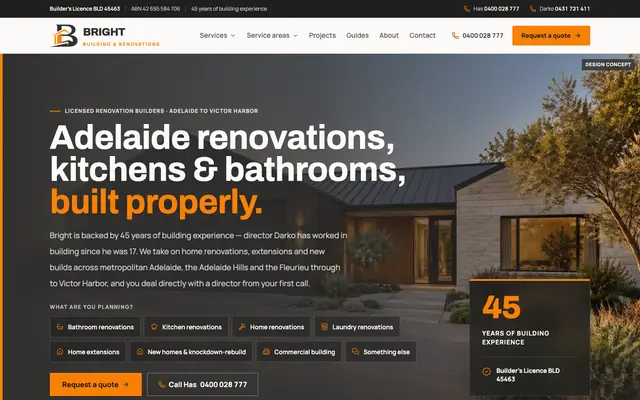
Home page of the Bright Building & Renovations website

Bright Building & Renovations

Trades & construction · Adelaide, Adelaide Hills & Fleurieu

A licensed South Australian builder working across Adelaide, the Adelaide Hills and the Fleurieu. Its 30-page site has seven service-area pages and a seven-step quote form, the same approach that could take a customer through system type, rooms to condition and roof access before they ask for a ducted quote.

Home page of the Simple Engineers website

Simple Engineers

Professional services · Adelaide

Adelaide structural engineers. Their quote form shows fee ranges and accepts file uploads, so an installer's version could ask for pictures of the meter box, the existing unit's rating plate and the wall where a new head would go, alongside the service pages and articles.

“Rebuilt two websites for our businesses and saved us a fortune on hosting etc. Nothing is ever a problem, will email back on a Saturday night if need be.”

Lockyer Valley Batteries, Google review

★ 5.0 from 33 Google reviews (opens in a new tab)

Want numbers from a trade site? Western Sydney Stump Grinding has landed at least 62 jobs, about $46,500 of work, from a single-page site we built. Read the case study.

See all 14 recent client sites in our portfolio.

What an air conditioning website costs in Adelaide

One page

$399

Splits, ducted and evaporative work on one page, with your BLD licence number, your ARC authorisation, the suburbs you cover, a breakdown form that takes a photo and a call button.

Suits installers doing splits, ducted and evaporative

Up to 3 pages

$899

A home page for installs and breakdowns, a page for REPS or evaporative work (whichever brings you more jobs), and a page for service plans and winter heating.

Up to 8 pages

$1,499

For larger crews: separate pages for splits, ducted reverse cycle, evaporative, REPS upgrades, commercial work, service plans and the parts of Adelaide you travel to.

  • Payment. No deposit. We build your draft first, you ask for as many changes as you like, and you pay once you approve it. If you don't go ahead, you owe nothing.
  • GST. WebCraft Studio isn't registered for GST, so no GST is added.
  • Timing. Most sites are live within 5–10 days of us getting your words and photos; bigger sites (up to 8 pages) take 2–3 weeks.
  • Hosting. After launch, hosting is $30 a month: hosting, security monitoring, backups, email support and unlimited text and image changes on your existing pages. New pages or features are quoted first. No contract, cancel anytime.
  • Domain and email. We register your domain in your name (about $20 a year), connect it to your site and set up your business email.

See full pricing and what each package includes

Questions Adelaide air conditioning businesses ask us

Which licence numbers should an Adelaide air conditioning website show?

Your building work contractor's licence number, which begins with BLD, any electrical contractor's licence the business also holds, and your ARC refrigerant trading authorisation, with a line saying your technicians hold refrigerant handling licences. CBS requires licence numbers in advertisements, and its guidance for electrical licence holders names websites specifically. We put the numbers in the footer of every page and next to your phone number.

We deliver REPS upgrades. What should the site say?

Who the activity provider is (you, or the business you install for), which heating and cooling activities you carry out, and what happens on the day, including taking away the old unit or heater. ESCOSA doesn't set REPS prices, so if you publish a price, say who it applies to. For the scheme's own rules, link to ESCOSA rather than rewording them.

Is noise worth a mention on our site?

A short one. In South Australia, complaints about air conditioners go to councils under the Local Nuisance and Litter Control Act 2016, and for fixed machines like an outdoor unit the question is whether the noise reaches a neighbour's habitable room, courtyard or entertaining area and unreasonably interferes, whatever the hour. A line on how you position condensers tells townhouse owners you've thought it through.

Can customers book a service online?

Yes. We can build online booking into the site and quote it with the rest of the job, or link the booking page your job management software already provides. Plenty of installers start with a request form asking for the suburb, the system and a photo of the rating plate, then confirm a time by phone.

We cover Gawler, the Hills and the Fleurieu as well as the metro area. How should the site show that?

With suburbs grouped by area on the home page, and on a larger site a page for each region you want more work from, put together from your notes on the jobs you do there. Bright Building's site has seven service-area pages built that way. If a region only gets installs and not breakdown visits, its page says so.

Have you built a website for an air conditioning business?

Not yet. Our South Australian trade clients are a renovation builder and a painting company, and our plumbing and gas client is in Queensland. Their sites are linked from our portfolio, so you can try the forms and call buttons on your phone. We're at Ste 3/110 Hutt St, we reply within 24 hours, and there's nothing to pay until you approve your site.

Ready to start your Adelaide air conditioning website?

Send us your BLD licence number, your ARC authorisation details, the suburbs you cover and photos of a few finished installs. We'll quote first and build the draft, and you pay only once you've approved it.

We reply within 24 hours. Prefer email? info@webcraftstudio.com.au