Website Design for Window Tinting Businesses

Websites for car tinters and home and commercial window film installers that keep the two kinds of customer apart, explain shades and film specs in plain terms, and either book a car in or collect window sizes for a quote.

What a window tinting website needs to cover

Most tinting businesses serve two quite different customers. A car owner wants to know how dark they can legally go, which film you use, what it costs for their model and when they can drop the car off. A homeowner with a west-facing living room, or an office manager fighting glare on screens, wants to know how much heat and light a film will cut, how it looks from the street and whether it's safe on their glass.

  • Separate paths for cars and for buildings

    Two clear routes from the home page, one for vehicles and one for homes and businesses, each with its own photos, prices or quote form and questions answered. A homeowner shouldn't have to scroll past ute packages, and a car owner shouldn't land on a page about office glare. On a one-page site, they become two distinct sections, each with its own button.

  • The legal limits for the states you work in

    How dark is legal? That's usually the first question. In the ACT, which applies the national standard, a car's front side windows need a light transmittance of at least 35%, the windows behind the driver at least 20%, and the windscreen can only take a strip across the top. Each state and territory sets its own rules, so show the figures for the ones you work in, link the transport department's page, and photograph each shade on a real car.

  • Film specs in a table, not a sales pitch

    List the films you stock with visible light transmission, UV rejection, solar heat rejection and warranty term, using each manufacturer's published figures. For home and commercial film, WFAANZ's WERS For Film program publishes independently verified data, including heating and cooling percentages, SHGC, U value and VLT. It no longer uses star ratings, so an old 'five-star film' line on a site is worth replacing with the current numbers.

  • A home quote form that asks about the glass

    How many windows and roughly what size, which way they face, single or double glazed, and a photo of each. The glass matters as much as the film: an industry column in Building Connection notes that annealed glass, laminated float included, is more prone to thermal stress breakage than toughened glass, and that heat-absorbing films added after installation can contribute. Asking up front lets you check the film suits the glass before you quote.

  • Car bookings built around the vehicle

    Make, model and body type (sedan, hatch, SUV, wagon or ute), which windows, the shade wanted and whether old film has to come off first. That's enough to price the job and give it the right slot. Say how long you need the car, whether there's a waiting area or a lift back, and the aftercare, such as how long the windows stay up.

  • Warranties explained in the maker's terms

    If you're an authorised installer for a film brand, say so and describe the manufacturer's warranty the way the maker does, linking its own page. If you also give a workmanship warranty of your own, the Australian Consumer Law sets what a written warranty against defects has to contain, including mandatory wording about consumers' rights, which has applied to services since June 2019.

  • Membership, and the jobs you do and don't take

    If you're a member of the Window Film Association of Australia and New Zealand, say so: its website has a member directory for people looking for a local tinter. Then be specific about scope. Some tinters don't do frosted or decorative film, security film or high-rise commercial work, and a line saying so saves everyone a phone call.

Client sites closest to a tinting business

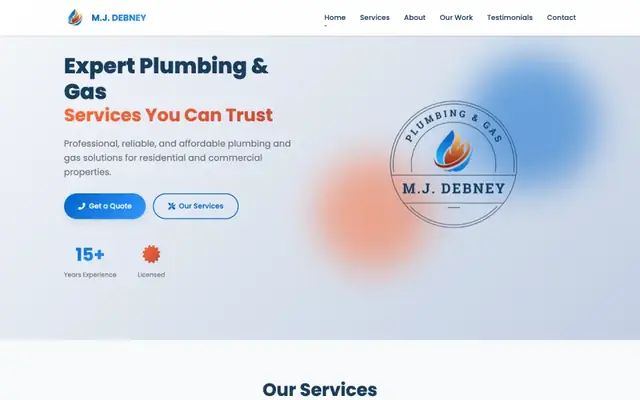
We haven't built a site for a window tinter, so there's no tinting job in our portfolio. Two client sites have the parts a tinting site needs: an engineering firm's quote form that shows a fee range and takes file uploads, the way a home film quote can collect window photos, and a plumber's single page with a service overview and a project gallery that swipes on a phone.

Home page of the Simple Engineers website

Simple Engineers

Professional services · Adelaide

Adelaide structural engineers designing retaining walls, concrete slabs and stormwater systems. The site has four service pages, 16 articles, tap-to-call and a quote form with fee ranges and file uploads. For a tinter, the same form collects window photos and rough sizes, and the fee range becomes a price guide per window.

Home page of the M.J. Debney Plumbing & Gas website

M.J. Debney Plumbing & Gas

Trades & construction · Queensland

A licensed Queensland plumber and gas fitter. One page carries a six-service overview, a 13-photo project gallery that swipes on mobile, client testimonials, a protected contact form and tap-to-call. A car tinter's finished vehicles and shade comparisons fit the same layout.

“They were very helpful and envisioned exactly what I was wanting for my website. They created the site very promptly and cost efficient.”

Michael Debney, Google review

★ 5.0 from 33 Google reviews (opens in a new tab)

Want numbers from a trade site? Western Sydney Stump Grinding has landed at least 62 jobs, about $46,500 of work, from a single-page site we built. Read the case study.

See all 14 recent client sites in our portfolio.

What a window tinting website costs

One page

$399

A mobile or car-only tinter: shades and legal limits, your film range, prices by vehicle type, a gallery and a booking form, all on one page.

Suits tinters doing cars and homes

Up to 3 pages

$899

A home page, a car tinting page with legal limits and prices by vehicle, and a home and commercial film page with specs and a quote form for window sizes.

Up to 8 pages

$1,499

Larger businesses: automotive, residential, commercial, safety and security film, decorative and frosted film, your film range, the gallery and FAQs.

  • Payment. No deposit. We build your draft first, you ask for as many changes as you like, and you pay once you approve it. If you don't go ahead, you owe nothing.
  • GST. WebCraft Studio isn't registered for GST, so no GST is added.
  • Timing. Most sites are live within 5–10 days of us getting your words and photos; bigger sites (up to 8 pages) take 2–3 weeks.
  • Hosting. After launch, hosting is $30 a month: hosting, security monitoring, backups, email support and unlimited text and image changes on your existing pages. New pages or features are quoted first. No contract, cancel anytime.
  • Domain and email. We register your domain in your name (about $20 a year), connect it to your site and set up your business email.

See full pricing and what each package includes

Questions window tinters ask us

Should we list car tinting prices?

If your prices are fairly steady, yes, set out by vehicle type: small hatch, sedan, SUV, wagon and dual-cab ute, for the back half and for the whole car, with each film grade as its own column. Old film removal and windscreen strips can go underneath as extras. For homes and offices, a starting price per window gives people a rough idea before you come out to measure.

Can customers book a tint online?

Yes. We can build booking and payment into your site, quoted per job, with slot lengths that suit each vehicle type. If you already use a booking app, the Book button on every page links straight to it instead. Home and commercial jobs usually suit a quote request rather than a booking, because you need to see the glass first.

Should our site show the legal tint limits?

We'd suggest it. It's often the first thing a car owner asks, and a clear answer shows you won't fit film that's over the limit. Keep to your state's figures, link the official transport page, such as Access Canberra's tinting rules (opens in a new tab) in the ACT, and send us any change. Text changes on existing pages are covered by the $30 monthly hosting.

How do we show what a shade actually looks like?

Photograph the same car, or the same window, with each film you stock, in daylight, from outside and from the driver's seat, and label every photo with the film name and its light transmission. Phone screens shift brightness and colour, so add a line inviting people to see samples in person. For home film, a photo looking out through the film shows the view they'd keep.

Which package suits a tinting business?

A mobile or car-only tinter can start with the one-page site at $399. If you tint cars and buildings, the 3-page site at $899 gives each its own page. Businesses also doing commercial, safety or decorative film suit the 8-page site at $1,499. A site that size takes 2–3 weeks once we have your words and photos.

Do you work with tinters outside South Australia?

Yes. We're a web design team at Ste 3/110 Hutt St, Adelaide, working with businesses Australia-wide by phone and email; our current clients are in SA, NSW, VIC and QLD. Send us your film range, price list and photos of finished jobs, and we'll quote it.

Ready to start your tinting website?

Send us your film range, your prices by vehicle, the suburbs you cover and photos of finished cars and windows. We'll quote it and build the draft, and you pay only once you approve it.

We reply within 24 hours. Prefer email? info@webcraftstudio.com.au