Website Design for Tilers in Brisbane

Websites for Brisbane wall and floor tilers that put your QBCC classes where builders and homeowners look for them, show the bathrooms, under-house rooms and pool jobs you actually take on, and find out whether it's a slab or a timber floor before you drive out.

What a Brisbane tiler's website should answer

A tiling job in Brisbane might be an ensuite in a Kangaroo Point tower, an upstairs bathroom in an old high-set timber house, a rumpus room built in under that house, or a pool in Carindale. Each customer wants proof you've done their kind of job, that you hold the right QBCC class, and that the waterproofing under the tiles will hold. The site needs to show all three within a minute.

  • The QBCC classes on your licence, by name

    Queensland's wall and floor tiling class includes applying waterproofing for tiling, and the QBCC also issues waterproofing as a class of its own. Name the classes you actually hold rather than writing “fully licensed”, and keep your licensed name, number and QBCC Act statement in the footer of every page, so a builder vetting a subcontractor can check them against the QBCC's online licensee register in a minute.

  • Tiling only, or the whole room

    Some Brisbane tilers take tiling and waterproofing only, often for builders and bathroom renovators; others run a full bathroom with their own plumber and electrician. The QBCC has a separate builder licence restricted to kitchens, bathrooms and laundries, so the site should say plainly which kind of work you contract for. That keeps it in line with your licence and saves you replying to jobs you'd turn down.

  • A section for under-house rooms

    Brisbane City Council treats enclosing the space under an existing house as minor work in its character overlay, and the rooms made that way are the lowest in the house when water comes through. If you tile them, give them a gallery of their own and a few lines, in your words, on the materials you choose, such as epoxy grout or tiled skirtings. Council's flood advice already steers owners towards water-resistant floors, so some will arrive looking for exactly this.

  • A quote form that asks about the building

    Unit, townhouse or house first. For a house, high-set or low-set, and whether the room is upstairs on a timber floor or downstairs on a slab. Then which room, rough square metres, what covers the floor now (tiles, vinyl or carpet), roughly when the place was built, who is buying the tiles, and photo uploads. Those answers separate a splashback you can price from the photos from a job that needs a visit.

  • What the owner keeps at handover

    The QBCC counts building work that lets water into a building as a structural defect, and owners who have read that will ask about the layer they can't see. Say which membrane system you use, the drying time you allow before tiling, whether you water test a shower base, and the certificate or photos the owner keeps afterwards. A short handover section, written by you, deals with it before the quote.

  • Pools, outdoor areas and steps

    The QBCC's tiling class names swimming pools, spas, hearths, and terrazzo steps, risers and stringers, alongside floors and walls. If you do waterline tiles, pool coping, alfresco floors or front steps, list each one: people search for them one at a time. Older pools bring their own question about the coating underneath, covered in the Marblesheen note further down.

  • A gallery that filters by job

    Bathrooms and laundries, floors, under-house rooms, and outdoor and pool work, each behind a filter button, with captions such as “Ensuite, 1920s high-set house, Paddington” or “Pool waterline, Carindale”. Someone in a New Farm unit and someone with an old timber house in Ashgrove are looking for different jobs, and a filter lets each of them find theirs.

Tiling in Brisbane: QBCC classes, flood-prone lower floors and old materials

Which QBCC class covers what. The QBCC's wall and floor tiling class covers cutting and fixing tile, including ceramic, glass, marble, slate, stone and terracotta, to fireplaces, floors, hearths, spas, swimming pools and walls; building terrazzo floors, steps, risers and stringers; applying waterproofing for wall and floor tiling; and work of another class that is incidental to it. The separate waterproofing class covers applying, installing and repairing waterproofing more broadly, surface preparation included. For whole-room jobs, the QBCC has a builder licence restricted to kitchens, bathrooms and laundries, which covers installing, refurbishing, restoring and repairing them but not work that may affect the building's structure, and which asks for experience that includes supervising or managing jobs rather than trade work alone. A licence is needed for building work valued over $3,300, the figure on the QBCC's licensing page and in the current QBCC Regulation. The QBCC's advertising rules reach websites, social media and directory listings as well as print; our page for Brisbane builders sets out what the licence line on each page has to carry.

Home warranty, deposits and defects. The QBCC's list of residential work that needs Queensland Home Warranty Scheme cover once a project costs more than $3,300 (labour, materials and GST included) gives tiling as an example of work on or in a home, and separately lists replacing or refitting kitchen and bathroom fixtures. Deposits are generally capped at 10 percent on contracts from $3,301 to $19,999 and 5 percent from $20,000, and progress payments are meant to match the work actually done. On defects, the QBCC's definition of structural defective work includes work that “allows water penetration into a building”; its examples of defective work include cracked floor tiles, while a dispute about delays in finishing laying floor tiles is filed as a contractual matter. Owners are told to lodge a complaint within 3 months of noticing a structural defect and 7 months for a non-structural one. A tiler who explains how the waterproofing is done and recorded is answering a question those pages put in owners' heads.

Lower floors and flooding. Brisbane City Council's flood studies cover river, creek, storm tide and overland flow flooding, and its FloodWise Property Report gives a property's January 2011 and February 2022 flood levels where they're known. Council's flood-resilient design page carries a homeowner video suggesting carpet and other porous flooring be swapped for water-resistant flooring such as hardwood, tiles or polished concrete, with tiles or flood-resistant hardwood for skirtings, and a contractor video that describes treating every room as a wet room and tanking the walls to the floors the way a bathroom is done. The Queensland Government's Get Ready advice on strengthening a home for flood, which points readers to its Design Guidance for Flood Resilient Homes, lists flood-resilient grout on tiles, such as epoxy, among its retrofitting ideas. Council also says renovations involving only internal works are unlikely to need planning approval, and in the Traditional building character overlay it lists enclosing under an existing building among the minor works that may not need it either, though building approval is a separate question for a certifier. So some owners will reach you having already read the official advice on what their downstairs floor should be. If this is your work, the site can say so, without suggesting any floor will come through a flood untouched.

Towers in the middle, houses further out. At the 2021 Census, Brisbane City had 465,124 occupied private dwellings: about 63 percent separate houses, 11 percent semi-detached homes and townhouses, and 26 percent flats or apartments. The mix swings hard from one part of the city to another. In the ABS's Brisbane Inner area, made up of the CBD, Fortitude Valley, Spring Hill, New Farm, Kangaroo Point, South Brisbane, West End and Highgate Hill, 84 percent of occupied homes were flats or apartments, 16,431 of them in blocks of nine storeys or more, and across Albion, Ascot, Newstead and the rest of Brisbane Inner – North the share was 56 percent. In Kenmore – Brookfield – Moggill it was under 1 percent, and in the neighbouring Logan and Ipswich council areas it was below 3 percent, with separate houses making up 85 and 89 percent of homes. Apartment work in Queensland happens under the body corporate's by-laws, and the state's body corporate guidance gives renovations causing noise, vibration or dust as an example of a nuisance, so a unit owner will want your working hours and how you keep the dust in. A tiler who mostly works in houses around Kenmore or Springfield Lakes can leave that out and lead with family bathrooms and outdoor areas.

Old vinyl, old pools, and how we work. Workplace Health and Safety Queensland's asbestos flooring fact sheet says the felt backing on some older vinyl sheet flooring contains friable asbestos, that it turns up mostly in buildings from before the mid-1980s, and that only an A class licence holder may remove it; taking up more than 10 m² of bonded asbestos vinyl tiles needs a B or A class licence, and the glue beneath them may contain asbestos as well. For pools, the state's guidance on Marblesheen coatings says a coating applied before 1990 may contain asbestos and that an untested pool built before 1990 must be assumed to contain it, that a full resurface means removing the old surface at least from around fittings and tiles, and that removing more than 10 m² needs a licensed removalist. If you lift old floors or retile old pools, say who handles that stage and how it's priced. We present what you tell us and link to the official pages; we don't give safety or licensing advice. We're an Adelaide team on Hutt St and work with Brisbane businesses by phone and email; our Queensland clients include a plumber and gas fitter and a dance school at Thorneside on Brisbane's bayside. You send your licence details, your own words about the work, job photos and suburbs, and we send back a draft link to look over on your phone.

Sites we've built that a Brisbane tiler's could follow

Our portfolio doesn't include a tiling site yet. The closest are a Queensland plumber and gas fitter whose services include bathroom renovations, and a Brisbane bayside dance school with a photo gallery visitors can filter, the same idea as a tiling gallery filtered by job. The review below is from SA Tiling Pro Pty Ltd, a tiling company, about working with us.

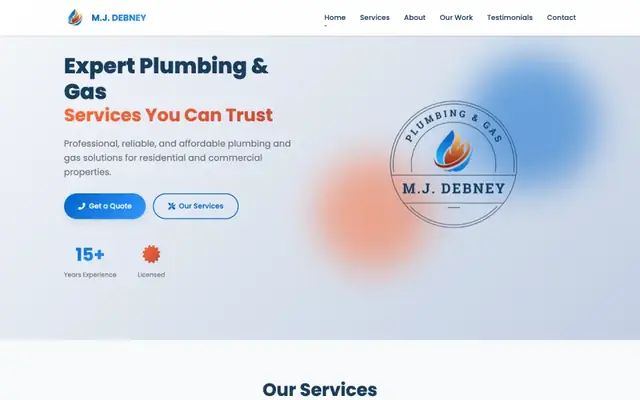
Home page of the M.J. Debney Plumbing & Gas website

M.J. Debney Plumbing & Gas

Trades & construction · Queensland

A licensed Queensland plumber and gas fitter whose services include bathroom renovations. One page holds a six-service overview, a 13-photo gallery that swipes on a phone, testimonials, a protected contact form and tap-to-call: much what a tiler working alone needs, with tiled rooms in place of plumbing jobs.

Home page of the Queensland Dance & Performing Arts website

Queensland Dance & Performing Arts

Community, creative & tourism · Thorneside, Brisbane's Bayside

A dance school at Thorneside on Brisbane's bayside. Its 12 pages include one for each program, a weekly timetable, an online enrolment form and a photo gallery visitors can filter, which is how we'd sort a tiler's bathrooms, under-house rooms and pool work.

“…walked us through everything, gave us a fixed quote so we knew exactly what we were paying…”

SA Tiling Pro Pty Ltd, Google review

★ 5.0 from 33 Google reviews (opens in a new tab)

Want numbers from a trade site? Western Sydney Stump Grinding has landed at least 62 jobs, about $46,500 of work, from a single-page site we built. Read the case study.

See all 14 recent client sites in our portfolio.

What a Brisbane tiling website costs

One page

$399

Your QBCC licence line, a filtered gallery, your waterproofing and handover, the suburbs you cover and a quote form that asks unit or house, slab or timber, all on one page.

Our suggestion for most Brisbane tilers

Up to 3 pages

$899

A home page, a bathrooms and waterproofing page, and a page for under-house rooms, outdoor areas and pools, each with its own photos and quote questions.

Up to 8 pages

$1,499

For tiling businesses running crews: a home page plus pages for bathrooms, floors, under-house rooms, pools and outdoor work, unit renovations, builder subcontracting and waterproofing.

  • Payment. No deposit. We build your draft first, you ask for as many changes as you like, and you pay once you approve it. If you don't go ahead, you owe nothing.
  • GST. WebCraft Studio isn't registered for GST, so no GST is added.
  • Timing. Most sites are live within 5–10 days of us getting your words and photos; bigger sites (up to 8 pages) take 2–3 weeks.
  • Hosting. After launch, hosting is $30 a month: hosting, security monitoring, backups, email support and unlimited text and image changes on your existing pages. New pages or features are quoted first. No contract, cancel anytime.
  • Domain and email. We register your domain in your name (about $20 a year), connect it to your site and set up your business email.

See full pricing and what each package includes

Brisbane tiling websites: common questions

Which QBCC details go on a Brisbane tiler's website?

The name the licence is held in (a trading name can sit beside it, but the QBCC says an ad with only a trading name will most likely be non-compliant), the licence number, and a statement that you're licensed under the QBCC Act, easy to read and reasonably prominent. We place them in the footer of every page and can link to the QBCC's licensee register, though the QBCC logo itself can't go on your site. Check the wording against the QBCC's advertising guidance and your licence before launch.

Can we publish a price per square metre?

Be careful with it. The QBCC's advertising guidance says an ad mustn't contain false or misleading information, or leave something out where that makes it misleading. A floor rate that quietly excludes waterproofing, lifting old tiles or sheeting a timber floor could fall into that. Some tilers explain how they price instead: photos and measurements through the form, a look at the room, then a written quote. If you want figures on the page, spell out what they include.

Should the site say we do flood-resilient tiling?

If you do it, yes, carefully. Brisbane City Council's flood guidance points owners to water-resistant flooring, and the Queensland Government's Get Ready flood advice names epoxy grout. Describe the materials and methods you use, link to the council page, and leave out any suggestion that a floor will be unaffected by floodwater, because nobody can promise that.

Do we need to mention home warranty insurance?

It isn't one of the details the QBCC's advertising guidance lists, but owners may ask. The QBCC gives tiling as an example of work on or in a home that needs Queensland Home Warranty Scheme cover once the project costs more than $3,300. A line on how you handle jobs above that amount, linked to the QBCC's page, answers the question; the specifics sit between you, the QBCC and the owner, and we don't advise on them.

Which package suits a Brisbane tiler?

If you work on your own and mostly for builders, the one-page site at $399 usually does the job. The 3-page site at $899 suits a tiler who wants bathrooms on one page and under-house, outdoor and pool work on another. The 8-page site at $1,499 is for a business with crews and several lines of work, such as unit renovations alongside builder subcontracting.

You're in Adelaide and we're in Brisbane. How does that work?

By phone and email. We're a web design team in Adelaide, South Australia, working with businesses across Australia, with current clients in SA, NSW, VIC and QLD, including a Queensland plumber. You send your licence details, your own words about the work, photos and suburbs; we build a draft you can check on your phone, ask for as many changes as you like, and pay once you approve it. We reply within 24 hours.

Ready to start your Brisbane tiling website?

Email us your licence number and the QBCC classes on it, your own words about the work you take on, a dozen photos of jobs you're proud of, and where across Brisbane you'll work. We'll build a draft, you tell us what to change, and you pay once it's right.

We reply within 24 hours. Prefer email? info@webcraftstudio.com.au