Website Design for Plumbers in Coffs Harbour

For plumbers, drainers and gasfitters on the Coffs Coast. The City of Coffs Harbour supplies the water, owns the sewer and regulates the plumbing, and right now it is registering backflow devices, approving septic systems and smoke-testing suburbs for stormwater in the sewer. Your site can tell owners which of those jobs you take on, from Red Rock down to Bonville.

What a Coffs Coast plumbing website should cover

A plumber here hears from a mixed crowd: a Toormina owner holding a council letter about a downpipe, a motel manager on the highway told to sort out a grease arrestor, someone settling on acreage at Nana Glen with a septic tank they've never seen, a builder waiting on a drainage inspection. Each of them should find their job on your site without ringing to ask.

  • A section for owners who got a stormwater letter

    Council is working through every sewered suburb with smoke and dye tests to find roof downpipes, tank overflows and yard drains that run into the sewer, then asks the owner to fix them. If you trace and redirect those connections or raise low gully traps, give that work a heading that matches the letter, so the owner who searches for it finds you.

  • Backflow testing written for businesses

    Council meters on services up to 25 mm come with low-hazard backflow protection built in. Bigger services and medium or high hazard sites need a device the owner supplies, and medium and high hazard devices are registered with council when they go in and tested every year by a qualified tester, with the report back to council within two working days. If you're qualified to test, say so and say how you handle the paperwork.

  • Grease arrestors and trade waste named plainly

    Takeaways, restaurants, motels, butchers, service stations, mechanical workshops, vehicle washes, supermarkets and dentists all need council approval to put trade waste into the sewer, and they're required to pre-treat it first. List the equipment you install and maintain, such as grease arrestors, basket arrestors, oil separators or plaster arrestors, so a business owner can see you know what council will ask for.

  • Septic and treatment systems for acreage buyers

    Off the town sewer, homes run septic tanks, aerated treatment systems, reed beds, sand filters, pump-out tanks or composting toilets. A new owner must apply for approval to operate within two months of the sale, and a buyer can have the system inspected before purchase. A short section on the systems you service catches people at exactly that point.

  • Inspection timing builders can plan around

    Council takes inspection requests online the day before, in a morning window (10.30am to 12.30pm) or an afternoon one (1.30pm to 3.30pm), Monday to Friday. A builders' section saying you lodge the notice, book the inspections and supply the sewer service diagram tells a site supervisor you won't hold up the slab or the backfill.

  • Rainwater tanks, above and below ground

    Council's backflow page makes owners responsible for backflow protection on below-ground rainwater tanks. If you install tanks, pumps and toilet or laundry connections, say which kinds you fit and show a finished job or two, captioned with the suburb.

Plumbing on the Coffs Coast: one council for water, sewer and inspections

The licence side is the same across NSW: a licence for plumbing, draining or gasfitting work of any value, a contractor licence to contract for it, and Fair Trading's advertising guidance asking for the licensee's name, licence number, category of work and a business phone, websites included. Our Sydney plumbers page covers those rules. What changes here is that the City of Coffs Harbour is water authority, sewer owner and plumbing regulator in one, under a delegation from Building Commission NSW, the state's plumbing regulator.

Council's steps run in order. The plumber or drainer gives council at least two days' notice before creating or changing a sewer connection or an on-site sewage system, using the Notice of Work form, after the sanitary plumbing and drainage application has gone in online. Inspections happen before anything is covered or backfilled: external drainage and the sewer connection, all drainage inside and out including trade waste, sealing of disused services, any work that failed an earlier inspection, and a final inspection before anyone moves in. Within two days of finishing, the owner and council each get a Certificate of Compliance, plus a Sewer Service Diagram where sewer work was done. Council points out that these records matter when the property is sold or renovated, and when a failure is investigated later.

The stormwater program is the job most likely to bring owners to a plumber's website. Council's view is that the sewer is built for wastewater, not rain, and that stormwater getting in can overload pump stations and treatment plants and cause overflows. Its inspectors push harmless smoke through the sewer to see where it escapes from gutters or drains, or put dye in gutters and watch for it in the sewer. They look only at external plumbing and don't go inside, residents get a letter beforehand and a reminder the day before, and police and fire services are told so nobody calls in a fire. The testing covers homes, shops and industrial sites in every suburb and will take several years, and council says it usually contacts owners first rather than going straight to fines.

Backflow follows council's Backflow Prevention and Cross Connection Control Policy (Containment Only), which works to AS 2845 and AS/NZS 3500. Trade waste approvals are generally granted for five years before the business reapplies, and the list of what counts goes past restaurants and workshops to pools, schools, hospitals and nursing homes, septic tank waste, boat pump-out facilities and chemical toilets. On-site sewage is managed under council's On-Site Sewage Management Strategy, first written in 2000, reviewed in 2006 and updated in 2015, and operating a system without approval is an offence.

Council's area runs from Corindi Beach, Red Rock and Woolgoolga through Emerald Beach, Moonee Beach and Korora to Toormina, Sawtell, Boambee and Bonville, and inland to Coramba, Nana Glen, Lowanna and Ulong. Cross into Bellingen Shire at Urunga, the Nambucca Valley or the Clarence Valley and each of those councils sets its own inspection requirements, so a site that lists those towns should say you deal with their paperwork too. We're an Adelaide team on Hutt St and work with coastal NSW businesses by phone and email; Tomi's Bobcat and Excavation in the Bega Valley is one of them.
Plumbing and coastal NSW sites we've built

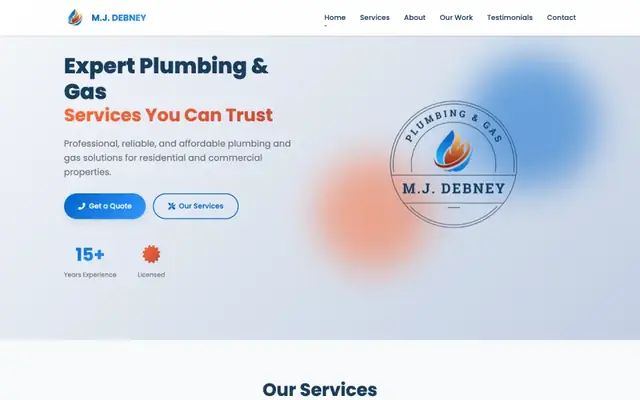
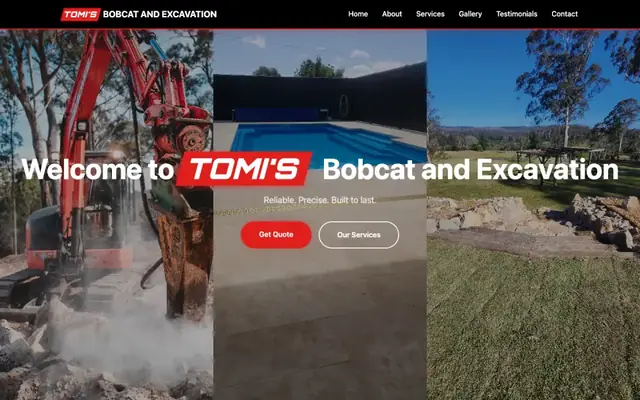
We don't have a Coffs Harbour client yet. Our plumbing client is M.J. Debney Plumbing & Gas in Queensland, and on the NSW coast we built the site for Tomi's Bobcat and Excavation, whose photo-heavy page suits a plumber with drainage, tank and septic jobs to show.

Home page of the M.J. Debney Plumbing & Gas website

M.J. Debney Plumbing & Gas

Trades & construction · Queensland

A Queensland plumber and gas fitter covering general plumbing, gas, hot water, drainage, backflow and bathroom renovations. One page holds the six services, a 13-photo gallery you can swipe through on a phone, testimonials, a protected contact form and tap-to-call.

Home page of the Tomi's Bobcat and Excavation website

Tomi's Bobcat and Excavation

Trades & construction · South Pambula & Bega Valley

Excavator and bobcat work, licensed pool building and structural landscaping around South Pambula. Three service sections, a 42-photo gallery made for swiping, a carousel of testimonials and a contact form that ends on a thank-you page, all on a single page.

“…Salem walked us through everything, gave us a fixed quote so we knew exactly what we were paying, and turned around the build faster than we thought possible.”

SA Tiling Pro Pty Ltd, Google review

★ 5.0 from 33 Google reviews (opens in a new tab)

Want numbers from a trade site? Western Sydney Stump Grinding has landed at least 62 jobs, about $46,500 of work, from a single-page site we built. Read the case study.

See all 14 recent client sites in our portfolio.

What a plumbing website costs in Coffs Harbour

One page

$399

Your services, licence details, the towns you cover from Woolgoolga to Bonville, a stormwater-letter section, job photos, a quote form and tap-to-call on one page.

Suits a plumber with commercial work

Up to 3 pages

$899

A home page, a page for businesses (backflow testing, grease arrestors, trade waste) and a page for septic and treatment systems on unsewered blocks.

Up to 8 pages

$1,499

For a crew with several utes: a home page plus pages for hot water and blocked drains, gas, backflow, trade waste, on-site sewage and new homes, and one for Bellingen and Nambucca if you go there.

  • Payment. No deposit. We build your draft first, you ask for as many changes as you like, and you pay once you approve it. If you don't go ahead, you owe nothing.
  • GST. WebCraft Studio isn't registered for GST, so no GST is added.
  • Timing. Most sites are live within 5–10 days of us getting your words and photos; bigger sites (up to 8 pages) take 2–3 weeks.
  • Hosting. After launch, hosting is $30 a month: hosting, security monitoring, backups, email support and unlimited text and image changes on your existing pages. New pages or features are quoted first. No contract, cancel anytime.
  • Domain and email. We register your domain in your name (about $20 a year), connect it to your site and set up your business email.

See full pricing and what each package includes

Questions Coffs Harbour plumbers ask us

Can an Adelaide team build a site for a Coffs Harbour plumber?

Yes. We're a web design team in Adelaide, South Australia, working with businesses Australia-wide by phone and email, and our current clients are in SA, NSW, VIC and QLD. You email your licence details, services, towns and photos; we send a draft link you can open on your phone; you ask for changes and pay once you approve it. We reply within 24 hours.

Is it worth mentioning council's smoke testing?

If you fix illegal stormwater connections, yes. Council is testing every sewered suburb over several years and asks owners to arrange the repairs, so people will be searching for someone to do it. A section that names the problem in plain words (downpipe into the sewer, low gully trap, tank overflow) and says you'll find and fix it is enough.

Most houses have backflow protection in the meter. Who is the backflow section for?

Businesses and bigger properties. Council builds low-hazard protection into meters on services up to 25 mm; anything larger needs a device the owner supplies, and medium or high hazard sites must register theirs and have it tested every year. Those owners have a test to book every year, so write the section for them, and say whether you send the report to council for them.

Should trade waste have its own page?

If food businesses are a big part of your work, it can. Council requires approval for trade waste and pre-treatment such as a grease arrestor, and approvals are generally granted for five years before the business reapplies, so owners come back to the subject. On a one-page site it becomes a short section with its own contact button.

We go to Urunga and Nambucca Heads. Should they be on the site?

Yes, under their own heading, with how often you're down there. Bellingen and Nambucca Valley councils each set their own plumbing inspection requirements, so it helps to add that you handle their applications and inspections as well as Coffs Harbour's.

Ready to start your Coffs Harbour plumbing website?

Tell us where the ute is based, the towns you cover and whether backflow, trade waste or septic work is part of the business. We'll send a quote, build the draft, and you pay only once you've approved it.

We reply within 24 hours. Prefer email? info@webcraftstudio.com.au