Website Design for Plumbers in Bundaberg

Websites for plumbers working across the Bundaberg Region, from the river suburbs and Bargara out to Childers and Gin Gin. Pages written around what council actually asks of owners: a hidden leak fixed within 15 working days of its letter, a backflow device tested every year, and a septic tank checked every year, with your number on screen the whole way down.

What a Bundaberg plumber’s site needs to cover

Most calls a Bundaberg plumber gets start with something council has sent or said: a courtesy letter about a jump in consumption, a written request to test a backflow device, advice that a blockage sits on the owner’s side of the main. When your site speaks to that piece of paper, the owner knows they’ve rung the right person.

  • A leak page that mentions the 15-day clock

    Council’s Water Leak Relief Policy only considers a reduction when a registered plumber repairs the leak within 15 working days of council’s advice, and the owner applies within 60 days of the repair with the plumber’s account or a letter describing the work. A leak section saying how quickly you can attend, and that your invoice spells out what was found and fixed, is exactly what someone holding that letter needs to read.

  • Half-yearly readings, explained in a sentence

    Meters here are read roughly every six months, so a slab or underground leak can run for a long time before it shows on a rate notice. Council’s own check is simple: turn everything off, note the meter, wait about an hour and look again. Repeat that test on your page, then add one line: if the dials moved, call us.

  • Repiping older homes with galvanised pipe

    Council’s water-quality advice says orange or rusty water that clears after two to five minutes usually points to corrosion inside the house, common in older homes with galvanised iron pipes, and that leaving them can end in a leak or burst. If you repipe older homes, describe that symptom in the owner’s words, because that’s how they’ll describe it to you.

  • Tree roots, and who pays for which part

    Council clears roots from its own sewer mains at no cost, will remove roots from a private line for a fee, and doesn’t repair private pipes at all; that’s left to a licensed plumber the owner chooses. A drains page that sets out the split, then says what you do (camera inspections, root cutting, relining or replacing broken pipe, if you offer them), answers the question before the owner has to ask.

  • Backflow testing ahead of council’s written request

    Owners must register each testable device and have it tested every year by an endorsed backflow plumber. Council writes to them before the due date, and results have to reach council within 10 working days of the test. Irrigation systems, fire hose reels and vehicle or bin wash-down bays are the usual reasons a home or business has one, so name those on the page.

  • Septic and treatment plant servicing for rural blocks

    Homes off the sewer network need an on-site system, and council says septic tanks should be checked every year, with many systems needing a service every three months. That work has to be done by an agent holding an on-site sewerage facility endorsement or the restricted licence for it. If you hold one, say which, and list the acreage areas and towns you service.

  • Licence line and towns on every page

    Your QBCC licence details in the footer, tap-to-call that stays on screen, and the places you really drive to: Bundaberg North, South and East, Bargara, Burnett Heads, Elliott Heads, Moore Park Beach, Childers, Woodgate and Gin Gin. A retiree in Bargara and a cane grower near Gin Gin should both see their town before they reach the form.

Plumbing in the Bundaberg Region: meters, drainage plans and flood work

Licensing is set statewide: a QBCC licence for plumbing and drainage, endorsements for work such as backflow testing, and your licensed name, licence number and a licensing statement on your website and other ads. Our Brisbane plumbing page sets out the detail. What changes in Bundaberg is who you deal with: Bundaberg Regional Council is the water and sewerage provider for a region formed in 2008 from the city and the Burnett, Isis and Kolan shires, and its Plumbing Compliance Team handles backflow and on-site systems.

Meters are read twice a year, in an August-to-December cycle and a February-to-June cycle, and consumption is charged on the rate notices issued in July and February. Residential owners with their own meter also get a Water Advice Notice comparing their use, and council may send a courtesy letter when a reading jumps. It trialled about 1,200 smart meters in the CBD, Burnett Heads, Childers and Gin Gin in a pilot that ended in August 2020; they could flag leaks early, but council reported significant delays in getting up-to-date information to customers and says it is reviewing its systems. For most owners, then, the first sign of a hidden leak is still a letter or a bill. Relief is limited to one successful application every three years, and only for leaks that couldn’t be detected and weren’t inside a building. A site can explain those terms and link to council; whether a claim succeeds is council’s decision, not yours or ours.

Council can supply plans showing its sewer mains and the private sewer pipes on a property, but only to the owner, a licensed plumber or a solicitor handling a settlement; anyone else needs the owner’s written consent. They’re requested with its Plumbing Compliance Plan Request Form, by phone, or at the East Operations Centre in Victoria Street, Bundaberg East. That’s worth a line on a drains page, because a plan saves digging in the wrong spot. Council’s root advice is useful too: roots typically spread about one and a half times as far as the branches, and it lists figs, jacarandas, mangoes, poincianas, bottlebrushes and gums among the trees it doesn’t recommend near sewer pipes. It also treats downpipes or pool water drained into the sewer as illegal and can prosecute; in heavy rain that extra water pushes sewage back up into private pipes and can lift manhole lids in yards.

Floodwater brings its own jobs. The Burnett River peaked at 9.53 metres at the city gauge in January 2013, and Bundaberg is one of the council areas listed for the Queensland Government’s Stronger Homes Grant for homes flooded in the severe weather that began on 24 December 2025. Among the works it covers are raising hot water systems and raising pumps connected to the home; yard drainage and garden tanks are excluded, and the work must be done by a suitably licensed Queensland contractor. Our Bundaberg tradies page has more on the grant and the river. A plumber’s site can describe those jobs plainly and send owners to the official page to check whether they’re eligible.

We’re an Adelaide team at Hutt St and work with Bundaberg plumbers by phone and email. You send your licence details, the towns you cover and photos of your jobs; we send back a draft link you can look over on your phone between call-outs, and nothing is paid until you’ve approved it.
Plumbing and regional trade sites we’ve built

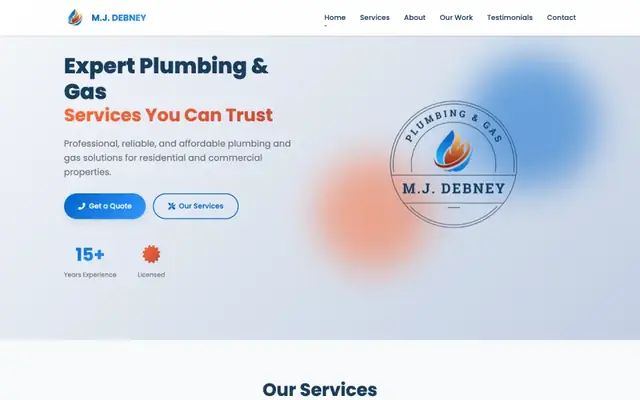
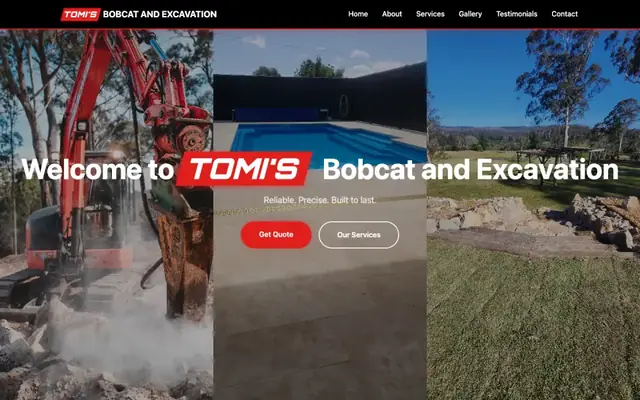
Our plumbing client is M.J. Debney Plumbing & Gas in Queensland. Next to it is Tomi’s Bobcat and Excavation on the far south coast of New South Wales, a regional one-page site built around a big swipeable gallery, which suits a plumber who wants repipes, drain repairs and hot water installs to do the talking.

Home page of the M.J. Debney Plumbing & Gas website

M.J. Debney Plumbing & Gas

Trades & construction · Queensland

A licensed Queensland plumber and gas fitter. Six services sit on a single page alongside a 13-photo gallery of finished jobs that swipes on a phone, testimonials from clients, a spam-protected contact form and tap-to-call.

Home page of the Tomi's Bobcat and Excavation website

Tomi's Bobcat and Excavation

Trades & construction · South Pambula & Bega Valley

An excavation business in South Pambula working across the Bega Valley. One page holds three service sections, a 42-photo gallery, a testimonial carousel, a contact form with a thank-you page and tap-to-call on mobile. Swap the bobcat shots for root-cracked pipe and new hot water units and the same layout works for a plumber.

“They were very helpful and envisioned exactly what I was wanting for my website. They created the site very promptly and cost efficient.”

Michael Debney, Google review

★ 5.0 from 33 Google reviews (opens in a new tab)

Want numbers from a trade site? Western Sydney Stump Grinding has landed at least 62 jobs, about $46,500 of work, from a single-page site we built. Read the case study.

See all 14 recent client sites in our portfolio.

Bundaberg plumbing website prices

Suits a one-van business

One page

$399

Services, licence line, your towns, a leak section with council’s 15-day rule, backflow testing, a short septic paragraph, job photos, a quote form and tap-to-call, all on a single page.

Up to 3 pages

$899

A home page, a page for leaks, repipes and blocked drains with council’s drainage plans explained, and a page for backflow testing and on-site system servicing.

Up to 8 pages

$1,499

For a bigger crew: a home page plus pages for leak detection, galvanised repipes, drains and roots, backflow, septic and treatment plants, raising hot water systems and pumps, and Childers, Gin Gin and the coast towns.

  • Payment. No deposit. We build your draft first, you ask for as many changes as you like, and you pay once you approve it. If you don't go ahead, you owe nothing.
  • GST. WebCraft Studio isn't registered for GST, so no GST is added.
  • Timing. Most sites are live within 5–10 days of us getting your words and photos; bigger sites (up to 8 pages) take 2–3 weeks.
  • Hosting. After launch, hosting is $30 a month: hosting, security monitoring, backups, email support and unlimited text and image changes on your existing pages. New pages or features are quoted first. No contract, cancel anytime.
  • Domain and email. We register your domain in your name (about $20 a year), connect it to your site and set up your business email.

See full pricing and what each package includes

Questions Bundaberg plumbers ask us

Council has written to an owner about high water use. What should our leak page say?

Say you find and fix concealed leaks, how soon you can usually attend, and that your account describes the repair in writing, since council’s relief policy asks for a registered plumber’s account or letter and a repair within 15 working days of its advice. Link to council’s water billing page for the full criteria. We’d word it as a description of your service, never as a promise that relief will be granted.

Is it worth telling customers that council keeps drainage plans?

Yes, on the drains page. Council issues them to the owner, a licensed plumber or a settlement solicitor, and a sentence saying you’ll get the plan before you dig shows care with someone’s yard. It also explains why you might ask for the property address before you arrive.

We service septic tanks and treatment plants out past Gin Gin. How should that look on the site?

As its own section or page, naming the endorsement you hold, the system types you service and the localities you cover. A booking form that asks for the system type, the brand if known and when it was last serviced lets you plan the run before you ring back.

Should our website mention the Stronger Homes Grant?

Only if you do the work it covers, such as raising hot water systems or pumps on flood-affected homes, and only as a plain description with a link to the Queensland Government page. Eligibility is decided by the grant team, so the site shouldn’t suggest a customer will qualify. If the program closes, email us and we’ll take the section down; text changes on existing pages are part of the $30 monthly hosting.

Can an Adelaide team build a website for a Bundaberg plumber?

Yes. We work with businesses Australia-wide by phone and email from Hutt St in Adelaide, and our current clients are in SA, NSW, VIC and QLD, including our Queensland plumbing client, M.J. Debney Plumbing & Gas. You supply the words and photos and we arrange them into the pages. There’s no deposit: you see the draft first and pay once you approve it.

Start your Bundaberg plumbing website

Tell us the towns you cover, whether you test backflow or service on-site systems, and the jobs you’d like more of, and send your licence details and a handful of job photos. We’ll quote first, build the draft, and you pay only once you’re happy with it.

We reply within 24 hours. Prefer email? info@webcraftstudio.com.au