Website Design for Interior Designers

Websites for interior designers, decorators and stylists that let a homeowner walk through your finished rooms one project at a time, see how you work and charge, and book a first consultation without a week of emails.

What an interior designer's website has to do

People choosing a designer judge taste first and process second. They scroll your work looking for rooms that feel like the ones they want, then hunt for the practical answers: whether you take on a project their size, how your fees work, how long it takes and what happens at the first meeting. Those who found you on Instagram or Houzz come to the website to see the whole picture before they make contact.

  • Projects told as briefs and outcomes

    Each project gets a short write-up in your words: the brief (a dark terrace that needed light, a family room that had to survive two dogs and three kids), what you changed, the palette and key pieces, then photos of the finished rooms. Sorted by room or by residential and commercial work, the portfolio lets a visitor find the kitchen or the coastal living room closest to the one in their head.

  • Project photos you have the right to publish

    The best shots of your work usually come from a photographer you hired. The Arts Law Centre of Australia explains that a photographer commissioned to take commercial photos owns the copyright unless they agree otherwise in writing, and the person who commissioned them has a right to use them for the purpose they were commissioned for. Check your agreement covers your website, credit the photographer and stylist where they ask, and get the homeowner's OK before their rooms go online, leaving out anything that identifies the house.

  • Services, and how you charge for them

    Set out what you take on: full-service design, decorating and styling, colour consultations, furniture and decor sourcing, e-design for clients in other towns, or commercial fit-outs. Then explain the fee model, whether that's a fixed fee per stage, an hourly rate or a mix, and how furniture you source is charged. Clients who understand how you bill before the first call spend that call on their project instead of on your rates.

  • A first consultation people can book

    A Book a Consultation button on every page opens Calendly or whichever scheduler you already use, with in-home and video sessions offered separately. If you charge for the first consult and want the fee taken at the time of booking, we can build booking and payment into the site, quoted per job. The page around the button says how long the session runs, what to have ready (floor plans, photos of the space, a Pinterest board) and what you send afterwards.

  • Your stages, and what the client gets at each

    Concept, design development, documentation, procurement, installation: whatever you call your stages, list them with what lands in the client's hands at each one, such as mood boards, a furniture layout, a sample board, a costed product schedule or an install day. First-time clients often can't tell where the design ends and the buying begins, and this section is where they find out.

  • Titles and memberships worded accurately

    The title architect is protected by state law. The Board of Architects of Queensland lists interior architect and interior architecture among terms that can breach its Act when an unregistered person uses them in a way that suggests they're an architect, and Victoria's registration board warns building design businesses that architecture and architectural in business names, websites and social media profiles can suggest an architectural firm. If you're a DIA Accredited Designer, the Design Institute of Australia grants use of its logo to accredited designers who accrue 50 CPD points each calendar year, and we place it beside your bio.

  • Design only, or design and build

    Some designers hand the renovation to the client's builder; others contract the trades themselves. If you do the second, building licence rules can apply. In NSW, a contractor licence is needed to carry out, advertise or contract for residential building work worth more than $5,000 in labour and materials including GST, and the government's definition of that work includes renovating and decorating. Your site should make clear which way you work and, if you hold a licence, show the number.

Client sites with the parts a designer needs

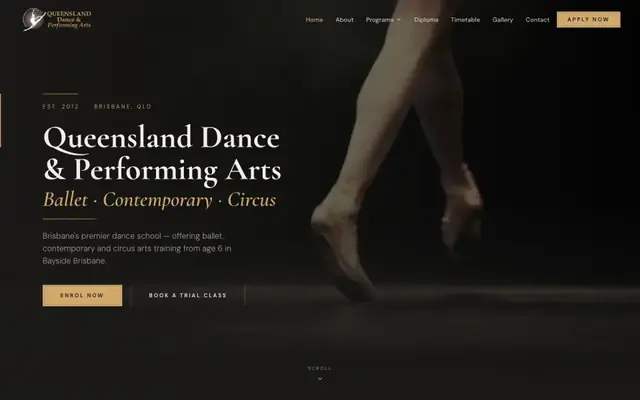
We haven't built a site for an interior designer yet, so there's no design studio in our portfolio to show you. Two client sites carry the pieces a designer's site rests on: a dance school whose photo gallery visitors can filter, which is how a portfolio sorted by room works, and a coach whose discovery-call booking sits on every page, the same set-up as a bookable first consultation.

Home page of the Queensland Dance & Performing Arts website

Queensland Dance & Performing Arts

Community, creative & tourism · Thorneside, Brisbane's Bayside

A dance school at Thorneside on Brisbane's Bayside teaching ballet, contemporary and circus arts. Its 12 pages include a page for each program, a weekly class timetable, FAQs, an online enrolment form and a photo gallery that can be filtered. Swap the class categories for kitchens, living rooms and bathrooms, and the same filter sorts a designer's projects.

Home page of the Dr Tabara Dione Coaching website

Dr Tabara Dione Coaching

Professional services · Melbourne

Confidential coaching for doctors, led by a Melbourne specialist anaesthetist. The site has a services overview, an about page covering her credentials, a contact form and online discovery-call booking linked from every page, which is the arrangement a designer can use for a first consultation.

“My website is exactly how I wanted. I highly recommend Salem for any business wanting a professional website without the bull.”

Johannah Whilding, Google review

What an interior designer's website costs

One page

$399

A decorator or stylist starting out: services, how fees work, a gallery of your best rooms, a consultation button and the areas you cover, all on one page.

Where most design studios start

Up to 3 pages

$899

A home page with consultation booking, a portfolio page with a write-up for each project, and a services page setting out your stages and how you charge.

Up to 8 pages

$1,499

Studios with residential and commercial work: separate portfolio pages, services, e-design, your stages, the team, a consultation page and an FAQ.

  • Payment. No deposit. We build your draft first, you ask for as many changes as you like, and you pay once you approve it. If you don't go ahead, you owe nothing.
  • GST. WebCraft Studio isn't registered for GST, so no GST is added.
  • Timing. Most sites are live within 5–10 days of us getting your words and photos; bigger sites (up to 8 pages) take 2–3 weeks.
  • Hosting. After launch, hosting is $30 a month: hosting, security monitoring, backups, email support and unlimited text and image changes on your existing pages. New pages or features are quoted first. No contract, cancel anytime.
  • Domain and email. We register your domain in your name (about $20 a year), connect it to your site and set up your business email.

See full pricing and what each package includes

Questions interior designers ask us

Can clients book and pay for a first consultation online?

Yes. The simplest version is a Book button on every page that opens the scheduler you use now, such as Calendly, with your in-home and video times. If the first consultation is paid and you want the fee collected when it's booked, we can build booking and payment into your site, quoted per job. Either way, the consultation page states what it costs, how long it runs and your rescheduling policy.

Should we publish our design fees?

Project fees are hard to list, because the scope changes so much from one job to the next. Explaining how you charge still helps: a fixed fee per stage, an hourly rate or a mix, and whether you have a minimum project size. If your first consultation has a set price, publish it. When your fee structure changes, send us the new wording; text changes on existing pages are covered by the $30 monthly hosting.

Can we use photos from our Instagram, and 3D renders?

Yes, if they're yours to use and hold up at full size. Instagram compresses images, so send the original files where you still have them. Professional project photos depend on what your photographer agreed to, so check the licence covers your website. Concept renders can sit beside the finished photos as long as they're labelled as renders.

Can we describe ourselves as interior architects?

Check before you use it. NSW's Architects Registration Board (opens in a new tab) says it is an offence to represent an individual or business as an architect when they are not, and Queensland's board names interior architect as a title that can breach its Act when an unregistered person uses it in a way that suggests they're an architect. If you're unsure about a particular word, check with your state's architects registration board before it goes on the site.

Which package suits an interior designer?

A stylist or decorator starting out can begin with the one-page site at $399. Most studios suit the 3-page site at $899 because it gives the portfolio and your services and fees a page each. If you work across residential and commercial projects, offer e-design or want several portfolio categories, the 8-page site at $1,499 fits; a site that size takes 2–3 weeks once we have your words and photos.

Do you work with designers outside Adelaide?

Yes. We're a web design team at Ste 3/110 Hutt St in Adelaide, working with businesses Australia-wide by phone and email, and our current clients are in SA, NSW, VIC and QLD. Send us your project photos, your service and fee wording and links to a few sites whose look you like, and we'll come back with a draft for you to mark up.

Ready to start your interior design website?

Send us photos of three to six finished projects with a paragraph on each, your services and how you charge, and the scheduler link you use for consultations. We'll quote it and build the draft, and you pay only once you approve it.

We reply within 24 hours. Prefer email? info@webcraftstudio.com.au