Website Design for Architects and Building Designers

Websites for architecture practices, building designers and design-and-documentation studios that let the photography carry each project, explain how a job runs from first brief to handover, and describe who is registered as what, accurately.

What an architecture or building design website needs

People commissioning a house, an extension or a small commercial building often spend a long time on a designer's site before getting in touch. They look for past projects that resemble what they have in mind, try to work out how the process and fees run, and check who will actually do the design. A practice website answers those questions in roughly that order.

  • Projects with room to breathe

    Each project gets its own entry: large images that still load quickly on a phone, the suburb or region, the brief, the constraints (a narrow lot, a heritage overlay, a sloping block, a fixed budget) and how the design responded. A project index that filters by type, such as new homes, alterations and additions, or multi-residential, takes a visitor straight to work like theirs. Credit the photographer, and confirm their licence covers use on your website.

  • The process, stage by stage

    Clients rarely know what happens between the first meeting and a builder starting on site. Set out the stages you take on, such as briefing and site analysis, concept design, design development, planning approval, documentation for the building permit, tendering and contract administration, and say what the client receives and decides at each one. If some clients engage you only up to approvals, say that too.

  • How you charge, without a price list

    Most practices don't publish fixed prices, but visitors still want to know how fees are worked out: a percentage of construction cost, a fixed fee for each stage, or hourly rates for feasibility studies and small jobs. A paragraph on your approach, and whether you have a minimum project size or construction budget, saves meetings with clients who were never going to go ahead.

  • The word “architect” used only where it's earned

    Each state and territory has an architects registration board that registers architects and pursues unregistered use of the term “architect”. In NSW, only an individual on the NSW Register of Architects may use the title, and a business may describe itself as an architect only if it has nominated a registered architect who is responsible for its architectural services. Queensland goes further, restricting titles such as “residential architect” and “architectural building designer”. We name each architect with the board they're registered with and link to that board's register.

  • Building designers: plain titles and visible licence numbers

    In Victoria, where building designers register with the Building and Plumbing Commission, the Architects Registration Board of Victoria's guidance for building designers advises against “architecture” or “architectural” in a business name, recommends the title “building designer”, and says a small-print disclaimer at the bottom of a website is unlikely to correct a false impression. In Queensland, preparing plans for building work is licensed work under the QBCC Act, and a licensee's advertising, websites included, must show the licensed name and the licence number. We put your registration or licence and qualifications beside your name, not only in the footer.

  • Memberships, accreditation and awards, named precisely

    Membership of the Australian Institute of Architects, accreditation through the Building Designers Association of Australia, and membership of Design Matters National each mean something different, so the site names the body and the level held. Awards are listed with the year, program and category, such as a residential alterations and additions category in an Institute state chapter's awards, and link to the published results where possible. A shortlisting is described as a shortlisting.

  • A briefing form that sorts the enquiries

    The form asks for the project type (new home, extension, renovation, multi-unit or commercial), the site's suburb, whether the client already owns the site, a rough construction budget, the timing, and whether they have a survey or existing plans to upload. You can see at a glance which enquiries suit your practice, and the client has started thinking through the brief before your first meeting.

The closest work in our portfolio

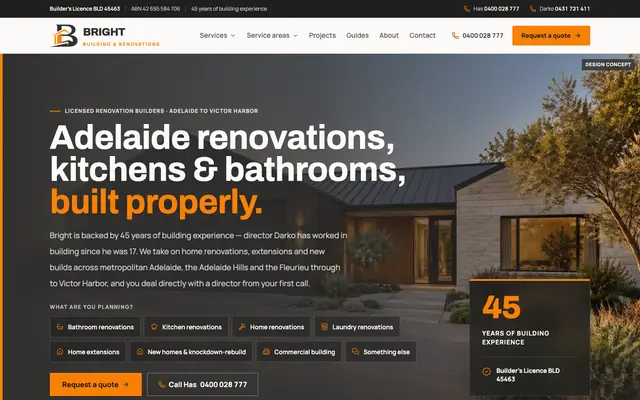
None of our clients is an architecture practice or a building designer, and we won't present one as if it were. The nearest is Bright Building & Renovations, an Adelaide renovation builder whose site rests on a project gallery and a set of planning guides, the same two parts a design practice leans on. Below it is a Google review about getting a site exactly as the client pictured it.

Home page of the Bright Building & Renovations website

Bright Building & Renovations

Trades & construction · Adelaide, Adelaide Hills & Fleurieu

A licensed South Australian builder taking on renovations, extensions, new homes and commercial fit-outs. Its 30 pages include seven service pages, seven service-area pages, five planning guides, a project gallery, an FAQ and a seven-step quote form. On a design practice's site, the planning guides become pages on approvals and the stages of design, and the quote form becomes a briefing form.

“My website is exactly how I wanted. I highly recommend Salem for any business wanting a professional website without the bull.”

Johannah Whilding, Google review

What an architect's or building designer's website costs

One page

$399

A sole practitioner or new studio: a selection of projects, how you work, your registration or licence, and a briefing form, on one page.

Up to 3 pages

$899

A home page, a projects page with a gallery and short write-up for each job, and a page on your process, fees, registration and enquiries.

Our suggestion for portfolio-led practices

Up to 8 pages

$1,499

A home page, a project index with pages for your strongest projects, the process, the studio and its registered people, and the briefing form.

  • Payment. No deposit. We build your draft first, you ask for as many changes as you like, and you pay once you approve it. If you don't go ahead, you owe nothing.
  • GST. WebCraft Studio isn't registered for GST, so no GST is added.
  • Timing. Most sites are live within 5–10 days of us getting your words and photos; bigger sites (up to 8 pages) take 2–3 weeks.
  • Hosting. After launch, hosting is $30 a month: hosting, security monitoring, backups, email support and unlimited text and image changes on your existing pages. New pages or features are quoted first. No contract, cancel anytime.
  • Domain and email. We register your domain in your name (about $20 a year), connect it to your site and set up your business email.

See full pricing and what each package includes

Questions architects and building designers ask us

Our photos are large professional files. Will the site be slow?

It shouldn't be. We prepare each photo in several widths in a modern image format, so a phone downloads a smaller version and a large screen gets a sharper one, and images further down the page load only as the visitor scrolls towards them. Send us the full-resolution files and we do the rest.

Can a building designer's website say “architectural design”?

Be careful. In Queensland, someone who isn't a registered practising architect must not use “architectural design”, “architectural design services” or “architectural services” to promote their services unless those services are provided using a registered practising architect. Victoria's architects board treats the same expressions as restricted for non-architects. We describe your services as building design, in the wording you approve; for your situation, read the ARBV's guidance for building designers (opens in a new tab) or your own state board's.

Can we add new projects after the site goes live?

Yes. Send us the photographer's images and a short write-up, and we add them. New photos and text on existing pages are covered by the $30 monthly hosting; a new project page is quoted first. Many practices add finished work a few times a year, once the photography comes back.

How do we credit a project someone else built?

Name the builder and the other consultants in the project credits, with their agreement, and state your role: full service, design and documentation, or design through to planning approval. Clients, the press and award juries all read credits, and a clear statement of your role avoids awkwardness when the builder posts the same photos.

Which package suits a practice?

A sole building designer or new studio can start with the one-page site at $399. A practice that wants a gallery and a process page fits the 3-page site at $899. For an established practice we'd suggest the 8-page site at $1,499: it gives the strongest projects pages of their own. A site that size takes 2–3 weeks once we have your words and photos.

Do you work with practices outside Adelaide?

Yes, by phone and email from our base on Hutt St in Adelaide; our current clients are in SA, NSW, VIC and QLD. If you're registered or licensed in more than one state, the site can list each one, which matters when a project sits across a border from your studio.

Ready to start your practice's website?

Send us a shortlist of projects with the photographer's images, a description of how you work, and the registration or licence details for each designer. We'll quote it and build the full draft, and you pay once you've approved it.

We reply within 24 hours. Prefer email? info@webcraftstudio.com.au