Licences. Our main handyman page sets out the NSW threshold: a contractor licence is needed to do, advertise or contract for residential building work worth more than $5,000 in labour and materials (GST included), and for specialist work at any value: electrical wiring, plumbing, draining, gas fitting, and air conditioning and refrigeration work. NSW also licenses what it calls minor trade work, which it describes as new, repair or replacement work that can't easily be assigned to a specific trade area, with endorsements for particular jobs such as shower screens and splashbacks. If you hold a licence, its number belongs on the site; if every job you take stays under the threshold and away from the specialist trades, the site should describe that work without implying a licence you don't have.
Units and strata. NSW sorts work inside a strata apartment into cosmetic work, minor renovations and major renovations. According to the NSW strata renovation rules, cosmetic work doesn't affect the structure or outside of the apartment, needs no waterproofing and can go ahead without approval: installing or replacing hooks, nails, screws, handrails, blinds, curtains or built-in wardrobes, painting inside, filling minor holes and cracks in internal walls, and laying carpet. Minor renovations need more than half the votes cast at a strata meeting, or the committee's approval where a by-law allows it. The NSW list includes installing or removing kitchen cupboards, changing recessed light fittings, putting down hard flooring (with an acoustic certificate), and fitting a clothesline, a rainwater tank or ceiling insulation, and the owner has to supply the qualifications and details of the tradespeople doing it. A scheme's by-laws can add items to either list. The NSW Government's window, deck and balcony safety page also says residential strata buildings must be fitted with window safety devices, which can limit a window's opening to less than 12.5 cm, and NSW lists windows and window locks among the common property an owners corporation repairs and maintains. If you fit or repair window locks, put them on the strata page.
Rentals. The NSW page on making changes to a rental property lists the minor changes a landlord can't unreasonably refuse. They include securing furniture to a wall other than a tiled one, a childproof latch on the outside gate of a single dwelling, fly screens, curtains or removable blinds, cleats or cord guides for blind cords, indoor child safety gates, window safety devices, shatter-resistant window film, and hooks, nails or screws for pictures. The tenant needs the lease to allow it or the landlord's written permission, pays unless the landlord agrees to, and can take a refusal to NCAT; the protections don't apply to heritage properties or homes on the loose-fill asbestos register, and some limits apply in strata schemes and social housing. On the landlord's side, NSW counts a fault or damage that makes a property unsafe or insecure as an urgent repair, alongside gas leaks, burst water services and serious roof leaks. And under the smoke alarm rules for rentals, a landlord must check the alarms once a year and fit new removable batteries yearly, while a hard-wired alarm can only be repaired or replaced by a licensed electrician.
Older homes. SafeWork NSW warns that a home built before the late 1980s may contain asbestos, in flooring, kitchens, bathrooms, roofs, ceilings and walls, and that disturbing it, by cutting or drilling for example, can release fibres into the air. Friable asbestos always needs a licensed removalist, and so does more than 10 square metres of bonded asbestos. In November 2023 SafeWork NSW launched an online asbestos awareness course and named home handypersons among the workers it is meant for. For homes built before 1980 there is a second check: the NSW Government tells tradespeople to check for loose-fill asbestos insulation before quoting or starting work, to ask the owner whether the house has been tested, and to stay out of the roof space and subfloor until it has been if loose-fill is suspected. The public register lists only homes that have tested positive, so an address that isn't on it hasn't been cleared.
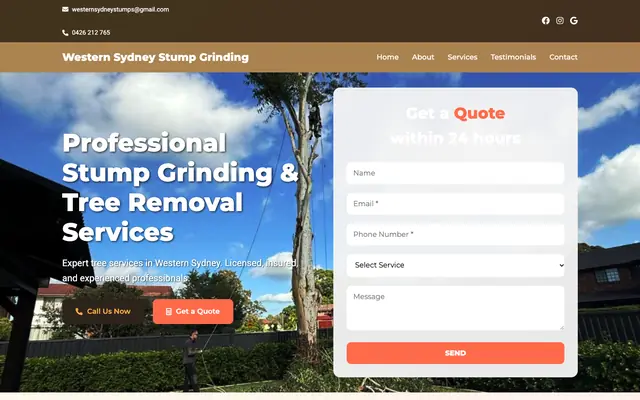
Where you'll travel. Few handymen cover all of Sydney, so the site should name the suburbs or council areas you do take on, such as the Inner West, the Northern Beaches, the Sutherland Shire or the Hills Shire, and say plainly where you stop. That saves you calls from the far side of the city and tells a property manager whether to send you a job. WebCraft Studio is an Adelaide team on Hutt St, so a Sydney handyman works with us by phone and email, as our Sydney clients Western Sydney Stump Grinding and Resolve Forward do. You send your rates, the jobs you take, your suburbs and a few photos of finished work; the draft comes back as a link you can check between jobs, you ask for whatever changes you want, and payment waits until you sign it off. The rules above are summarised from the NSW Government pages linked in each paragraph; we lay out what you tell us about your work and point to those pages rather than give legal advice.