Website Design for Carpenters in Melbourne

Websites for Melbourne carpenters who build decks and verandahs, restore period homes or frame for builders: your BPC registration set out the way Victoria's Building Act asks, a deck page that's honest about permits, and a quote form that picks up Heritage Overlays and bushfire prone land before you drive out.

What a Melbourne carpenter's website needs to cover

Victoria asks different questions of a carpentry job than Sydney or Brisbane do. Decks attached to a house go through a building permit, many inner and middle-ring streets sit under a Heritage Overlay, and parts of the fringe are mapped for bushfire. A homeowner wants to know whether you look after that side of the job; a builder wants your registration class and how soon you're free. The site should settle both before anyone picks up the phone.

  • Registration details in the footer, with your class

    Victoria's Building Act asks for the registered name and registration number on any advertisement offering domestic building work, and a website is one. We set both out as text in the footer of every page, add your class if you want it shown (domestic builder limited to carpentry, say) and link to the BPC's public register so a careful customer can check you in a few seconds.

  • A deck page that explains the permit step

    Victoria's Building Regulations list no permit exemption for decks, unlike the NSW exempt development rules for small ones, and the regulator's practice note says a deck attached to a house or pool needs a building permit whatever its size. The deck page should say, in your words, who engages the building surveyor, whether the permit is in your price and what the permit stage usually adds to the timeline.

  • Pergolas and verandahs kept apart

    Victoria's Building Regulations define a pergola as open: unroofed, or covered only with open-weave permeable material. Attach a solid-roofed structure to the house instead and Frankston, for one, calls it a verandah, which needs a building permit. Separate galleries, and a question on the form about open or solid roofing, stop a customer reading your pergola prices and expecting them to cover a roofed outdoor room.

  • A quote form that asks the VicPlan questions

    VicPlan, the state's free property map, shows the planning overlays on a lot and has a bushfire layer. The form asks for the suburb, whether the house is under a Heritage Overlay or in a bushfire prone area (with a link to VicPlan for anyone unsure), the lot size, how high the deck will sit off the ground, whether it attaches to the house or a pool, and a few photos. You can see which jobs carry a planning step before you price them.

  • Period-home work in a gallery of its own

    Return verandahs rebuilt, weatherboards replaced, sash windows freed and rehung, front fences and gates made to an old pattern. Owners of older houses in Kew, Williamstown or Brunswick look for someone who has worked on a house like theirs, so these jobs sit together with captions such as “Verandah posts and frieze replaced, Hawthorn”.

  • Framing and fix-out for builders, on a separate page

    A site supervisor filling a gap in the program wants the stages you take on, whether you hold a framing or carpentry class, the corridors you'll drive to (the west, the south-east growth suburbs, the Peninsula) and the notice you need. A short page with a direct number reads better to them than a homeowner gallery.

Carpentry in Melbourne: registration, permits and overlays

Registration. Victoria has no separate carpentry licence. A carpenter contracting with homeowners comes under builder registration with the Building and Plumbing Commission (BPC), which took over from the Victorian Building Authority on 1 July 2025. Consumer Affairs Victoria says registration is needed for domestic building work worth more than $10,000 and, whatever the value, to re-block, re-stump, demolish or remove a home; its registration checklist adds any building work that requires a permit, regardless of cost. The limited classes in the Building Regulations that fit this trade include domestic builder limited to carpentry (alterations and repairs to homes, carports, garages, pergolas, decks and verandahs), limited to framing, limited to cabinet making, joinery and stair construction, and limited to re-stumping and re-blocking. Section 169H of the Building Act then puts the registered name and number on your advertising, which our page for Melbourne builders explains. Registering carpenters as a trade in their own right is back on the table: the Department of Transport and Planning has issued a consultation paper on implementing carpentry registration and licensing, and the Housing Industry Association's October 2026 submission asks for it to be withdrawn.

Decks, verandahs and pergolas. Schedule 3 of the Building Regulations 2018 sets out the building work that needs no building permit, and decks and verandahs aren't on it. The regulator's practice note on building permits (BP-01) says decks and verandahs attached to a building such as a house or swimming pool need a permit irrespective of size, as do detached decks that form part of a building's amenity. Boroondara's deck guidance says a deck always needs a building permit, and Frankston says the same regardless of size. Pergolas are treated differently: Schedule 3 exempts an open pergola if it is no more than 3.6 m high with a floor area of 20 m² or less and, where it belongs to a house, sits no more than 2.5 m forward of the front wall. Planning is a separate test. In Boroondara, which takes in Kew, Hawthorn and Camberwell, a deck under a Heritage Overlay needs a planning permit if it can be seen from a street (not a laneway) or a public park, and a verandah needs one wherever the Heritage Overlay applies. On lots under 300 m² in the residential zones, a deck floor more than 800 mm above natural ground also needs one, and council says the planning permit must be issued before the building permit application goes in.

Bushfire and termites on the fringe. Parts of the outer east and north are designated bushfire prone areas. Maroondah council says a building permit there needs a Bushfire Attack Level assessment, Maroondah and Nillumbik both give BAL 12.5 for ember protection as the minimum construction standard, and Whittlesea notes that the standards reach alterations and additions as well as new homes. VicPlan's bushfire layer shows whether a property is mapped. Down the bay, the whole Mornington Peninsula Shire is designated as subject to termite infestation under regulation 150 of the Building Regulations 2018, and the shire says new houses, extensions included, need termite management to AS 3660.1. If you frame extensions on the Peninsula or build decks in the hills, a line on how you handle those jobs answers a question careful owners will ask.

Contracts, deposits and Home Warranty. Consumer Affairs Victoria says work worth more than $10,000 needs a written major domestic building contract, and caps deposits at 10 per cent of a contract price below $20,000 and 5 per cent from $20,000. Those rules are moving. The Domestic Building Contracts Amendment Act 2025 takes effect by 1 December 2026, and proposed regulations would fix the major contract threshold at $20,000 and set deposit limits in regulations. Home Warranty, run by the BPC, has applied since 1 July 2026 to eligible contracts over $20,000 on buildings of three storeys or less. A carpenter's site is better off describing how you quote in general terms, with a link to the official guidance, than printing percentages that may soon be out of date.

How we work with Melbourne carpenters. We're an Adelaide team on Hutt St, and Melbourne businesses work with us by phone and email. Our Victorian client so far is a coaching practice for doctors, and we haven't built for a carpenter yet, so your site is built from what you send: registration details, photos of finished jobs, the suburbs you want work in and your own account of how you handle permits. We arrange it, link the official guidance, and leave planning and legal calls to you and your building surveyor.
Sites we've built that a carpentry business could follow

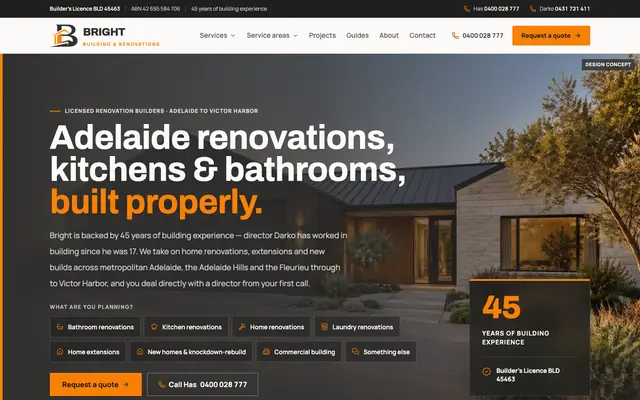
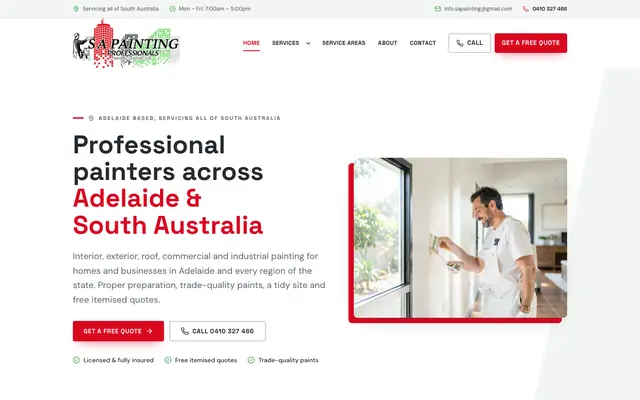
There's no carpenter in our portfolio yet, and no Victorian trade. The closest are a licensed Adelaide renovation builder whose site gives each kind of job and each service area its own page, and an Adelaide painting company whose suburb and postcode search lets a customer check coverage across a wide area, which suits a carpenter working anywhere from the Peninsula to the outer east.

Home page of the Bright Building & Renovations website

Bright Building & Renovations

Trades & construction · Adelaide, Adelaide Hills & Fleurieu

Renovations, extensions and new homes across Adelaide, the Adelaide Hills and the Fleurieu. Thirty pages, including seven service pages, seven service-area pages, five planning guides and a seven-step quote form. The planning guides are the part a Melbourne carpenter might borrow: a page that explains, in your words, how the permit side of a deck or verandah works when you build it.

Home page of the SA Painting Professionals website

SA Painting Professionals

Trades & construction · Adelaide & all of SA

Interior, exterior, roof and commercial painting across Adelaide and regional South Australia. Twelve service pages, region pages and a suburb and postcode search sit beside an online quote form and tap-to-call. The same search could tell a customer in Frankston or Eltham whether you'll come out before they start the form.

“My website is exactly how I wanted. I highly recommend Salem for any business wanting a professional website without the bull.”

Johannah Whilding, Google review

★ 5.0 from 33 Google reviews (opens in a new tab)

Want numbers from a trade site? Western Sydney Stump Grinding has landed at least 62 jobs, about $46,500 of work, from a single-page site we built. Read the case study.

See all 14 recent client sites in our portfolio.

What a Melbourne carpenter's website costs

One page

$399

Registration line, your services, one gallery, the suburbs you cover and a quote form with the overlay and deck-height questions, all on a single page.

Where most Melbourne carpenters start

Up to 3 pages

$899

A home page, a decks, pergolas and verandahs page that walks through the permit step, and a page for builders who need framing or fix-out.

Up to 8 pages

$1,499

A home page and separate pages for decks, for verandahs and pergolas, for period-home restoration, for bushfire-area work and for builders' work, plus pages for the two parts of Melbourne you most want jobs from.

  • Payment. No deposit. We build your draft first, you ask for as many changes as you like, and you pay once you approve it. If you don't go ahead, you owe nothing.
  • GST. WebCraft Studio isn't registered for GST, so no GST is added.
  • Timing. Most sites are live within 5–10 days of us getting your words and photos; bigger sites (up to 8 pages) take 2–3 weeks.
  • Hosting. After launch, hosting is $30 a month: hosting, security monitoring, backups, email support and unlimited text and image changes on your existing pages. New pages or features are quoted first. No contract, cancel anytime.
  • Domain and email. We register your domain in your name (about $20 a year), connect it to your site and set up your business email.

See full pricing and what each package includes

Questions Melbourne carpenters ask us

Where does our BPC registration go on the site?

In the footer of every page, as plain text: the name you're registered under and your registration number, which is what section 169H of the Building Act asks of advertising for domestic building work. If you'd like your class shown, such as domestic builder limited to carpentry, it sits on the same line. The footer links to the BPC's Find and check a practitioner register so a customer can confirm it.

Can the site tell people a small deck won't need a permit?

We'd avoid it. Victoria's building regulator says in its practice note that decks attached to a house or pool need a building permit whatever their size, and Boroondara and Frankston councils tell residents a deck always needs one. The site is better used to explain your process: whether you engage the building surveyor, whether the permit sits inside your quote, and that a planning permit may have to come first where an overlay applies.

Much of our work is in Nillumbik and the outer east. What should the site say about bushfire?

That you build to the Bushfire Attack Level in the property's assessment, which levels you've built to, and whether you organise the assessment or the owner does. Maroondah council says a building permit in a designated bushfire prone area needs a BAL assessment, and both Maroondah and Nillumbik give BAL 12.5 as the minimum standard. A photo from a job at each level, with the materials named, carries more weight than a paragraph of claims.

Carpenter registration might change. Will the site need redoing?

No. The Department of Transport and Planning has issued a consultation paper on registering and licensing carpenters, and whether it goes ahead is still open; in its October 2026 submission the Housing Industry Association asked for the paper to be withdrawn. If your registration or the rules change, updating the footer and services list is a text change on existing pages, covered by the $30 monthly hosting.

How does an Adelaide team work with a Melbourne carpenter?

By phone and email. You tell us which jobs you want more of, then send photos, registration details and your suburb list, and we send a draft link you can check on your phone between jobs. You ask for changes and pay once you approve it. Our current clients are in SA, NSW, VIC and QLD, and we reply within 24 hours.

Get a draft of your Melbourne carpentry site

Send us your registration number, a dozen photos of decks, verandahs or stairs you've built and the parts of Melbourne you cover. We'll build the draft and send you the link, and you pay only once you approve it.

We reply within 24 hours. Prefer email? info@webcraftstudio.com.au