Website Design for Builders in Tweed Heads

For Tweed builders working from Banora Point and Terranora down to Kingscliff, Pottsville and Murwillumbah, and sometimes across the line in Coolangatta. Each licence labelled with its state, your flood-level work shown job by job, and a quote form that asks for the property's flood levels before you price an addition.

What a Tweed builder's website has to get right

Behind many Tweed enquiries sits a second question: not only can you build it, but can it be built here, at that floor height? Owners of older homes in flood-affected streets, buyers in the new estates and Queensland clients a few hundred metres away each need a different answer. The site can sort them before you return a single call.

  • Each licence labelled with its state

    Your NSW licensee name, licence number and category plus a business phone in the footer, matched to Building Commission NSW's register. If you also hold a QBCC licence, show it beside the NSW one, marked QLD. If you don't, a plain 'NSW side only' saves a Coolangatta owner a wasted call.

  • Additions on low-set homes explained

    Council's flood DCP allows only limited extensions to a house whose existing floor sits below the flood planning level, and larger additions have to be split-level and reach that level. If these jobs are your bread and butter, describe how you approach them and show two or three you've finished.

  • Raised and rebuilt homes in their own gallery

    Lifted houses in South Murwillumbah, rebuilt ground floors in Chinderah, a retrofit with flood-compatible linings: caption each with the suburb or village and what was done. Owners still working through flood recovery are likely to look for this kind of work first.

  • Estate homes at Kings Forest and Cobaki

    Both estates were approved through state concept plans, and a buyer may already have a lot number and a signed contract when they first call. A page for each estate you build in, with homes you've completed there, catches the people who search by estate name.

  • A quote form that asks for flood information

    Plans, a survey and the contract of sale as uploads, plus whether the owner already has council's flood levels for the lot. It also asks which side of the border the property is on and offers meeting times marked NSW time, since Queensland skips daylight saving.

  • Memberships and awards named correctly

    Master Builders NSW runs a Tweed division, and Tweed projects enter the association's Northern Regions awards. If you're a member or placed in the awards, show the program, year and category beside the project rather than a row of unexplained logos.

Building in the Tweed: what your website should reflect

South of the border the state rules are those that apply in Sydney: a Building Commission NSW licence whose name, number and category appear in all advertising, the internet included; a deposit capped at 10 percent; and Home Building Compensation cover before any deposit on residential work over twenty thousand dollars. Our Sydney builders page has the detail. North of it, the QBCC sets its own advertising requirements, explained on our Gold Coast builders page. Neither state's licence simply works in the other: general building work isn't due to come under NSW's automatic mutual recognition scheme until 1 October 2027, and before then a Queensland licensee has to apply to Building Commission NSW to have the licence recognised, just as an NSW licensee applies to the QBCC under mutual recognition to work on the Queensland side. The website should show the licences you actually hold, each with its state.

Flood planning is where the Tweed differs most. Section A3 of the Tweed Development Control Plan, the part on flood liable land, moved to version 1.7 on 4 March 2026 after a council resolution on 12 February. That version revises the defined flood event, the flood planning levels and the related controls to match the 2024 Tweed Valley Flood Study Update and Expansion and the 2025 Interim Flood Planning Levels Policy, replaces the 1984 maps of inappropriate development with modern maps covering the whole shire, and brings the section into line with the NSW Flood Risk Management Manual 2024. The defined flood event is now the highest of several levels, among them the flood of record (the 2022 peak, for example) and, as an allowance for climate change, the 0.2 percent AEP flood from the 2024 study. The flood planning level adds 0.5 metres of freeboard to that, and it sets the minimum habitable floor level. Any floor height a builder's site quoted from before March 2026 may now be wrong, and quoting heights at all is best left to council's property flood reports.

Extensions are handled carefully. Under the same section, a minor extension to an existing single dwelling means adding no more than 35 square metres. Where a home's lowest approved habitable floor is below the flood planning level, a minor habitable extension can be allowed only if it's outside high flow and high hazard areas, doesn't open the way to a dual occupancy or to turning a garage or other non-habitable space into rooms, respects any earlier floor-area limits, and is built to a flood resilient design with flood compatible materials up to the planning level. Larger additions need a split-level design that reaches the planning level. The DCP also names filled estates in Banora Point, West Kingscliff and Pottsville, and raised homes in Chinderah, South Murwillumbah and rural villages, as examples of low islands that can be cut off and then covered in the biggest floods. A builder whose site says plainly that it checks these rules before designing an addition gives owners in those suburbs a reason to call.

Recovery work continues. The Tweed is one of seven Northern Rivers council areas in the NSW Reconstruction Authority's Resilient Homes Program; applications for raising and retrofit grants closed on 14 August 2026, and in June 2026 the government gave participants until December 2028 to finish raising or retrofitting, citing well documented capacity constraints in the region's building market. Our Tweed Heads tradies page has more on how that program works. Council has operated flood levees across the Tweed since the 1950s, Tweed Heads South among them, and a 2026 levee and drainage study looks at flooding and drainage in Tweed Heads South and Banora Point.

New streets are going in too. Kings Forest, near Kingscliff, has a concept plan approved in 2010 for 4,500 dwellings, and its first lots were released for sale in December 2023; Cobaki, just west of Gold Coast Airport, is planned for about 5,500 homes with buildings capped at three storeys. Master Builders NSW's Tweed division covers the NSW side of the Gold Coast region and inland to Murwillumbah, with quarterly information nights around the shire, and its Northern Regions Excellence in Building Awards take entries for 2027 until 21 February, with the gala at Ballina RSL Club in June. We're an Adelaide team on Hutt St; Tweed builders work with us by phone and email, and one of our Queensland clients is M.J. Debney Plumbing & Gas. Send your licence details, finished projects and the towns you build in, and we'll reply with a draft link. You pay once you approve it.
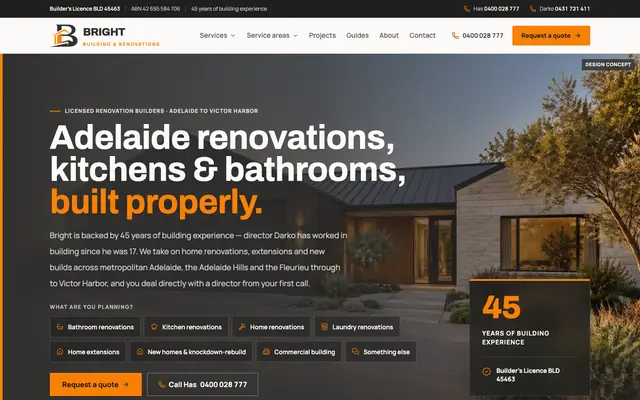

Sites we've built for a builder and a Queensland trade

Neither client is in the Tweed. Bright Building & Renovations is a licensed builder in South Australia whose site shows the licence footer, project gallery and detailed quote form a Tweed builder needs. M.J. Debney is a Queensland plumbing and gas business, a reminder of how a trade on the Queensland side presents its licence.

Home page of the Bright Building & Renovations website

Bright Building & Renovations

Trades & construction · Adelaide, Adelaide Hills & Fleurieu

Renovations, extensions, new homes and knockdown-rebuilds for a licensed builder covering Adelaide, the Adelaide Hills and the Fleurieu. Thirty pages, including seven service pages, seven area pages and five planning guides, and a seven-step quote form that asks about drawings, budget and start date.

“Rebuilt two websites for our businesses and saved us a fortune on hosting etc.”

Lockyer Valley Batteries, Google review

★ 5.0 from 33 Google reviews (opens in a new tab)

Want numbers from a trade site? Western Sydney Stump Grinding has landed at least 62 jobs, about $46,500 of work, from a single-page site we built. Read the case study.

See all 14 recent client sites in our portfolio.

What a Tweed builder's website costs

One page

$399

Licence details for each state you work in, the homes you build, projects captioned by suburb and a quote form that takes plans and flood levels, on one page.

Up to 3 pages

$899

A home page, a projects page split into new homes and flood-level work, and a page on how a job runs, from flood report to handover.

Our suggestion for a Tweed builder

Up to 8 pages

$1,499

Pages for new homes, additions, raising and retrofits, estate builds, your projects, your process, an about page with memberships, and one on the NSW and Queensland areas you cover.

  • Payment. No deposit. We build your draft first, you ask for as many changes as you like, and you pay once you approve it. If you don't go ahead, you owe nothing.
  • GST. WebCraft Studio isn't registered for GST, so no GST is added.
  • Timing. Most sites are live within 5–10 days of us getting your words and photos; bigger sites (up to 8 pages) take 2–3 weeks.
  • Hosting. After launch, hosting is $30 a month: hosting, security monitoring, backups, email support and unlimited text and image changes on your existing pages. New pages or features are quoted first. No contract, cancel anytime.
  • Domain and email. We register your domain in your name (about $20 a year), connect it to your site and set up your business email.

See full pricing and what each package includes

Questions Tweed builders ask us

Can you build a Tweed builder's website from Adelaide?

Yes. We're an Adelaide (South Australia) web design team working with businesses Australia-wide by phone and email, with current clients in SA, NSW, VIC and QLD. You send licence details, photos and plans, we send a draft link, you ask for any changes you want, and you pay once you approve it. Nobody needs to visit a site.

We hold NSW and QBCC licences. How should the site show them?

Both go in the footer of every page, each marked with its state and worded as its register lists it. Then split your areas page in two, NSW suburbs and Queensland suburbs, so a client can see at a glance whether you build on their side. If you only hold one licence, the site says so.

Should our site explain the 35 square metre extension rule?

Not in detail. Say that additions on flood-affected homes are limited by council's flood controls, that you check the property's flood levels before designing, and show finished additions. Link to council for the rules themselves; your site describes your process, and we don't give planning advice.

Our site quotes flood levels from before March 2026. What should we do?

Take the numbers out. Version 1.7 of the flood DCP revised the flood planning levels, and any figure on your site may now be wrong for some properties. A line saying you work from the property's current flood report is accurate whatever the levels become, and wording changes on existing pages are covered by the $30 monthly hosting.

How can owners in the Resilient Homes Program find us?

Give raising and retrofit work a page of its own, with finished jobs captioned by suburb, a short description of how you run that kind of project, and a form that asks whether the owner is already in the program. Eligibility and grant terms belong to the NSW Reconstruction Authority, so link to it rather than restating them.

Ready to start your Tweed builder's website?

Send your licence details for each state, a few finished projects and the towns you build in on both sides of the border. We'll quote first, build the full draft, and you pay only once you're happy with it.

We reply within 24 hours. Prefer email? info@webcraftstudio.com.au