The conduct rules. NSW solicitors practise under the Legal Profession Uniform Law, which also applies in Victoria and Western Australia, and under the Australian Solicitors' Conduct Rules made for it. Rule 36.1 requires a solicitor or principal to make sure any advertising, marketing or promotion of the solicitor or practice is not false, not misleading or deceptive (or likely to be), not offensive and not prohibited by law. Rule 36.2 adds that a solicitor must not convey a false, misleading or deceptive impression of specialist expertise, and may advertise using the words “accredited specialist”, or post-nominals derived from them, only if accredited by the relevant professional association. A firm's website is promotion, so that applies to every page of it, solicitor profiles included.
Personal injury and work injury. NSW used to prohibit lawyers from advertising personal injury services. The Law Society of NSW's advertising guidance (opens in a new tab) notes that the Uniform Law didn't carry over the ban in the repealed Legal Profession Regulation 2005, and that the Workers Compensation Regulation 2016 left out the ban on advertising work injury legal services that the 2010 regulation contained. Rule 36 still governs how that work, and any result, is described. We lay out the wording you approve and point you to the Law Society for questions about it; we don't give compliance advice. Complaints about NSW lawyers are handled by the Office of the Legal Services Commissioner.
Credentials a client can check. NSW practising certificates are issued by the Law Society's Council. Its online Register of Solicitors lists solicitors who hold a current certificate, shows which of them are Law Society members, and includes accredited specialists. Accreditation comes with conditions: applicants need at least five years of full-time practice and must have worked in the area in each of the three years before applying, for at least a quarter of full-time practice. Only specialists who renew each year may promote themselves as specialists, anyone on leave has to stop holding themselves out as one for that period, and the program's three logos can't be altered. Areas offered in 2026 include family law, elder law, personal injury, employment and industrial law, immigration, children's law, dispute resolution, and planning and environment.
Sydney is many local markets. The Law Society recognises nine suburban law societies inside Sydney: Bankstown & District, City of Sydney, Eastern Suburbs, Inner West, Liverpool-Fairfield, North Metropolitan (covering Chatswood, Ryde, North Sydney and Hornsby), Northern Beaches, Parramatta & District, and St George-Sutherland. Clients think the same way, looking for someone nearby or someone who appears in their court. The Downing Centre Local Court is on Liverpool Street in the city; Parramatta Local and District Court is at 12 George Street, with the Children's Court at number 2. Court arrangements also change: the refurbishment of Penrith Courthouse moves its Local Court sittings to Parramatta from 21 December 2026 to mid-March 2027, so a Western Sydney practice whose site tells clients where to go needs to update that page for the period. Text edits like that are covered by the $30 monthly hosting.
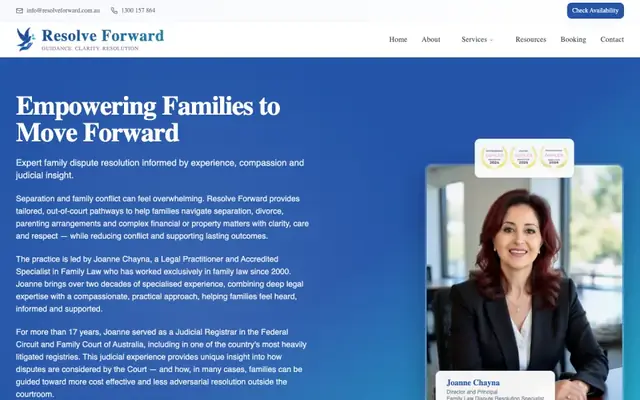
Working with us. We're an Adelaide team at Ste 3/110 Hutt St and work with Sydney firms by phone and email. Resolve Forward, a family law dispute resolution practice, is one of our Sydney clients. Partners can look over the draft link when it suits them, and the firm pays nothing until it approves the site.