Website Design for Insurance Brokers

Websites for general insurance brokers and authorised representatives that let a business owner request a quote for the exact cover they need, show whose licence you operate under, and keep your Financial Services Guide and complaints policy one click from any page.

What an insurance broker's website needs to do

People rarely browse broker websites for fun. They arrive with a trigger: a renewal premium that jumped, a landlord asking for a certificate of currency, a head contractor demanding professional indemnity, or a claim the insurer is slow to settle. NIBA, the brokers' peak body, describes the broker's role as explaining features, exclusions and costs, comparing more policies than one insurer offers, and negotiating with the insurer at claim time. Your site should show quickly which covers you place, who licenses you and how to start a quote.

  • A quote form that changes with the cover

    The first question is the cover: business package, public liability, professional indemnity, commercial motor or fleet, home and contents, landlord, strata, cyber or management liability. The next questions follow from that answer: occupation and turnover for liability, the number and use of vehicles for a fleet, the number of lots for strata. A renewal date field shows you which enquiries are urgent, and an upload lets people attach their current schedule. We build multi-step forms like this into the site.

  • Licence numbers a client can look up

    Your AFSL number, or your authorised representative number alongside your licensee's name and AFSL number, sits in the footer of every page. ASIC's Professional Registers search covers both AFS licensees and AFS authorised representatives, so a cautious business owner can look you up, and the details on your site should match the register exactly. If your licensee supplies wording its representatives must use, we copy it as given.

  • Your FSG, or website disclosure information

    ASIC's FAQs on Financial Services Guides, updated in December 2025, explain that in some situations a provider can make website disclosure information available instead of giving an FSG. It has to contain everything an FSG would, show its date, stay current and be readily accessible; ASIC says information behind a password doesn't count. An authorised representative also needs the licensee's authorisation before publishing or updating it. Whichever approach your licensee takes, it gets a plain link in the footer.

  • A complaints page that names AFCA

    ASIC's RG 271 says financial firms must have a publicly available, readily accessible complaints policy, and that the policy should appear on the firm's website in an accessible location. The same guide says website FAQs and similar material should tell people they can take an unresolved complaint to the Australian Financial Complaints Authority, with AFCA's contact details. Your policy gets its own page, in the words you or your licensee provide.

  • What happens when a client claims

    Claims support is the reason many small businesses use a broker at all, so give it a section of its own: who to call first, what to photograph and keep, what you lodge and chase on the client's behalf, and how you keep them updated. If you'd like insurers' claim lines listed for after-hours emergencies, we set them out in a table you can ask us to update whenever a number changes.

  • Wording your licensee can approve

    ASIC says providers of advice to retail clients must give a general advice warning when giving general advice, so pages describing covers can carry the warning your licensee has approved. ASIC's RG 234 guides anyone promoting financial products and services on avoiding false or misleading advertising. If you give personal advice but aren't independent, impartial or unbiased in the legal sense, ASIC's guidance says your FSG or website disclosure information must say so and explain why. We flag words like "independent" in your text so your licensee can check them.

  • Pages for the industries you know

    Brokers who specialise in trades, hospitality, transport, farms or strata win work by showing they understand that client's risks. A page per specialty, written by you, can list the covers those clients usually ask about, the questions you'll need answered and the kinds of contracts that require proof of cover. On smaller sites, specialties become short sections on the covers page.

The closest work in our portfolio

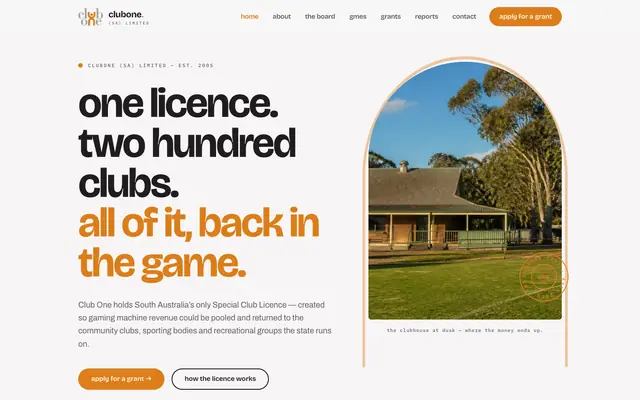
We haven't built a website for an insurance broker yet, and we won't pass another client off as one. Two sites do jobs a broking site depends on: Simple Engineers' quote form accepts file uploads, and Club One's site takes applicants through a four-part online application and explains its gaming machine entitlements.

Home page of the Club One (SA) website

Club One (SA)

Community, creative & tourism · South Australia

A South Australian not-for-profit holding the state's only Special Club Licence. Its seven-page site has a four-part online grant application, a page explaining gaming machine entitlements and board profiles. A quote request that branches by cover type can be split into steps the same way.

“Salem was fantastic to work with on our accounting firm’s website. From day one, he was professional, responsive…”

Quang Luc Le, Google review

★ 5.0 from 33 Google reviews (opens in a new tab)

Advising on life risk insurance as a financial adviser? See our page on website design for financial advisers.

See all 14 recent client sites in our portfolio.

What an insurance broker website costs

One page

$399

A sole broker or authorised representative: the covers you place, licence details, claims help, FSG and complaints links and a quote form, on one page.

Our suggestion for most brokers

Up to 3 pages

$899

A home page with the quote form, a covers page split into business and personal insurance, and a claims and complaints page that names AFCA.

Up to 8 pages

$1,499

Brokerages with specialties: a page per industry you insure, business and personal covers, claims, the team with their credentials, and complaints.

  • Payment. No deposit. We build your draft first, you ask for as many changes as you like, and you pay once you approve it. If you don't go ahead, you owe nothing.
  • GST. WebCraft Studio isn't registered for GST, so no GST is added.
  • Timing. Most sites are live within 5–10 days of us getting your words and photos; bigger sites (up to 8 pages) take 2–3 weeks.
  • Hosting. After launch, hosting is $30 a month: hosting, security monitoring, backups, email support and unlimited text and image changes on your existing pages. New pages or features are quoted first. No contract, cancel anytime.
  • Domain and email. We register your domain in your name (about $20 a year), connect it to your site and set up your business email.

See full pricing and what each package includes

Questions insurance brokers ask us

We're an authorised representative. Who signs off the website?

Usually your licensee, along with you. We send you a link to the full draft, which you can forward to your licensee's compliance team before anything goes live. Their changes are made like any other round of changes, and you pay only once you approve the finished site. If they supply set wording for the footer, the general advice warning or the FSG link, we use it word for word.

Can clients get a price online straight away?

For most commercial covers, no: the premium depends on each insurer's underwriting, so the site collects the details and you come back with options. If you use an online quoting platform for some simpler products, we link it from the matching cover. If you'd like to take payments inside your own site, for example for invoices, we can build a payment system into it, quoted per job.

Should we mention NIBA and the Code of Practice?

If you're a member, yes. NIBA says its membership subscribes to the Insurance Brokers Code of Practice, and brokers who hold NIBA's Qualified Practising Insurance Broker (QPIB) designation can list it on their profiles. NIBA says a new version of the Code starts on 1 January 2027, so any page that quotes or links the Code should point to the right one. Check the details on NIBA's website (opens in a new tab), and update the reference when the new Code takes over; text changes are covered by the $30 monthly hosting.

Can we show the insurers we place business with?

You can list them by name if you genuinely deal with them. Insurer logos are their trade marks, so use them only where the insurer or your licensee allows it. A list that's honest about breadth works better than a wall of logos: say roughly how many insurers and underwriting agencies you use, and which ones you place most of your work with.

Which package suits an insurance broker?

Most brokers suit the 3-page site at $899: home and quote form, covers, and claims and complaints. A sole authorised representative can fit the essentials on one page for $399. Brokerages that specialise in several industries, or want a profile for each broker, are better on the 8-page site at $1,499. A site that size takes 2–3 weeks once we have your words and photos.

Ready to start your broking website?

Tell us which covers you place most, whether you hold your own AFSL or act as an authorised representative, and how clients reach you now. We'll quote it, build a draft your licensee can review, and you pay once you approve it.

We reply within 24 hours. Prefer email? info@webcraftstudio.com.au