Website Design for Mortgage Brokers

Websites for mortgage and finance brokers that answer the questions Moneysmart suggests borrowers ask: whether you're licensed, which lenders you can access and how you're paid.

What a mortgage broker website needs to do

ASIC's Moneysmart site tells home buyers to look a broker up on ASIC's Professional Registers before meeting them, then to ask which lenders they work with and how they're paid. A website that answers those questions up front leaves the first meeting free for the loan itself.

  • Licence and representative numbers

    Your Australian Credit Licence number, or your credit representative number with your licensee's name and ACL number, in the footer of every page. Borrowers can search both on ASIC's Professional Registers, so they have to match exactly. Section 52 of the National Consumer Credit Protection Act requires a licensee to cite its ACL number in prescribed documents, and aggregators' advertising guides apply that to ads placed by their credit representatives, so we use the wording your licensee gives you.

  • Your lender panel, described honestly

    Which lenders you can access and, since Moneysmart suggests borrowers ask, the kinds you can't. Your Credit Guide already has to name the lenders you do the most business with (up to six), so the list on the site should line up with it. We list only lenders you're currently accredited with, and add logos only if your aggregator's rules allow them.

  • How you're paid, before anyone asks

    Lenders generally pay brokers a commission, typically an upfront and an ongoing payment, and some brokers also charge a fee, which Moneysmart notes must be set out in a written quote the borrower signs first. One plain paragraph on how that works for you, with a link to your Credit Guide, settles a question many borrowers arrive with.

  • Words to leave out

    Section 160B of the National Consumer Credit Protection Act stops a licensee describing itself or its service as "independent", "impartial" or "unbiased", or using words of similar meaning, unless strict conditions are met, including not keeping commissions paid by lenders. We flag those words if they turn up in what you send us, and your licensee has the final say.

  • Calculators without a rate to maintain

    Under Part 10 of the National Credit Code, advertising a home loan interest rate brings a comparison rate requirement. A link to Moneysmart's mortgage calculator (opens in a new tab), or a calculator where visitors type in their own rate, keeps your site from showing figures that go out of date. A custom calculator is quoted first, like any feature.

  • A booking button for the first chat

    A "Book a call" button on every page that opens the calendar tool you already use, plus a short call-back form asking for the loan purpose, rough timing and the best time to ring. Payslips, ID and bank statements go through your aggregator's or CRM's secure fact-find instead.

Finance and professional services work

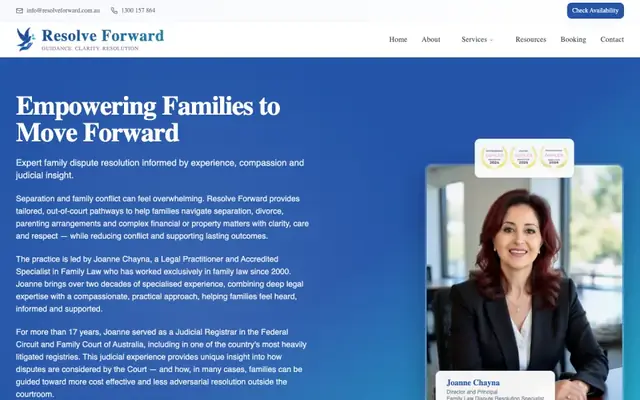
There's no mortgage broker in our portfolio yet. The closest example is a Sydney dispute resolution practice where clients pick a package, book online and fill in an intake form, much the same path a borrower takes from a broker's website to a first call.

Home page of the Resolve Forward website

Resolve Forward

Professional services · Sydney

Family law mediation and dispute resolution in Sydney. Clients choose a priced package that links to online booking, and a five-step intake form collects the basics up front. We also built six service pages with FAQs, a contact form and a newsletter signup.

“He was incredibly hands-on, always available to answer questions, and made every requested change promptly and without hesitation.”

Resolve Forward, Google review

★ 5.0 from 33 Google reviews (opens in a new tab)

Hold an AFSL and give financial advice rather than credit assistance? See our page on website design for financial advisers.

See all 14 recent client sites in our portfolio.

What a mortgage broker website costs

One page

$399

A solo broker: who you help, your lender panel, how you're paid, licence details, a booking button and a call-back form.

Our suggestion for most brokers

Up to 3 pages

$899

A home page, a "how we work" page covering commission and your Credit Guide, and a page for your main loan types.

Up to 8 pages

$1,499

For brokerages with several brokers: a profile for each, and pages for first-home buyers, refinancing, investors and self-employed borrowers.

  • Payment. No deposit. We build your draft first, you ask for as many changes as you like, and you pay once you approve it. If you don't go ahead, you owe nothing.
  • GST. WebCraft Studio isn't registered for GST, so no GST is added.
  • Timing. Most sites are live within 5–10 days of us getting your words and photos; bigger sites (up to 8 pages) take 2–3 weeks.
  • Hosting. After launch, hosting is $30 a month: hosting, security monitoring, backups, email support and unlimited text and image changes on your existing pages. New pages or features are quoted first. No contract, cancel anytime.
  • Domain and email. We register your domain in your name (about $20 a year), connect it to your site and set up your business email.

See full pricing and what each package includes

Questions mortgage brokers ask us

Where do our credit licence details go?

In the footer of each page and again beside your profile. That's your ACL number if you hold your own licence, or your credit representative number plus your licensee's name and ACL number if you work under an aggregator. Your licensee sets the exact wording, and we use it as given.

Can we publish interest rates on the site?

You can, but a credit ad that quotes an interest rate must also show the comparison rate, at least as prominently as the rate itself and with the warning the regulations prescribe. Rates also move often. If you want them on the site, have your licensee's compliance team check the page first; updating a rate later is a text change, which our hosting covers.

Should our website say how we get paid?

We think so. Moneysmart's suggested questions for borrowers include how the broker is paid and whether it differs between lenders. A short section on upfront and trail commission, any fee you charge, and where your Credit Guide sets out the details answers it in your own words.

Can the website mention the best interests duty?

Yes, if you want it to. Since 1 January 2021 mortgage brokers have had to act in borrowers' best interests when providing credit assistance, and Moneysmart now tells borrowers that. Send us a paragraph on what it means for how you compare loans, and your licensee can approve it before it goes on your "how we work" page.

Can borrowers upload documents through the site?

We'd send them to the secure fact-find or document portal your aggregator or CRM provides, behind a clear button. Payslips, bank statements and ID are better handled there than in a website form, which only needs a name, a phone number and what the loan is for.

Which package suits a mortgage broker?

For most brokers we suggest the 3-page site at $899: home, how you work and get paid, and your loan types. A solo broker starting out can fit the essentials on one page for $399. Brokerages with several brokers usually need the 8-page site at $1,499 so each broker gets a profile.

Ready to talk about your broking website?

Tell us whether you hold your own credit licence or work under an aggregator, and how borrowers book with you now. We'll quote, build a draft you can show your licensee, and you pay once it's approved.

We reply within 24 hours. Prefer email? info@webcraftstudio.com.au