Greater Sydney is split into dozens of council areas, and each sets its own tree controls in its development control plan, so the same jacaranda can need a permit in one suburb and be exempt a few streets away. Two examples show the range. The City of Sydney asks owners to get permission before pruning or removing a tree on a home or business property unless an exemption applies; heritage-listed trees usually need development consent; an application is needed even to prune a neighbour's branches that hang over the fence, and the council says cutting them back to the boundary line isn't allowed. It assesses permit applications within 28 days and requires approved work to follow AS 4373 and be done by an arborist with at least AQF Level 3. Ku-ring-gai, on the upper North Shore, treats a plant 5 metres or taller, or with a trunk 150 mm or more across at ground level, as a tree, and asks for an application for any tree work where no exemption applies, dead trees included. It doesn't require an arborist report with a basic application, but recommends a consulting arborist who is an accredited IACA member and a contractor who belongs to the Tree Contractors Association. If your site names the councils you work in most, those are the rules your clients will be asking about.
The safety rules changed in March 2026. SafeWork NSW's Tree works code of practice commenced on 27 March 2026 and replaces the 1998 Amenity Tree Industry code. If your website, your quotes or your safe work method statements still refer to the old code, it's worth updating the wording. The new code sets out who may work near overhead lines: an ordinary person shouldn't climb a tree within 3 metres of electric lines, while trained persons, such as people holding UET20321 Certificate II ESI – Powerlines Vegetation Control, may work closer with a safety observer and a risk assessment. Work inside the no-go zone needs written approval from the electricity supply authority.
Which network a job sits on depends on the suburb. Ausgrid's network takes in northern, southern and eastern Sydney as well as the Central Coast, Newcastle and the Hunter, and Ausgrid tells owners they're responsible for clearing growth from their own trees up to the property boundary to keep the service wire safe, and that they should engage an accredited or authorised contractor. Endeavour Energy covers Sydney's Greater West, the Blue Mountains, the Southern Highlands, the Illawarra and the South Coast, and also tells owners they're responsible for keeping trees on their property a safe distance from power lines. If you hold that authorisation, say so on the page and name the network; if you don't, a line explaining what you'll do instead is enough.
Two more rules come up often enough to deserve a sentence each. Where homes back onto bushland, the Rural Fire Service's 10/50 scheme lets landholders in an entitlement area clear trees within 10 metres of a home without approval, provided they check the RFS online tool on the day. The RFS also says the scheme doesn't allow vegetation to be removed below the soil surface, which is worth knowing if your client expects the stump to go too. And when a neighbour's tree is the problem, the Land and Environment Court hears disputes under the Trees (Disputes Between Neighbours) Act 2006 and, where an application needs evidence of the damage a tree has caused, recommends engaging expert arborists with appropriate qualifications and experience. If you write reports for those cases, put that on the site.
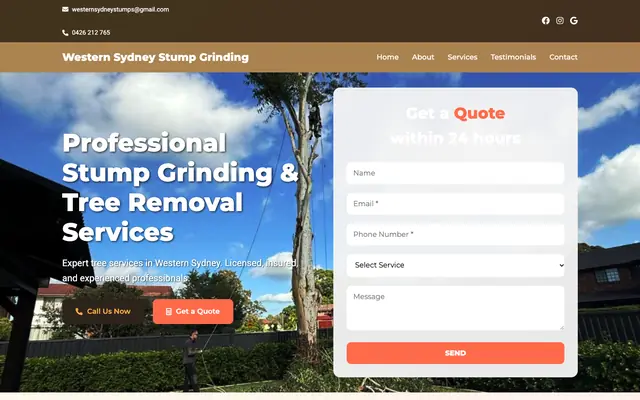
Sydney clients search by region and suburb: the Northern Beaches, the North Shore, the Hills District, the Inner West, the Eastern Suburbs, the Sutherland Shire, Parramatta, Penrith and Campbelltown. We're a web design team in Adelaide and work with Sydney businesses by phone and email; we don't visit job sites. Our tree service client, Western Sydney Stump Grinding, works across Western and Greater Sydney, so we've already set out storm call-outs and a service-area list for a tree business in this city.