Licensing is the same here as in the south, and our Hobart tradies page covers it: CBOS regulates electrical, plumbing, gas-fitting and building services work under the Occupational Licensing Act 2005, customers can look up licence holders on its online search, and the rule that once made contractors print licence numbers in advertisements was repealed from 1 January 2017. We put your numbers on the site regardless. For local detail on particular trades, see our Launceston pages for builders, covering the flood map and heritage list, plumbers, covering the combined drainage system, and electricians, covering private power poles.
Launceston is Tasmania's second-largest city, and many of its trades work well beyond the city itself. The Northern Tasmania Development Corporation is funded by seven councils: the City of Launceston, West Tamar, George Town, Meander Valley, the Northern Midlands, Dorset and Break O'Day. Scottsdale is Dorset's regional centre, and St Helens, St Marys and Scamander are the main towns of Break O'Day on the east coast. The Tamar runs as a 70-kilometre estuary from the city to the sea, and the Batman Bridge, opened in 1968, joins Sidmouth and Deviot on the west bank to Hillwood on the east. West Tamar takes in Riverside, Legana, Grindelwald, Exeter, Beaconsfield and Beauty Point; George Town Council covers George Town, Low Head, Bell Bay, Hillwood, Lefroy and Pipers River. Customers often search by those town names, so we list them as they are rather than folding them into "greater Launceston".
Several City of Launceston rules touch nearly every trade. Any individual, builder, contractor or business doing temporary works on a council road, park or reserve, including placing materials, using machinery or vehicles for building work, or putting up hoardings or scaffolding, needs a permit or authorisation first. The council asks for applications at least ten working days before the start date, says processing generally takes five to seven days, and requires a traffic management plan from a suitably qualified and accredited person plus public liability cover of at least twenty million dollars in the applicant's name. A skip bin on the road reserve needs the same permit fixed to it and visible, with reflective material on its corners if it stays overnight. All new, replacement, altered or repaired driveway crossings need a council permit, with no application fee; a single crossover is 3.6 metres wide and a double 6 metres, and the council says that, if an application is approved, the letter and permit follow within five to 10 working days. Boundary fences come under the Boundary Fences Act 1908, and the council contributes to repairing or replacing fences that adjoin council property.
Two kinds of customer are worth a page of their own. Landlords work to the minimum standards in Part 3B of the Residential Tenancy Act 1997, which have applied since August 2015: a heating device in the main living area, such as a fixed electric or gas heater, a heat pump or a wood heater (an open fireplace doesn't count without the Residential Tenancy Commissioner's approval), curtains or blinds on bedroom and living area windows, ventilation openings of at least 5% of a room's floor area or an exhaust fan in bathrooms and laundries, windows relied on for airflow that can be fastened open at least 15 centimetres, and continuous hot and cold water. Because each rule applies when a lease is signed, extended or renewed, agents need the work finished before that date, not after it. The other is hospitality. Launceston became a UNESCO City of Gastronomy in 2021, and UNESCO says the region's cafés, food vans and restaurants employ more than 4,000 people and that it accounts for 60% of the state's wine-producing area. The council says a new fixed food premises must be fitted out to the Tasmanian appendix of the National Construction Code, needs building and plumbing approval, and must pass an Environmental Health Officer's inspection, with the application in at least 14 days before opening. Trades who know that timeline can say so on the page.
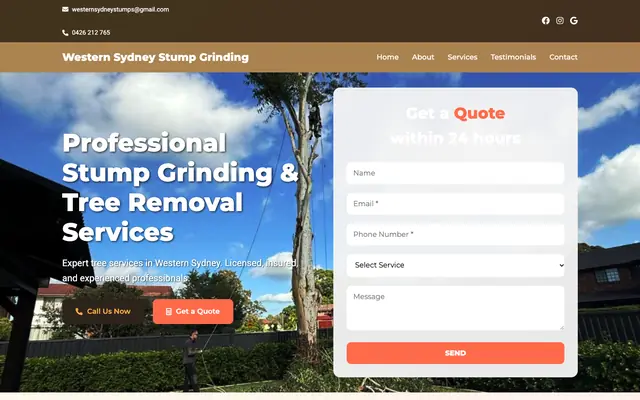
We're an Adelaide team on Hutt St, and we work with Tasmanian trades by phone and email at the prices we charge everywhere else. Our current clients are in SA, NSW, VIC and QLD; we haven't built a site for a Launceston business yet, so the examples below are a Western Sydney tree service and an Adelaide painting company, chosen for how they show customers where the business will travel.