The licensing side matches the rest of NSW. You need a licence for plumbing, draining or gasfitting work of any value, a contractor licence to contract for it, and NSW Fair Trading's advertising guidance, which covers websites, asks for the licensee's name, licence number, category of work and a business phone number. Our Sydney plumbers page sets out those rules in full. What's different here is the water authority and the inspections.
Central Coast Council inspects on-site plumbing work across the region, acting as the local plumbing regulator under the single statewide scheme the Plumbing and Drainage Act 2011 set up. The process runs in order. An application for a plumbing and drainage inspection is emailed to council, which assesses it and issues an invoice within 48 hours, and the fees must be paid before inspections can be booked. At least two days before work starts, the plumber gives council a signed Notice of Work. Inspections are booked with council's team at least 48 hours ahead, by email, online form or phone. Within two days of finishing, the plumber gives council and the owner a Certificate of Compliance, plus a drainage diagram for any sanitary drainage work.
Cross into Lake Macquarie, at Wyee, Morisset or Swansea, and the arrangement changes. Properties there that Hunter Water services fall under Building Commission NSW's audit inspections, booked through its MyInspections portal, while those Hunter Water doesn't service go to Lake Macquarie council. Our Newcastle plumbers page covers the Hunter Water side. If you work both sides of the boundary, your service-area section is the place to say so.
Council's backflow rules are set out plainly. A property identified by a plumber as medium or high hazard needs a containment device on its water connection, and more than one if it has more than one connection to the main. The owner registers the device with council and pays the application fee, after which council issues a certification letter. Devices are tested by an accredited backflow plumber when installed and every year afterwards, with results sent to council, and the hazard rating has to be reassessed when what happens on the site changes. A single low-hazard house on a 20 mm or 25 mm drinking water connection doesn't need a device.
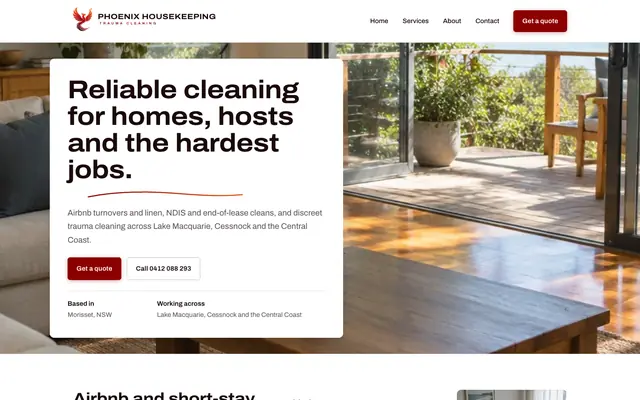
On-site sewage is the other local job. Council says all on-site sewage management systems must be registered with it and need an approval to operate. Installing a new system or altering an existing one needs an application to council, internal plumbing work on those properties still needs a plumbing inspection application and fee, and an old septic tank being replaced is demolished following NSW Health's Advisory Note 3. We're an Adelaide team on Hutt St and work with coast businesses by phone and email; Phoenix Housekeeping, which cleans homes across the Central Coast, Lake Macquarie and Cessnock, is one of our clients.