Website Design for Boat and Marine Services

Websites for marine mechanics, shipwrights, boatyards, detailers and boat hire operators that tell an owner which engines you work on, whether you'll come to their berth, and how far ahead you're booked before the season starts.

What a marine business website needs to show

Boat owners tend to know exactly what they've got: the make of the outboard, its horsepower, roughly how many hours are on it and where the boat lives. What they don't know is whether you work on that engine, whether you'll come to the marina or they'll have to tow it in, and how long they'll wait. Plenty of them leave it until the weather warms up, so everyone wants the same few weeks. A marine website answers those practical questions before the phone rings.

  • Engines and brands, named precisely

    List the outboard, inboard, sterndrive and jet ski brands you work on, and say whether that includes older two-strokes. An owner looking for help already knows the brand on the cowling, so brand names belong in headings rather than buried in a paragraph. If a manufacturer has appointed you as a dealer or service centre, say so and use the logo artwork they supply. If not, describe it as servicing that brand, so nobody assumes a dealer appointment you don't hold.

  • A service booking form that asks about the boat

    The form collects what you'd otherwise ring back to find out: engine make, model and horsepower, engine hours, boat length and hull type, where it's kept (on a trailer at home, a marina berth, a swing mooring or dry stack) and the week that suits. Owners can attach photos of a chewed-up prop, a gelcoat crack or a torn canopy. If you want customers to choose a time and pay online, we build booking and payment into the site, quoted per job, or link the booking tool you already use.

  • Where the work happens

    Say plainly whether you're mobile, workshop-based or both. A mobile mechanic can list the marinas, boat ramps and stretches of water covered, such as a bay, a river or a lake system, because that's how boat owners describe where they are. On the 8-page site, a waterway you want more work on can have a page of its own, the same way a trade business has service-area pages.

  • Slipway and hardstand limits up front

    The first thing an owner needs to know about a boatyard is whether the boat will fit. Put the maximum length, beam and weight your slipway or travel lift handles near the top of the page, along with what an antifouling job involves, from haul-out and hull clean to the final coat, and roughly how long a boat sits on the hardstand. Owners planning a slip date then know whether to call you at all.

  • The busy season and your lead times

    Pre-season servicing and antifouling before summer tend to land in the same few weeks, and lay-ups come in a rush when the season ends. A short notice near the top saying how far ahead you're booking saves calls you can't take while you're on the tools, and it can change week to week. Updating that line is a text change, covered by the $30 monthly hosting.

  • Hire boats and commercial vessel work

    If you hire out boats, the booking page is where people learn what to expect on the day. In NSW, for example, a hire-and-drive vessel needs a certificate of operation to be available for hire, and the company must give hirers a safety briefing before they head out. Saying how long the briefing takes keeps late arrivals from cutting into their time on the water. If you service charter boats or work boats, which AMSA regulates under the National System for Domestic Commercial Vessel Safety, give that work its own section so operators can find it.

  • Memberships owners recognise

    The Boating Industry Association says it represents more than 650 organisations, and every member pledges to abide by its Code of Practice. In Victoria, the Boating Industry Association of Victoria tells buyers to look for its member decal. The Marina Industries Association, representing marinas, slipways and boatyards, runs the Gold Anchor and Clean Marina programs. If you're a member or hold one of these accreditations, we show it using the artwork the association supplies.

The closest work in our portfolio

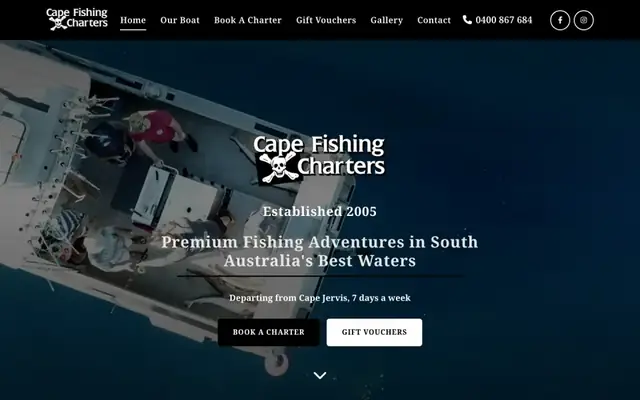
We haven't built a site for a marine mechanic, boatyard or detailer, and we won't pass another business off as one. The nearest is a boating business: Cape Fishing Charters, a charter operator out of Cape Jervis in South Australia, whose one-page site takes booking requests. Simple Engineers, an Adelaide engineering firm, shows the other part a repair business needs, a quote form that accepts uploaded files. Below them is a Google review about replies that come on a weekend.

Home page of the Cape Fishing Charters website

Cape Fishing Charters

Community, creative & tourism · Cape Jervis

Full-day fishing charters from Cape Jervis, seven days a week, around Backstairs Passage, Kangaroo Island and the Pages. The one-page site has a booking request form, gift voucher requests, a catch photo gallery, an FAQ, customer reviews, an embedded map and tap-to-call. A hire or charter operator could use the same layout; a marine mechanic would swap the trip request for a service request.

Home page of the Simple Engineers website

Simple Engineers

Professional services · Adelaide

Adelaide structural engineers who design retaining walls, slabs and stormwater systems. The site has four service pages and 16 articles, and its quote form shows fee ranges and takes file uploads. For a marine repairer, those uploads would be photos of hull damage or a failed part, arriving with the enquiry.

“Rebuilt two websites for our businesses and saved us a fortune on hosting etc. Nothing is ever a problem, will email back on a Saturday night if need be.”

Lockyer Valley Batteries, Google review

What a marine business website costs

One page

$399

A mobile marine mechanic or boat detailer: engines and services, the marinas and ramps you cover, a gallery, a service request form and tap-to-call on one page.

A common fit for marine workshops

Up to 3 pages

$899

A home page with your season notice, a services page listing the brands you work on, and a booking page with the service request form and photo uploads.

Up to 8 pages

$1,499

Boatyards and larger workshops: pages for servicing, repairs, antifouling, the slipway and its limits, detailing and electronics, the waterways you cover, and booking.

  • Payment. No deposit. We build your draft first, you ask for as many changes as you like, and you pay once you approve it. If you don't go ahead, you owe nothing.
  • GST. WebCraft Studio isn't registered for GST, so no GST is added.
  • Timing. Most sites are live within 5–10 days of us getting your words and photos; bigger sites (up to 8 pages) take 2–3 weeks.
  • Hosting. After launch, hosting is $30 a month: hosting, security monitoring, backups, email support and unlimited text and image changes on your existing pages. New pages or features are quoted first. No contract, cancel anytime.
  • Domain and email. We register your domain in your name (about $20 a year), connect it to your site and set up your business email.

See full pricing and what each package includes

Questions marine businesses ask us

Can boat owners book a service online?

Yes. The simplest version is a service request form: the owner fills in the engine details, where the boat is kept and the week that suits, and you confirm a time. If you'd rather customers pick a slot and pay when they book, we build booking and payment into the site, quoted per job, or link a booking tool you already use from a Book button on every page.

Should we put prices for a standard service on the site?

Many owners want a rough figure before they ring. If your price depends on horsepower or the number of cylinders, a short table of starting prices by engine size works, with a line saying parts and extra work are quoted once you've looked at the engine. Put down what you'd tell someone over the phone. When prices change, send us the new figures: text changes are covered by the $30 monthly hosting.

Can customers send photos of damage with their enquiry?

Yes. The form can accept photos straight from a phone, so an owner can show you a cracked hull, a bent prop or a split bimini before you quote. They arrive with the enquiry, and you decide which questions the form asks first.

Can we sell parts and accessories online?

Yes. Our online stores are $799 for up to 25 products with one payment gateway and basic order management, or $1,999 for unlimited products, multiple payment options, customer accounts and advanced shipping. A smaller start is a page listing the oils, anodes and safety gear you stock, for customers to pick up at the counter.

Which package suits a marine business?

A mobile mechanic or detailer usually fits the one-page site at $399. A workshop that wants a service booking page and a list of the brands it services suits the 3-page site at $899. Boatyards with a slipway, several kinds of repair work and waterways to describe are better on the 8-page site at $1,499. A site that size takes 2–3 weeks once we have your words and photos.

Do you build sites for marine businesses outside South Australia?

Yes. We're a web design team at Ste 3/110 Hutt St, Adelaide, working with businesses Australia-wide by phone and email. Our current clients are in SA, NSW, VIC and QLD, and Cape Fishing Charters, our one boating client, runs out of Cape Jervis in South Australia.

Ready to start your marine business website?

Send us the services you offer, the engine brands you work on, where you'll travel and a few photos of recent jobs. We'll quote it and build the draft, and you pay only once you approve it.

We reply within 24 hours. Prefer email? info@webcraftstudio.com.au