The state rules are the same in Newcastle as in Sydney. Electrical wiring work of any value needs a licence through Building Commission NSW, advertising (your website included) must carry the licensee's name or registered business name, licence number, category of work and a business phone, and tested work finishes with a Certificate of Compliance for Electrical Work lodged on eCert. Our Sydney electricians page sets those out; this section covers what's particular to Newcastle.
Newcastle is on Ausgrid's network, which also supplies Sydney and the Central Coast, so Level 2 workers here are authorised by Ausgrid once their business is accredited under the NSW ASP scheme. Ausgrid's solar guidance says that in most cases the installer manages the approval, that a system can't be turned on until it's approved, and that customers now choose between a flexible and a fixed export connection. From late 2026, new and upgraded systems need a smart inverter that communicates with the network online. Where there's no reliable internet, Ausgrid approves the system with a static export limit of 1.5 kW, and an inverter that loses its connection for an extended period is capped at that level until it's back online.
Larger jobs carry their own Ausgrid steps. Some installations must be inspected by Ausgrid before they're energised, among them new high-voltage installations and new consumer mains or main switchboards over 100 amps, and its audit program treats work such as solar over 30 kW and battery storage as higher risk. A commercial page that says you've taken jobs through that process tells a business owner or builder you know the sequence.
Inner Newcastle has a lot of old housing stock. The council's development control plan covers nine heritage conservation areas: Cameron's Hill, Cooks Hill, Glebe Road Federation Cottages, Hamilton Business Centre, Hamilton Residential Precinct, Hamilton South 'Garden Suburb', Newcastle City Centre, Newcastle East and The Hill. It describes Cooks Hill's mid-19th-century workers' houses and terraces, Newcastle East's two- and three-storey terraces, and the Federation and inter-war bungalows of Hamilton South. For solar, in those streets as elsewhere in the city, City of Newcastle says a system is exempt development only if it meets the standards in the state's Transport and Infrastructure SEPP; otherwise it needs consent first, either through a complying development certificate or a development application assessed against the Newcastle LEP and DCP. A line saying you check which applies before you quote is useful to an owner in The Hill.
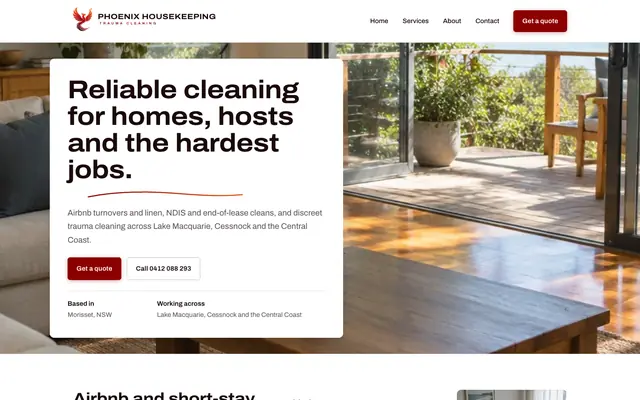
Greater Newcastle is five council areas (Newcastle, Lake Macquarie, Maitland, Port Stephens and Cessnock), and your callers may live in any of them. Rather than repeat the council list, tell people how far you'll go for what: perhaps the inner suburbs and the western side for a call-out, the lake for a half-day job, Port Stephens or the Cessnock towns for a switchboard or a solar install. Industrial work follows a different map: the Port of Newcastle operates from sites along the Hunter River estuary, and plant experience there belongs on a commercial page rather than in a suburb list. We're an Adelaide team on Hutt St and work with Hunter businesses by phone and email; one of our NSW clients, Phoenix Housekeeping, is on Lake Macquarie.